
The Song That Brought Him Back
How a New Year’s Eve in Nashville Taught Me That Music Heals in Silence

After my mother passed, grief settled into our home like winter fog—thick, gray, and impossible to ignore. He stopped whistling while fixing the sink. Stopped tapping his boot to the oldies station. Even his laugh, once so loud it startled the dogs, vanished into a silence so heavy it filled every room. For two years, he moved through life like a man walking in someone else’s shoes. So when he said, voice barely above a whisper, “Let’s go south for New Year’s,” I didn’t ask why. I just booked the tickets.
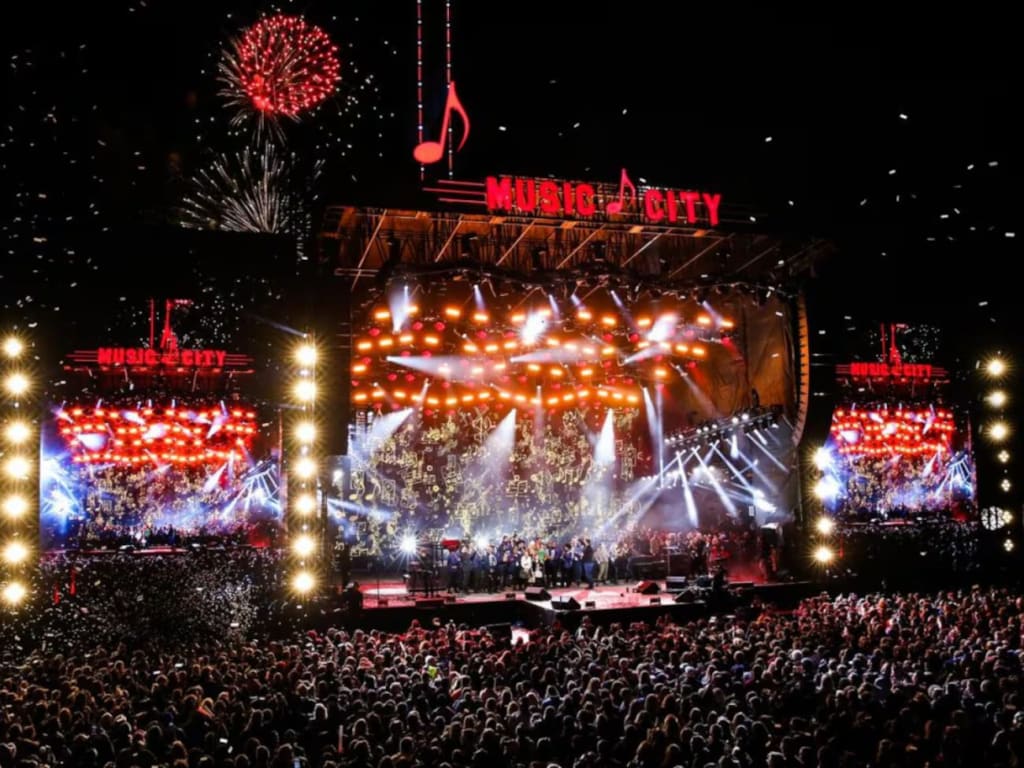
We arrived on a cold, clear December 31st. The air smelled of woodsmoke and damp earth, and the city hummed with a quiet energy—nothing flashy, nothing forced. Just people gathering, not to perform joy, but to simply feel it again. We wandered into a wide-open park filled with strangers in flannel jackets and scuffed boots, sharing blankets, passing paper cups of something warm, laughing like they remembered how. No one was dressed for a photo. No one was trying to be seen. They were just there—present, human, imperfect.
I hadn’t seen my father’s eyes light up in years. But as dusk fell and the first notes of a familiar guitar drifted through the trees, something shifted inside him. It was a simple song—“Guitars, Cadillacs”—the one he used to play on repeat after his first heartbreak at nineteen, back when he still believed love was something you could fix with a six-string and a tank of gas. He didn’t say a word. He just stood taller, like his bones remembered how to carry hope again.
I don’t know who was singing that night, and honestly, it didn’t matter. What mattered was the way the crowd leaned into the music—not as spectators, but as participants in a shared ache. A woman beside us held her daughter close and sang along, voice trembling on the high notes. An older man in a worn cowboy hat closed his eyes and swayed like he was back in a honky-tonk in ’72, young and reckless and full of dreams. In that moment, the music wasn’t entertainment. It was a lifeline—a quiet reminder that sorrow doesn’t have to be carried alone.
When the countdown began, there were no grand announcements, no celebrity hosts, no scripted moments. Just thousands of voices rising together in the dark, counting not just the seconds to a new year, but the breaths between grief and grace. At midnight, a soft, glowing shape descended from the skyline—a form that honored this city’s soul, not its skyline. Fireworks burst over the river, painting the sky in gold and crimson, but no one looked up. They were holding hands. Hugging neighbors. Wiping tears without shame. In that sea of ordinary people, I saw something rare: collective vulnerability. And in a world that rewards performance, that felt like revolution.
That’s when I understood: Nashville doesn’t sell New Year’s Eve. It shares it.
In an age where joy is curated and grief is hidden behind filters, this gathering felt like an act of quiet rebellion. No one was filming. No one was posing. They were just there—with their broken hearts, their quiet hopes, their unspoken prayers—trusting the music to hold what words could not. And the music did. It didn’t promise healing. It didn’t erase pain. It simply said, “You’re not alone in this.”
We left before the final song. My father was tired, but his shoulders were lighter, his steps slower but surer. In the car, as we drove through quiet streets dusted with frost, he turned to me and said, “I forgot what it felt like to be part of something.”
I didn’t tell him it wasn’t the place or the song or the fireworks. It was the unspoken covenant in every lyric, every shared glance, every voice raised in harmony: You don’t have to heal alone. You don’t have to be strong to be worthy. Just show up.
This December, I’ll return—not for the spectacle, not for the lineup, but for the stillness between the notes. Because in a world that demands polish, Nashville offers something far more precious: permission to be messy, to be raw, to be human. And sometimes, that’s enough to begin again.
I’ve since learned that healing doesn’t always come in big moments. Sometimes it arrives in the quiet space between a father’s hum and a daughter’s held breath. Sometimes it’s hidden in the chorus of strangers singing the same sad song, each carrying their own story, yet bound by the same truth: we are all just trying to make it to the next verse.
And on that New Year’s Eve, under a Nashville sky streaked with light, my father found his voice again—not in a shout, but in a whisper. And that was enough.
#NewYearsEve #CountryMusic #HumanConnection #MusicHeals #GriefAndGrace #HopeFor2026 #RealMoments #SharedHumanity #Nashville #Storytelling
Disclaimer
Written by Kamran Ahmad from personal reflection and lived experience.
About the Creator
KAMRAN AHMAD
Creative digital designer, lifelong learning & storyteller. Sharing inspiring stories on mindset, business, & personal growth. Let's build a future that matters_ one idea at a time.
Keep reading
More stories from KAMRAN AHMAD and writers in Beat and other communities.
Tyla’s Chart-Topping Rise
Introduction When South African singer Tyla released her self-titled debut album in late 2023, few predicted it would ignite a global movement. But by 2025, her name was everywhere: on Billboard charts, Grammy stages, and playlists from Lagos to Los Angeles. Fueled by her breakout hit “Water”—a seductive fusion of amapiano, R&B, and pop—Tyla didn’t just enter the global music scene; she reshaped it.
By KAMRAN AHMAD2 months ago in Beat
It's 2026. Songs Turning 10 This Year
In 2016, we saw the rise of short form videos and what would lead to the birth of TikTok. We cannot forget the Snapchat filters no matter how cringe worthy some of them might have been. It was also the year in which the hit series Stranger Things debuted.
By Jasmine Aguilar7 days ago in Beat
T.I. VS 50 CENT T.I. Fires Back At 50 Cent With Wild Accusations About His Personal Life! (Audio)
Beef, tension, and or drama are like the napalm to the rap game. They burn fiercely and stick to everything. With the current feud between TI and Co and 50 Cent simmering to a boil, it appears as if the two camps may never see eye to eye. The stakes seem too high and the two have gotten personal.
By Skyler Saundersa day ago in Beat



Comments
There are no comments for this story
Be the first to respond and start the conversation.