
The Return of the Spare
A fictional royal drama about power, rivalry, and the danger of unfinished wars


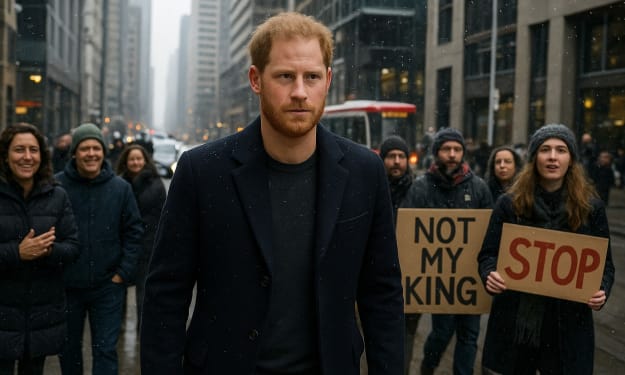
Power rarely announces itself loudly. More often, it creeps back in quietly, through side doors and softened language. That was how the Palace first sensed the shift—not through a speech or a lawsuit, but through movement. Requests. Reassessments. Subtle changes in posture among people who had spent years pretending the storm had passed.
Prince William felt it before anyone said it out loud.
His days were filled with carefully structured engagements—policy briefings, charity visits, quiet meetings designed to prepare him for a crown that would demand steadiness more than charisma. Every step was deliberate. Every word measured. That was the role: continuity, not spectacle.
And then there was Harry.
He was supposed to be gone. Not erased, not banished, just… elsewhere. A closed chapter. But chapters have a way of reopening when the author refuses to move on.
Behind closed doors, King Charles was furious—not with Harry alone, but with the risk he represented. The monarchy survived on clarity: one future king, one visible line, one center of gravity. Anything else created confusion. Confusion invited scrutiny. And scrutiny was dangerous.
What alarmed the Palace wasn’t Harry’s anger—it was his strategy.
The public explanation was harmless enough. A routine review. A reassessment of security needs. Nothing unusual. But insiders understood what it signaled. Security wasn’t just protection; it was legitimacy. Presence. Permission.
If Harry regained it, he could return not as a guest, but as a figure of consequence.
And Harry was changing.
Gone was the relaxed grin, the playful defiance. In its place stood something sharper. He looked older, heavier, like a man carrying a war he never finished fighting. His appearances were increasingly solo. His tone nostalgic. Britain, home, duty—words carefully chosen, not from longing, but from calculation.
Those close to him noticed the obsession: perception.
Harry didn’t want reconciliation. He wanted relevance.
The idea forming in his mind was dangerous in its simplicity. If William was becoming the responsible future king—the restrained statesman—then Harry would become the alternative. The emotional one. The outspoken one. The prince who said what others couldn’t.
A parallel presence.
Not a coup. Something subtler. Appearances timed just right. Speeches echoing themes William avoided. Charities framed as grassroots rather than institutional. A shadow court built not in marble halls, but through media, symbolism, and carefully cultivated outrage.
William understood the threat immediately.
He had no interest in competing. The crown could not afford rivalry. A monarchy divided against itself did not modernize—it fractured. And Harry, unpredictable and wounded, was a fracture waiting to spread.
What frightened advisors most was not Harry’s anger, but his impatience.
His projects abroad had stalled. The applause had faded. Deals that once seemed inevitable dissolved quietly. And desperation sharpened every move. Lawsuits escalated. Narratives hardened. Every “no” from institutions became proof, in Harry’s mind, of betrayal.
Meanwhile, distance grew elsewhere too.
Meghan remained present, but increasingly separate. Harry’s return strategy required something uncomfortable—distance from the very image that once empowered him. He needed to look traditional again. Grounded. Serious. Alone.
The Palace saw it clearly: this was not healing. It was repositioning.
Charles worried about the public. William worried about the institution. Both worried about timing. A generational transition was already underway. The last thing the monarchy needed was a second gravitational pull—one driven by resentment rather than responsibility.
And yet, stopping Harry outright carried its own risks. Denial would fuel martyrdom. Silence would invite speculation. Every option had a cost.
The most dangerous possibility was the simplest one: Harry getting exactly what he wanted.
Because if he did, the games would begin quietly. A charity event here. A visit there. A comment framed as concern but landing as criticism. William, bound by restraint, would say nothing. Harry, free from duty, would say everything.
The media would feast.
Brother versus brother. Stability versus emotion. Crown versus charisma.
The monarchy had weathered abdications, scandals, and wars. But this was different. This was internal competition—two visions of royalty colliding in real time.
And Harry, for all his talk of justice and reform, wasn’t trying to save the monarchy.
He was trying to outgrow it.
As one senior advisor put it quietly, “This isn’t a homecoming. It’s a challenge.”
And challenges, once issued, rarely stay private.
The stage was set. The roles were clear. And the question lingering behind palace walls wasn’t whether the conflict would escalate—but how much damage would be done before it ended.
Because history is unforgiving to institutions that mistake family drama for harmless noise.
Sometimes, the spare doesn’t want a place at the table.
Sometimes, he wants the table turned over entirely.
About the Creator
Behind the Curtain
"Exploring the untold stories and hidden truths. From royal rumors to cultural deep dives, Behind the Curtain brings you bold, insightful narratives that spark curiosity and conversation."
Keep reading
More stories from Behind the Curtain and writers in Beat and other communities.
The Paris Scandal: Meghan Markle’s Glittering Comeback That Ended in Chaos
Paris was supposed to be Meghan Markle’s grand re-entry into the fashion world — a polished comeback after months of silence and fading spotlight. But what began as a glossy weekend of couture and confidence quickly spiraled into one of the biggest image crises of her post-royal life.
By Behind the Curtain4 months ago in Beat
Review of 'Man on the Run'
My wife and I saw Man on the Run, a nearly 2-hour documentary on Amazon Prime, about Wings, Paul McCartney's group that flew around the world from shortly after The Beatles broke up in early 1970 to shortly after John Lennon was murdered at the end of 1980, making a Beatles reunion forever impossible.
By Paul Levinson3 days ago in Beat
MAYLIE?
MAYLIE (born December 2, 2004) is an international pop artist and songwriter, known as Somelsy on Instagram. Born into a musical family and raised in a quiet town near the capital, she was immersed in music from infancy. As the granddaughter of a guitarist from a vocal-instrumental ensemble, she began experimenting with the guitar and synthesizer even before she could speak. It was her grandpa who instilled in her a lifelong love for music. Her Instagram account is entirely dedicated to her grandfather's guitar collection. The collection includes about 10 guitars of various ages, even from the 1980s.
By Alex Croft2 days ago in Beat
I wanted to title this something different, but worried that my chosen title might cause problems entering the United States in the future so this is the new title. It's the greatest title. No one has ever written a title better than this. (All titles unrelated to content).
Let me be honest. I am finding this difficult. Now, I like a challenge, a stretch, a bit of an obstacle course. “Write about the decline of the British Empire in the form of a narrative poem in which your protagonist is an artichoke” I read, and flex my fingers. “Write a haiku to evoke the sensation of sibilance using only the first half of the alphabet.” “Well”, I think to myself, “this should be fun.” But “write about a system that isn’t working”? A system that isn’t working? Now? In 2026? ONE system? My favourite system that isn’t working? The sexiest system that isn’t working? The one giving me the most angst day to day? The one giving me the most existential dread? I am, as I say, finding this difficult. I will own that I have contemplated writing a thousand words on why the steady “all on” setting on my fairy lights is the EIGHTH of seven options which must be sequentially activated to get there, because that is a system that some fool came up with and it definitely doesn’t work, and now who is paying the price, eh? But how can I write about my fairy lights when…. When…. When….
By Hannah Moore5 days ago in Humans


Comments
There are no comments for this story
Be the first to respond and start the conversation.