
'The One'
Elton John's post-rehab comeback

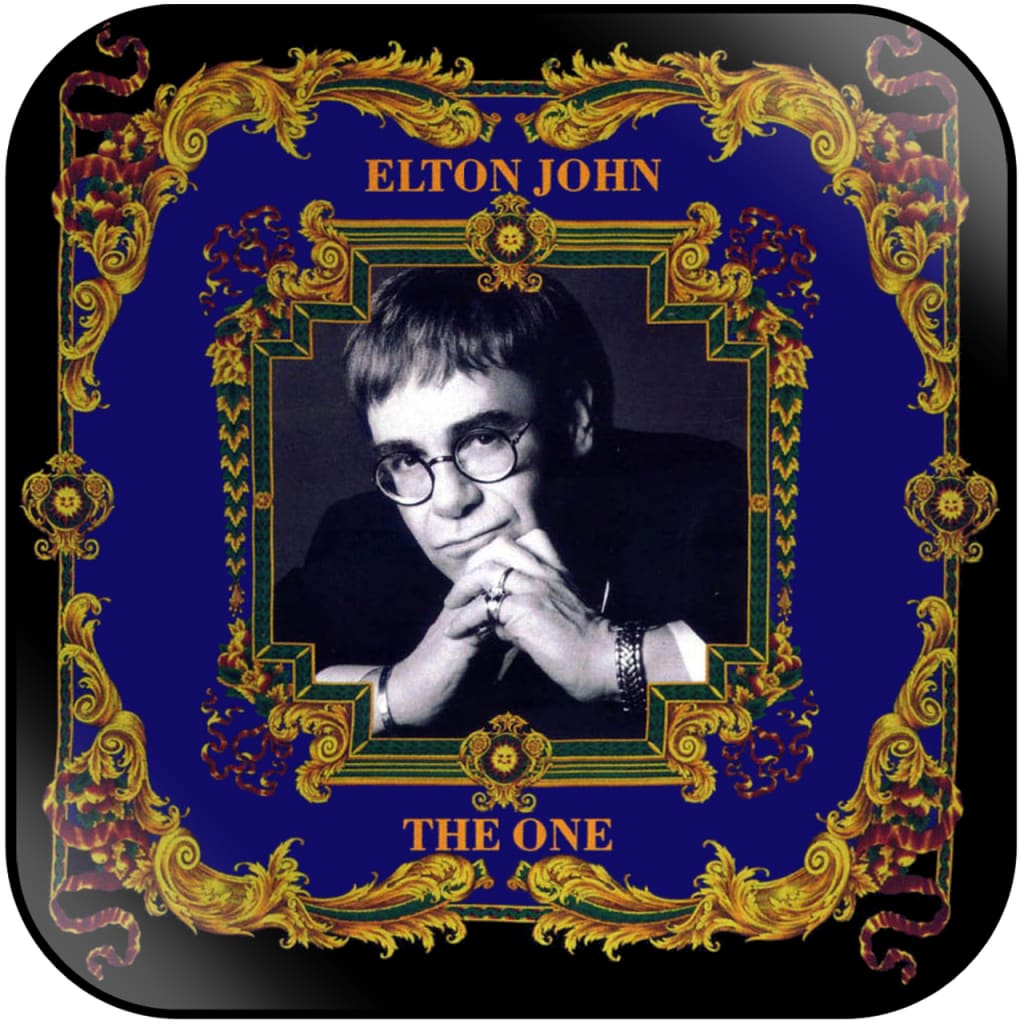
Following a stint in rehab to overcome his drug and alcohol addictions, Elton John decided to record a new album in 1992 at Studio Guillame Telll in Paris, France. He brought with him many of the usual suspects: a set of Taupin lyrics, Chris Thomas as producer, and veteran Elton John band members Davey Johnstone and Guy Babylon contributing electric guitar and backing vocals and keyboards and programming, respectively. There are also vocals from not only Nigel Olsson, but also Kiki Dee.
But he brought in some new blood as well: Olle Romo provided drums, percussion and programming, and Pete Townshend associate Pino Palladino added basswork to most of the songs. Other new faces contributing instrumentally to the album were keyboardist Mark Taylor and guitarist Adam Seymour. There were also several prominent guests, more about which later.
But the key new element in the room was Elton's sobriety; The One is probably the most consistent Elton album in a long time. There are several real highlights on the album and while at times the album suffers from a sameness of sound and tempo, there were no embarrassments or serious missteps here. Everything sounded highly professional; it was clear that Elton, who said that these were the first sessions he could clearly remember in quite some time, came to the studio to do his work.
Elton's rehabilitation and new attitude were shaped by the serious troubles in his world, and the world at large. Chiefly, his concern was the growing AIDS crisis, which had claimed his young friend Ryan White in 1990. And this album was dedicated to Vance Buck, an ailing nightclub and fashion entrepreneur and John associate who sadly died from AIDS a month after the albums release in June 1992. The cover art for the album was done by another designer/entrepreneur close to Elton: Gianni Versace.
The album opens with "Simple Life," a guitar and synth-harmonica heavy song, which would become the fourth single release from the album, though with slight sonic differences from the album version. It's a strong track, though probably not real hit material. By the time you get to track 2, a song that remains an Elton tour de force, the opener is largely forgotten.
Of course that next track is the title track, a secular spiritual that makes good use of strings and synthesizers, creating its highly uplifting feeling with some strong but economical sound effects, a fine overdubbed vocal performance by Elton, and of course plentiful piano vamps. Davey Johnstone provides a strong guitar line to close the track. Elton has said that he felt a strong connection to Taupin's lyric and classic Elton John drummer Nigel Olsson has expressed regret over not having played on the track (though he did get to perform it for posterity for Elton's "One Night Only" concert at Madison Square Garden in 2000). It was by far the most successful single from the album and was nominated for best male vocal performance at the 1993 Grammy Awards.
The next track, a beat-heavy ditty called "Sweat It Out' seems to be a commentary on the conservative government of Margaret Thatcher in Britain. Thatcher was a common target of British musicians in the 80s and 90s, and this would not be Elton and Bernie's only swing at her excesses as prime minister.
Next comes another single, one that was cobilled with guitar royalty Eric Clapton; the former member of the Yardbirds, Cream and Derek and the Dominos adds not only licks but a co-lead vocal. Written by John and Taupin with drummer Olle Romo, "Runaway Train" sounds much like a typical Clapton track from the 90s, with a strong percussive backing for Clapton's guitar and tasty backing vocals from Janice Jamison, Carole Fredricks and Beckie Bell. It was one of two tracks recorded in London rather than Paris.
Next is "Whitewash County," a sturdy uptempo number looking at racism that closed side one back in the days of LPs and cassettes. It's a good song, though not particularly a memorable one.
"The North" is a nice piano-driven ballad. It uses orchestration and piano much in the same style as the title track. Again, the effect is highly dramatic and the lyric is one of Bernie's best on the album.
Next up is "When a Woman Doesn't Want You," the first case on the album where a ballad follows a ballad and coming out of the drama of "The North," the track suffers a bit. Out of that context, however, it is an effective track, and it features some nice backing vocals by the aforementioned Elton associates Nigel Olsson and Kiki Dee.
"Emily" is a beat-driven but not really up-tempo track about death that is redeemed by great guitar work from Davey Johnstone complementing strong keyboard work from Elton.
"On Dark Street" once again takes a middling beat, again featuring Nigel Olsson and Kiki Dee on backing vocals, and more tasty interjections from Johnstone. Like "Sacrifice" from the previous album it is about a marriage falling apart. However unlike "Sacrifice" it is not a strong candidate for a slot in a modern-day Elton show though.
"Understanding Women" is the second song recorded in London, and it again features guitar royalty--this time, Pink Floyd guitarist David Gilmour. Gilmour had previously worked with Chris Thomas when the latter was brought in to supervise the final mix of the legendary Dark Side of the Moon album, a task necessitated by and complicated by the differing opinions of the various Floyd band members. Thomas claims that the experience was actually cordial, and long after The One, he would work with Gilmour again as producer of Gilmour's 2006 album "On an Island." Gilmour's guitar work is easily the highlight of what is otherwise an unremarkable song.
"The Last Song" was the third single from the album, and concerns the reconciliation of a gay man dying of AIDS with his estranged father. Elton says he cried as he wrote the music to Bernie's lyrics and had great difficulty singing them. Instrumentally it features only Elton's digital piano and Guy Babylon's synthesizers. The combo produces an elegant, heartfelt song that gives clear evidence that Elton was back on track, and would be an artist who would have a tremendous impact through the rest of the decade. Elton listed this as one of the songs that told his life story years later in an issue of Rolling Stone magazine.
The album went Double Platinum in the US and gave Elton his highest US Chart ranking since the mid 70s. Clearly some fans who strayed were drawn back in and within two years Elton would once again be one of the biggest stars in the world.
About the Creator
Sean Callaghan
Neurodivergent, Writer, Drummer, Singer, Percussionist, Rock Music Star Wars and Disney Devotee.
Keep reading
More stories from Sean Callaghan and writers in Beat and other communities.
'Sleeping With the Past'
For Elton John, the 1980s was a decade that resulted in several albums, with varying tone, consistency, and quality across the albums and often within them. For his 1989 album "Sleeping With The Past", he and lyricist Bernie Taupin decided to make an album consistent in tone and quality, based on the classic soul and R&B Records they both loved. To start with, Elton hired a new rhythm section of Romeo Williams on bass and Johnathan "Sugarfoot" Moffet on drums, veterans of various soul records recruited by guitarist Davey Johnstone specifically for their R&B backgrounds. Also new to the band was keyboard player Guy Babylon, a Johnstone recruit who would be a key figure in the Elton story until his death in 2009. The album was recorded at Puk Studios in Denmark over a period of 6 months, under producer Chris Thomas.
By Sean Callaghan6 years ago in Beat
Review of 'Man on the Run'
My wife and I saw Man on the Run, a nearly 2-hour documentary on Amazon Prime, about Wings, Paul McCartney's group that flew around the world from shortly after The Beatles broke up in early 1970 to shortly after John Lennon was murdered at the end of 1980, making a Beatles reunion forever impossible.
By Paul Levinson7 days ago in Beat
Top Rappers in Dallas, TX (2026 Update)
Dallas doesn’t always scream the loudest in hip-hop conversations—but it builds quietly and consistently. While Houston often dominates Texas headlines, Dallas has carved out its own identity: melodic street records, independent grind culture, and a fast-growing streaming presence.
By RapRadarDigest5 days ago in Beat



Comments (1)
I have always enjoyed Elton John’s music and most of his antics. He’s a musical genius. Thanks for sharing this, Sean! 😊😁