
The O.G. Art-School Punks
Getting to Know Talking Heads

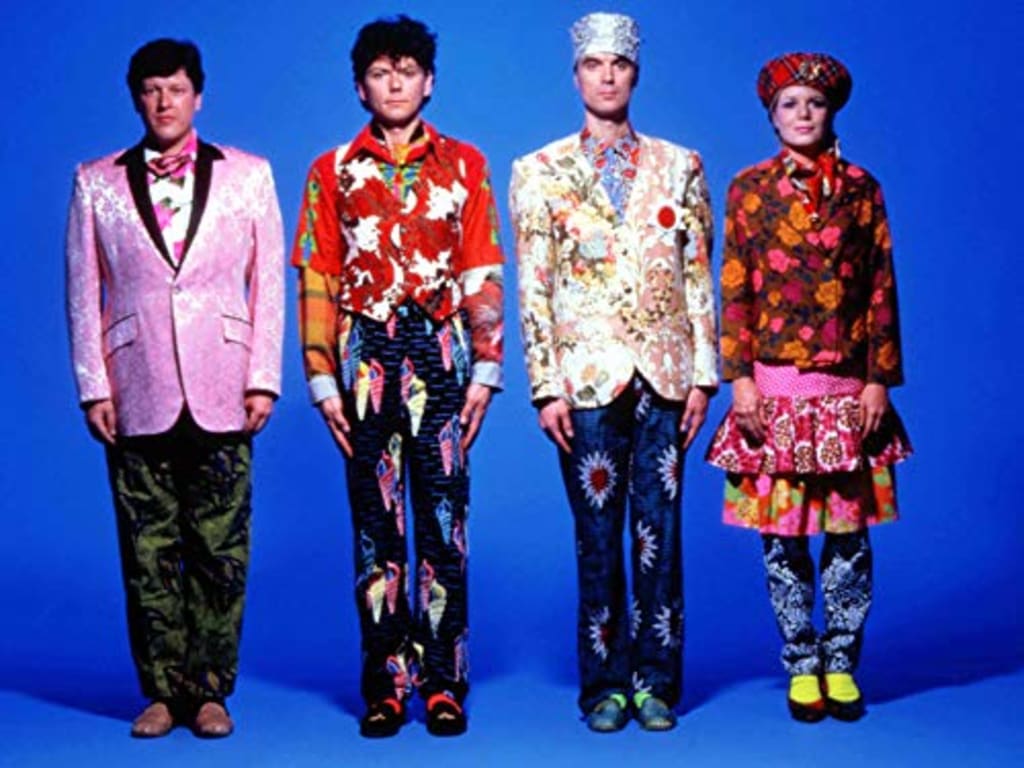
The Talking Heads punk-rock street cred is undeniable. Sure they didn't dress like The Ramones or sound like Dead Boy. They weren't going to piss in your parent's houseplants but they weren't going to play it straight either. Started by three art school students fresh to the Big Apple by way of Rhode Island, Talking Heads came at an exciting time, CBGB was experiencing a golden moment, birthing America's response to the UK's Clash and Sex Pistols, music videos were coming soon and The Heads' snarky subversive, poly-rhythmic songs, flavored more by Fela Kuti than Sid Vicious were unlike anything at the time or prior.
Frontman David Byrne has always eschewed the stereotypical ripped jeans and safety pins look in favor or baggy suits and skinny ties, short hair, cropped tight and clean. In the same way that punk's minimalism grew out of disco's excess, the Talking Heads' look, clean cut, sharp, simple, was a middle finger to bell-bottoms and boas. The Heads just wanted to play music and in some spectral, semi-intellectual way, what could be more punk rock than doing so in a suit? Eschewing the brash simplicity of its pissed-off peers in favor of more complex arrangements, bending more to world music influences then American rock and roll, the Heads wanted you to dance at the same time you were sticking it to the man. Same as it ever was.
Four individuals comprised the core of the band: Byrne on lead vocals and guitar, drummer Chris Frantz, Tina Weymouth on bass, and Jerry Harrison on keyboards and guitar. By the time of the critically acclaimed concert documentary “Stop Making Sense” the band had added an additional fleet of musicians and singers, including keyboardist Bernie Worrell who made a name for himself as part of the Parliament/Funkadelic world. The Talking Heads ushered in what would be called new-wave, they spiced it with art-rock and punk and let it marinate in funk. The band had radio success, tunes like “Burning Down The House," “Once in A Lifetime,” and “Psycho Killer” were on the pop charts but it was the videos that set the Heads apart from the pack of synth-heavy, sculpted-hair hessians dominating the airwaves in the early 1980s. You may even picture Byrne, shaking his body incessantly, karate chopping down his arm when someone mentions the Talking Heads. The music's anxious energy and Byrne's awkward athletic charisma make for an eyeful, memorable stuff. The Heads played up the visual thing live on stage as well (as evidenced in “Stop Making Sense” which streams for free on Amazon Prime), dancing in unison, Byrne taking winded, full-force laps around the stage, knees, hips, necks and shoulders always moving to a beat, constant motion, constant energy and relentless drive.
The band's first record, 1977's “Talking Heads:77” is a fun listen. Just kids, fresh out of art school, the world full of endless possibilities and their adopted home of The Village brimming with an unmistakeable creative energy. “Psycho Killer” put them on the World's map, some of its lyrics working equally as well as descriptors of the band's overall sound and feel: tense and nervous, a real live wire. The cut “Don't Worry About The Government” along with later songs like “Found A Job” and “Dancing For Money” conveyed a tongue-in-cheek dissatisfaction with the status quo, a turning up of the nose to all the American Dream white-picket-fence nonsense. Dance monkey dance, no need to worry, everything is under control.
From 1978-80 the band released three records with producer Brian Eno, known for his work with Roxy Music and David Bowie: “Songs About Buildings and Food,” “Fear of Music” and 1980's iconic “Remain in Light.” The latter being the band's studio highwater mark. They had worked with Eno on the two prior releases, they knew their way around each other. Byrne's fascination with Fela Kuti brought an exotic, foreign pulse to much of the record's groove. “Remain” also saw the beginning of the band bringing in additional players to build up the sound. They toured the album as 9-piece band. “Once in A Lifetime” was a smashing commercial success, due in part to it's eccentric video. “The Great Curve” served as an excellent precursor to the world music avenues Byrne would later explore as a solo artist.
As far as understanding the Talking Heads, really “getting" the whole thing, hearing the big picture, nothing serves as better evidence than “Stop Making Sense,” both the documentary film and the accompanying Soundtrack. You really hear the band's burgeoning penchant for static funk. The band had reached the pinnacle of its musical proficiency, the apex of its powers, the guest musicians brought new layers and the old songs managed to sound fresh all over again. The album has the hits, it also has wonderfully-weird versions of “Slippery People” and “Life During Wartime.” The film was an early effort by acclaimed director Jonathan Demme who would go on to do “The Silence of The Lambs” and “Philadelphia.”
The band had one of those ugly-lawsuit type falling outs so a full-on reunion probably isn't in the cards, but all the members have gone on to other outlets. Weymouth and Frantz (husband-wife duo) had commercial success with Tom-Tom Club, enlisting many of the musicians performing on later TH tours. David Byrne has had a gloriously peculiar solo career, releasing a varied collection of recordings, influenced by world music trends and whatever seems to tickle his fancy at any given moment. He started a record label, Luaka Bop which has a Brazilian flavor releasing artists like Os Mutantes, Tim Maia and Tom Ze alongside musical outliers like Javelin and Delicate Steve. You could spend years exploring Byrne's solo catalog (not a bad idea) but a good jumping off point would be his 1981 collaboration with Eno “My Life In The Bush of Ghosts.” This album could be the very definition of headphone music, songs so rich in layer and texture that a perfunctory poke around won't serve the purpose. Sonic sketches, everyday sounds, computerized instrumental runs, organized musical mayhem backing the incognito and often-buried vocals.
About the Creator
Keep reading
More stories from Jesse Stanek and writers in Beat and other communities.
The Original Smooth Operator
Let your mind drift back to the times of Miami Vice (no, the TV show, not the movie). It was a time when men weren’t afraid to wear white suits with pink tee-shirts, every home had some form of neon lighting and cigarette boats were the preferred method of transport for interesting people on the go. Lying in bed, listening to Sweet 98 FM, Hot Scott dropping the dedications, cheap red boombox delivering the hits of the day . . . Then out of nowhere, the smoothest voice you’ve ever heard comes through the speakers, like clean linen in a soft breeze, “coast to coast, LA to Chicago,” . . . Sade’s “Smooth Operator” was like nothing else on the radio, then or now. The song can still fill the brain with visions of pink flamingos and steamy nights under palm trees, her voice calmly soaring up and down the scale, her cadence and delivery an unrivaled level of sultry sweet, an exotic voice on familiar airwaves, a transcendent listen every time she sings.
By Jesse Stanek5 years ago in Beat
Review of 'Man on the Run'
My wife and I saw Man on the Run, a nearly 2-hour documentary on Amazon Prime, about Wings, Paul McCartney's group that flew around the world from shortly after The Beatles broke up in early 1970 to shortly after John Lennon was murdered at the end of 1980, making a Beatles reunion forever impossible.
By Paul Levinson7 days ago in Beat
Bennie Cloud: Blending Love, Rap, and Modern Hip Hop Energy
In today’s digital music landscape, independent artists are redefining how audiences experience music. Streaming platforms and social media have created opportunities for talented musicians to build their own audiences without relying solely on traditional industry systems. One emerging voice contributing to this movement is Bennie Cloud, an artist whose sound blends Rap, R&B, Hip Hop, and emotional storytelling into a style that reflects both modern culture and personal expression.
By charliesamuelabout 24 hours ago in Beat
Bomb Scare
It was 2027, and the world never thought it would happen. A missle hit the United States, but it wasn't where they had anticipated. A little town in the northeast was hit by a missile strike, they didn't know why, and they didn't know exactly where it hit, but they did know it was a coastal community, somewhere between Maine and Delaware.
By Gregory Payton2 days ago in Fiction




Comments
There are no comments for this story
Be the first to respond and start the conversation.