
The Music Lovers (1971)
On Ken Russell's Fractured Portrait of Tchaikovsky

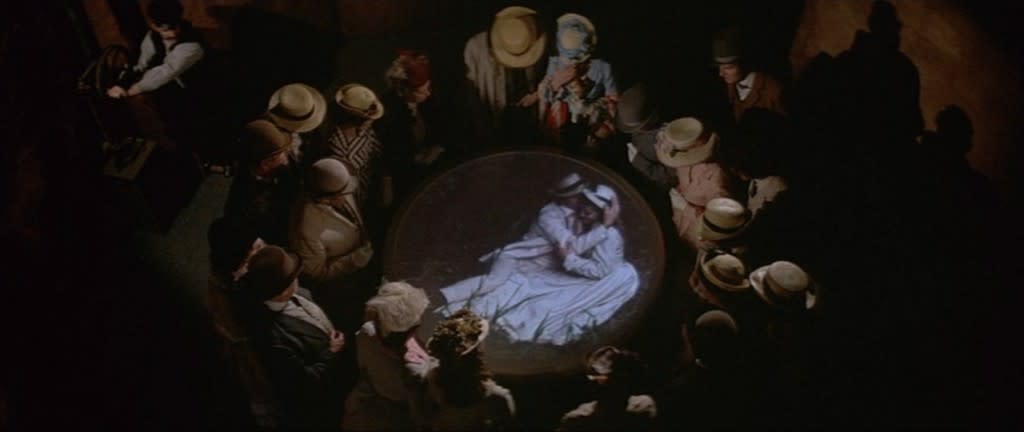
The Music Lovers is a film that begins in the streets of Moscow, a frenzy. The viewer slowly, consciously begins to focus on Piotr Illyich Tchaikovsky (Richard Chamberlain) and his lover, Count Chiluvsky (Christopher Gable) as they celebrate amidst what seems to be a general merry-making in the icy Russian. The music of Tchaikovsky is as frenetic and joyful as the occupation of the two celebrants; we see them next crawling out of bed with each other, much to the chagrin of Rubinstein (Max Adrian), who is currently housing the closeted homosexual composer and genius.
Gradually the film begins to open for us, like the petals of a wildflower exposed in the sun. Tchaikovsky impresses with his "Piano Concerto 1 in B-Flat Minor," gaining the love and devotion of two women who will loom large in the remainder of his life--Madame Nadezhda von Meck (Izabella Telezynska), a wealthy businesswoman who confesses herself antisocial, and who becomes a patron to Tchaikovsky, sending him a small fortune; and Nina (Glenda Jackson), a neurotic, sexually insatiable woman, who it seems is as equally taken with the idea of becoming the wife of a famous, brilliant composer, as she is of the man himself.
Tchaikovsky, haunted by the images of his cholera-stricken mother being forced into a scalding bath before she died, is mentally incapable of expressing love for anyone, on any significant level, let alone a woman he decides to marry because convention seems to demand it. Marry her he does though, and, during their honeymoon in Saint Petersburg, it becomes glaringly apparent that the relationship will be a troubled one.
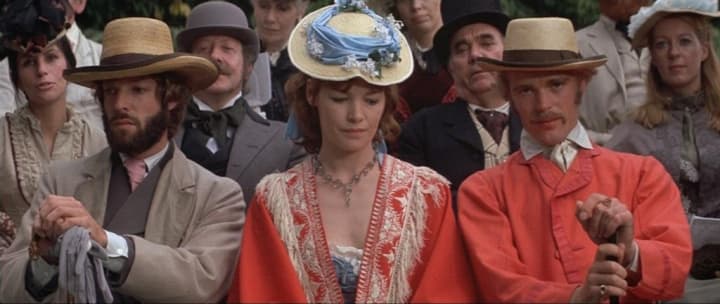
During a drunken night on a train, in a scene that is marked by the erotic excess that was the hallmark of Ken Russell's directorial style, Nina strips off her clothing, offering herself to him like a wanton in a seraglio.
His drunken response? He cannot perform, naturally. The marriage thus deteriorates, with Tchaikovsky complaining bitterly that he can no longer compose.
What follows is separation, his wife quickly being imposed upon by her mother (Maureen Pryor), whom she has apparently been attempting to escape for years. Her own behavior becomes sordid and sleazy, she inviting the wagging tongues of gossips by engaging in affairs and dalliances with the likes of Rimsky-Korsakov and others (in point of fact, a man mistaken for Rimsky-Korsakov by Nina takes advantage of the situation to go to bed with her anyway).
Nina's mother is an inveterate scoundrel as well, playing the pimp while her daughter beds every man she can find in the hopes of arousing the jealously of her cold, distant, and now absent husband. Of course, if it is any consolation, her husband, whom she seems obviously to have married out of a relentless lust for fame, sees his star ascendant in the world.
His image is written in flaming fireworks at posh parties given in his honor. Meanwhile, Nina descends further down the pathway toward madness, finally leaving him to a ruined house with burning piles of garbage in the yard. He collapses in despair; after all, she really professed her love for him.
The visual fireworks (a counterpoint to the emotional ones), begin to gather as the final denouement of the film is revealed; children swarm like bees, holding aloft sparklers as they celebrate the famous, troubled composer. The "1812 Overture" is celebrated by roaring cannon, fired by the disappointed, unrequited women in Tchaikovsky's life, literally blowing the heads off of spectators in gory detail, while brother Modeste (Kenneth Colley) swings from a rope while waving a sword, adoring crowds running comically, flinging paper ribbons behind them. It's a very hallucinatory part of the film, and it is counterpoised by the descent of Nina into madness.
She is soon an internee at a hideous Victorian bedlam, a Russian mental institution that is dark, filthy, and brutal. At one point, she straddles a grate in the yard, letting a number of dirty maniacs below violate her with their thrusting fingers while she laughs in insanity. It is one of the most repugnant images ever conceived for a film.
She has been thrust into a living hell; she is finally confined to a bed, strapped down, in a dungeon-like room. Tchaikovsky, meanwhile, lounges in a restaurant with Modeste, ordering up a glass of water though there is a cholera epidemic.
There is some confusion as to whether or not he KNEW the water was infected. At any rate, he drinks it, Modeste yelling for him to cease, to no avail. He dies, stretched out of a floor. (Thus, having incurred the presumed wrath of God due to his homosexual proclivities, he is visited by the same doom that took his mother so many years before.) The film despairs at the futility of human affairs, the final "downgoing" to tragedy and death, no matter the genius one is infused with.
The artist, of course, spends his lonely life often scorned and, alternately, loved, derided, mocked; and, yet, if he breaks through the iron wall of inattention and captures his or her audience--becomes the stuff of legends. Along the way, the artist may, or even must turn inward; the conventions of human love and life often cannot reach them; they exist in a world apart, a selfish, narcissistic world of dreams, fantasies, and self-created anxieties; the raw stuff of nightmares from which they may craft their greatest works. Tchaikovsky plumed the depths of life while, paradoxically, ascending to the pinnacle of praise and the zenith of his creative powers. But, The Music Lovers dares to ask: at what a price? What a price?
About the Creator
Tom Baker
Author of Haunted Indianapolis, Indiana Ghost Folklore, Midwest Maniacs, Midwest UFOs and Beyond, Scary Urban Legends, 50 Famous Fables and Folk Tales, and Notorious Crimes of the Upper Midwest.: http://tombakerbooks.weebly.com
Review of 'Man on the Run'
My wife and I saw Man on the Run, a nearly 2-hour documentary on Amazon Prime, about Wings, Paul McCartney's group that flew around the world from shortly after The Beatles broke up in early 1970 to shortly after John Lennon was murdered at the end of 1980, making a Beatles reunion forever impossible.
By Paul Levinson4 days ago in Beat
Top Rappers in Dallas, TX (2026 Update)
Dallas doesn’t always scream the loudest in hip-hop conversations—but it builds quietly and consistently. While Houston often dominates Texas headlines, Dallas has carved out its own identity: melodic street records, independent grind culture, and a fast-growing streaming presence.
By RapRadarDigesta day ago in Beat
Tatt~Master
— Assembly Line Tatt Machine ~ Impressions to Impress — As I begin to understand more about the Tattoo Phenomenon. I've written silly, yet verbatim, dating site anecdotes in 'Frazzled.' So let me ask you: Would you be More attracted to someone slathered with tattoos, or Less?
By Jay Kantor4 days ago in Humor




Comments
There are no comments for this story
Be the first to respond and start the conversation.