
The Kitchen Dwellers
Serving Up Mountain Music of Montana

By Brian D’Ambrosio
The term “mountain music,” though broad, could describe the sweep and intent and supply of a great deal of the contemporary vibrations flowing out of Montana.
While iconic mountain music-producing states such as Virginia and Kentucky have an associated history that’s well-blended and long-storied, Montana is still casting its chronicles.
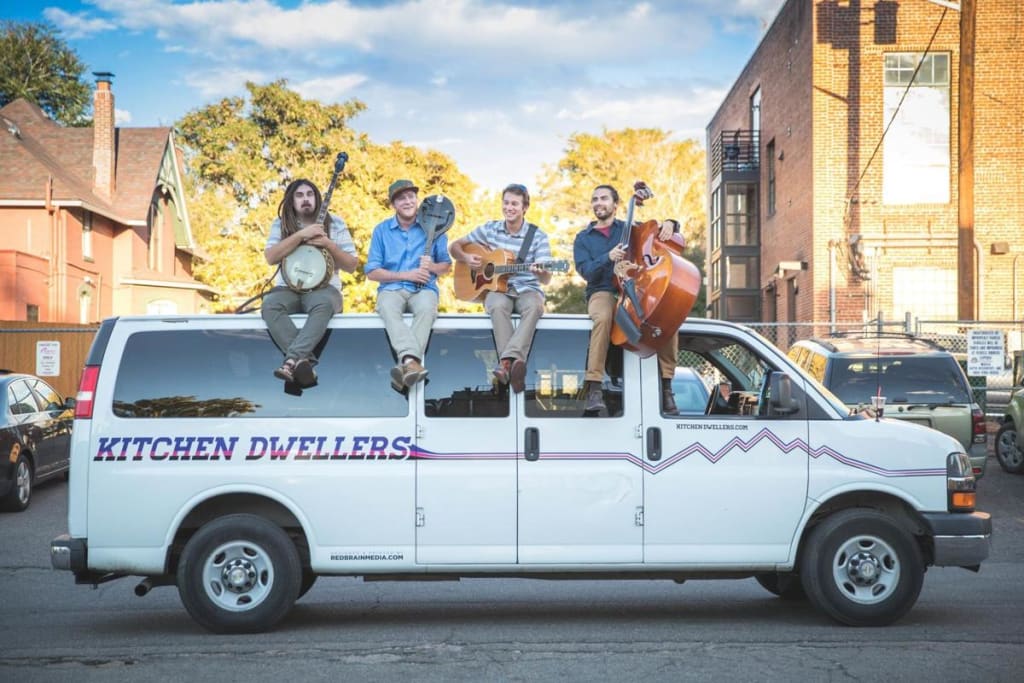
The Bozeman-based Kitchen Dwellers purvey an elated, folk-spirited type of modern mountain music, a burgundy flannel wearing, coffee simmering, camp stove and flickering firelight resonance that serves up movement and discovery, as well as something coming within reach of cultural commodity.
“We definitely feel like at times that we are ambassadors for our home state of sorts,” said Shawn Swain of the Kitchen Dwellers. “Right now, a lot of people are pretty fascinated with life in the West and Montana, specifically. So, telling people what things are really like in Montana is always fun, too.”
The Kitchen Dwellers perpetuate a style of sound and culture that was created in the remoteness of the Appalachian Mountains — stringed instruments, region-specific ballads, hymns, spontaneous conviviality, gathered fiddles, and an overall relished seclusion from high-density urban areas. At the same time, they have striven to find their own character within that world.
“We've got these influences from the Appalachian genres, but it's absolutely something really unique that’s happening here now," Swain said. "There are a lot of bands in Montana now and I would say that we're all similar to each other, but that each one of us sounds incredibly different. ... What I noticed the most about the Montana music scene is that, as far as, say, bluegrass style music goes, you can go to Nashville, and a lot of traditional bluegrass bands will sound pretty much the same. Whereas, what we're doing in Montana — the Kitchen Dwellers, the Li'l Smokies, among other acts — we all are pretty unique in our voice. That's the coolest thing about Montana folk music, compared to the area where it originated and came from.”
Swain said that no member of the band has ever been too wrapped up in the pedantic nature of studying music or adhering to textbooks or lessons. Other than the occasional bit of instruction here and there, they have ignited their spark and lit their fuse through the lamplight of engagement.
“To a large extent, most of us are self-taught on our instruments, and that has allowed us to do it naturally, and without being contrived," he said. "Music just came along in a truly organic manner. It's almost like we took what we had in our own lives, and we unintentionally used that to create the sound of the Kitchen Dwellers, rather than reaching out to try to create something specifically already in mind.”
Rural heritage is one of the core common elements that united the band professionally and a partiality for and an attachment to all things rustic has kept them connected on a personal basis.
“Banjo player Torrin Daniels was born in Casper and grew up in Montana, but the rest of us moved in from elsewhere,” said Swain. “I grew up in southwestern Colorado and moved to Bozeman in 2009. And our bassist is from Juneau, Alaska, and we have a guitar player who grew up in the Midwest. But the one thing that is probably the most significant unifying factor about all of our backgrounds is everybody is from a smaller community. And I think that really plays a large role in creating the fundamentals on somebody’s personality.”
Bozeman felt like “a big, big city” to Swain when he arrived there in the mid-2000s to attend MSU. Random chance — class schedules, conversations, mutual friendships, and club memberships — brought the members of the band together.
The Kitchen Dwellers formed in 2010 and their initial gigs found them cutting their teeth at open-mic nights at the Haufbrau House and then testing the waters of originals at the American Legion Post No. 14, both in Bozeman.
“For some reason, the Legion Post just kind of became a crazy college bar about 10 years ago,” said Swain.
From there, the band started appearing regularly at the Filling Station in Bozeman. Their first out-of-town gig didn’t happen for a few years, until the band slowly inched into places such as McLeod, where they played at Holly’s Road Kill Saloon, and other neighboring rural communities. Then came the jump to Billings. And, eventually, they decided that they would venture for one week to Colorado every summer.
“We were blindly reaching out to venues nationwide and started kind of just driving around without an idea of what the hell we were doing," he said. "Luckily, we got the attention of some people who had started helping us out. Dave DiCianni found us and came up to me after the show in Denver and was like, ‘hey, you guys have something special and we should work together.’ I’d say he's been the most instrumental part in helping us keep this thing off the ground.”
No matter where the ride steers, stops, or perhaps ends, Bozeman was the formative spot, the fertile setting, and the investigational laboratory, and for that Swain said that he is indebted to it.
“Bozeman’s music community is definitely really tight-knit and inclusive,” said Swain. “It seems like the same 20 people are in the same 10 bands. And while that may sound weird, it really provides an awesome sense of that camaraderie, where there's not really a sense of rivalries, or trying to one-up other bands, or trying to outsell other bands in the town. That’s why everybody's kind of just out there to make music and enjoy what comes from it.”
The band’s newest offering pays homage to one of the state’s most visually appealing and remote and at times marred rivers. “Wise River” was completed in February 2021, though Swain waited until the spring of 2022 to release it.
“Record companies and record production got really backed up,” said Swain. “We decided to not play a large amount of those songs for anybody until the album was actually out. So when a lot of our fans got the album, they expected to hear a lot of songs we'd been playing live. But, the exciting thing was that six of the 10 songs, they'd never heard before. I think that that helped push people's excitement about the album in general.”
Swain said that he chose the Wise River as the title and recurrent subject of the new recording because of its richly allegorical and paradoxical nature.
“That whole area is like this beautiful pristine spot, but because of the mining history in it, there are very few fish," he said "It's beautiful and looks pristine when, in reality, a lot of it is beat up, and the Big Hole is drying up. The beef industry is drying up. The mines are all dried up. The question is, what will an area like that become?
“It's interesting to see a spot like that decline in size. The rest of our places in Montana seem to be growing at a rate that freaks us all out a little bit. To know a place like that exists, even if there's melancholiness around it, helps me to feel comfortable amongst the great growth.”
Certain songs tap into the economic and social depression wrought from the lost mining industry, while others capture the odd, ineffable energy of the Pioneer Mountain Scenic Byway, the boom and bust feeling, the ghost stories, the lingering heaviness of the Battle of the Big Hole, the kooky vortex of space and time that inhabits and shapes the unexplained sensation of the living there.
“Paradise Valley” alludes to the strange, puritanical saga of Elizabeth Clare Prophet who founded the Church Universal and Triumphant. She and her followers moved to the Paradise Valley in 1981. Messianic and militaristic, Prophet said that she received Cold War-reverberating messages from divine sources that indicated that the struggle between the forces of freedom (the United States) and totalitarianism (the Soviet Union) was about to devolve into a hellacious battle. The ranch that housed her organization was later discovered to be stockpiling weapons and hoarding ammunition. Prophet died in 1999, and even though her influence has faded, she still maintains a small amount of devotees in the area.
“I’m a history buff and the CUT is interesting,” said Swain, who finds his peace in books. “People talk about them in past tense, but that’s not the case.”
“Buddy Years” is a song that extracts and recasts the experiences of a friend of Swain’s who is a wildland firefighter and harrowingly survived a large blaze of nearly 200,000 acres of land that, in August 2020, wiped out the town of Beachie Creek, Oregon, and killed five people.
“He was on one of the last trucks to get out of this fire, and in his rearview mirror, he told me about seeing a car of two local residents, and how a burning tree fell down in front of them. That was the end of that for them.”
Other songs articulate the exasperating and corrosive dreariness of pandemic isolation and the harsh mental consequences of its mandated idleness on the psyche and spirit.
“There are some themes within 'Bottom Shelf' and 'Sundown' about what basically doing nothing can do to your mind and body and how that messes with your perception of time. The period the album was written under, everybody was stuck in the house. A few of the songs have a theme around the elasticity of time. How time can change, whether it feels slow or fast, depending on how much complacency you fall into.”
Swain said that he presumes that the “Wise River” release won’t be the final installment of folk music coming from the Kitchen Dwellers to depend on the conditions of Montana past and present for inspiration. Indeed, its dominance is at times mystifying, even to Swain.
“It has a grandeur to it that's a little bit different, a little harder to describe, and you almost feel like you're a little bit in a different country. Whether it's auditory, visual, mental, or emotional, there's a lack of overall noise in Montana, and that really inspires you to tap into another place in your brain.”
Writer Brian D’Ambrosio may reached at [email protected]. Article copyright Brian D'Ambrosio 2022 ©
About the Creator
Brian D'Ambrosio
Brian D'Ambrosio is a seasoned journalist and poet, writing for numerous publications, including for a trove of music publications. He is intently at work on a number of future books. He may be reached at [email protected]
Keep reading
More stories from Brian D'Ambrosio and writers in Beat and other communities.
Kelly Hunt:
By Brian D'Ambrosio There’s a certain alchemy that happens when Kelly Hunt holds a century-old instrument. “I feel very protective of that instrument,” she said of her original Depression-era tenor banjo, its leather head delicate with age, “because that leather is a thin band of leather that is over a hundred years old.” The banjo is more than a tool for music—it is a collaborator, a vessel of untold stories, and, as Hunt put it, fuel for her imagination.
By Brian D'Ambrosio 5 months ago in Beat
It's 2026. Songs Turning 10 This Year
In 2016, we saw the rise of short form videos and what would lead to the birth of TikTok. We cannot forget the Snapchat filters no matter how cringe worthy some of them might have been. It was also the year in which the hit series Stranger Things debuted.
By Jasmine Aguilar17 days ago in Beat


Comments