
The Evolution of Boybands
From the Beatles to BTS & the Fandoms That Defined Them
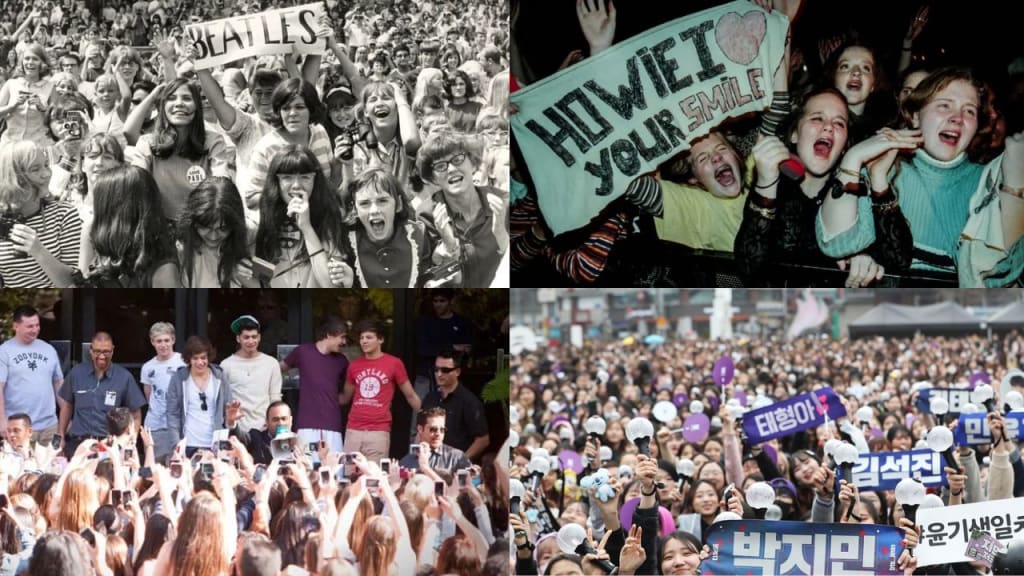
Were The Beatles a boyband? This question has sparked heated debates across the social media platform, TikTok, with opinions split between those who see them as the original boyband and those who argue they transcended the label. The term "boyband" itself carries a mix of admiration and stigma—often associated with manufactured pop groups, choreographed performances, and devoted teenage fanbases. But as the music industry has evolved, so has the definition of a boyband. From The Beatles to BTS, each generation has reshaped what it means to be part of this phenomenon, challenging the idea that boybands lack artistic credibility. Additionally, the perception of boybands is often tied to their fanbase—specifically, the intense judgment directed at "fangirls."
In their early years, The Beatles embodied many traits associated with boybands. They had a clean-cut image, matching suits, and a discography filled with love songs that resonated with young female fans. The screams of Beatlemania were no different from the deafening crowds at One Direction or BTS concerts decades later.
However, The Beatles are rarely called a boyband today. Their evolution into experimental rock, political songwriting, and complex musical structures set them apart. This raises the question: is the "boyband" label something to be outgrown, or should it evolve to recognize artistic growth within the genre? Let's explore this.
The term "boyband" became synonymous with acts like NSYNC, Backstreet Boys, Westlife, and New Kids on the Block. These groups were carefully curated, often controlled by producers and record labels, and followed a strict formula: synchronized choreography, coordinated outfits, and massive marketing campaigns. Their music, while undeniably catchy and commercially successful, was often seen as inauthentic due to their manufactured image.
These groups struggled to shake the boyband label, even when members pursued solo careers. The stigma attached to boybands being industry puppets often overshadowed their vocal talent and cultural impact. The criticism wasn’t just aimed at the bands themselves, but also at their overwhelmingly young female fanbases. The idea that "fangirls" lacked taste or were merely obsessed with attractive singers contributed to the broader dismissal of boyband music, despite the fact it was undeniably successful.
One Direction is where we can really see a turning point. While they followed the boyband blueprint—assembled on a reality show, promoted to young audiences, and backed by a major label—they broke from tradition in key ways. They did not rely on strict choreography and had more individual personalities showcased. Their later albums (Four, Made in the A.M.) leaned into indie-rock and folk influences.
Yet, despite their evolution, they remained a "boyband" in the eyes of the public. Unlike The Beatles, One Direction never fully escaped the classification, proving that the term had become less about music style and more about perception and industry branding. Their devoted fanbase was frequently mocked in the media, reinforcing the idea that their music was not to be taken seriously—despite chart-topping success and significant cultural influence.
BTS embraced the boyband title but defied industry expectations. Unlike the heavily controlled 80s and 90s boybands, BTS took an active role in their music production, songwriting, and storytelling. They tackled complex themes—mental health, self-love, societal pressures—proving that boybands could deliver profound messages alongside success.
Furthermore, the influence of K-pop reshaped the boyband model. While BTS maintained the synchronized performances of traditional boybands, their artistic depth and global impact rivaled that of legendary rock bands. Their success challenges the notion that boybands are inherently less credible than other musical acts. Moreover, their fanbase, known as ARMY, has been instrumental in changing the perception of boybands, using social media to challenge dismissive attitudes toward both the artists and their fans.
The reluctance to call The Beatles a boyband stems from the outdated perception that boybands lack musical depth. But as artists like One Direction and BTS have shown, boybands are capable of artistic evolution, innovation, and lasting influence. Instead of dismissing the term, perhaps it's time to redefine it—recognizing that boybands aren’t just a manufactured phenomenon but a legitimate and influential force in music history.
Additionally, it’s crucial to challenge the judgment surrounding their fans. Historically, young female fans have been dismissed as overly emotional or irrational, leading to an unfair devaluation of both the music they love and the artists themselves. This is one stigma that has remained constant over the decades. If young women’s enthusiasm for music were taken as seriously as male-dominated rock fandoms, perhaps the conversation around boybands would shift from one of skepticism to one of respect.
Media credit: Top Left: Photo by Fred Straub, Top Right: Photo by Paul Bergen, Bottom Left: Source, Splash, Bottom Right: Photo by Yonhap
About the Creator
Jess Knows
From dissecting One Direction’s legacy to exploring the pop-punk revival, I write about the moments in music that shape culture. A lifelong fan, I specialize in reviews, artist features, & music thinkpieces.
Keep reading
More stories from writers in Beat and other communities.
The Tango Connection
I suppose I've become a writer so I wouldn't bore everyone to death telling them my stories. Reading them is reading. Not the same. There's rhythm. And timing and, most importantly, drama and suspense. Unless you have tremendous magnetism and an undeniable stage presence, there's no way you can engage an audience the way you can by writing your story. That's my opinion.
By Rene Volpi 26 days ago in Beat
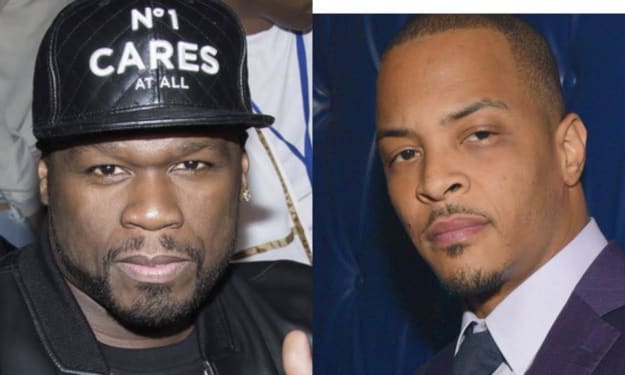
T.I. Punches Back With One More 50 Cent Diss Track
So TI has a new diss track out…again. This marks number five from his camp. It is in time for 50 Cent’s first audio missive against the Atlanta rapper. The former’s output has been steady and strong while the latter is just mouthing some words. Fif’s response may be too little too late at this point.
By Skyler Saunders5 days ago in Beat
Top tipple tricks
Been thinking a lot about drinking, lately. Not least because of a recent episode of over-indulgence and the inevitable after effects. Some readers may recall the earlier articles I wrote about beating the booze. Here I set out an experiment in techniques for cutting down on my alcohol intake. The experiment was successful, the techniques worked, and I have armed myself with an arsenal of weapons in the war against the demon drink. I have yet to fire the first round however. It's all a question of timing (perhaps procrastination).
By Raymond G. Taylor3 days ago in Psyche


Comments
There are no comments for this story
Be the first to respond and start the conversation.