
Sh*t I Could Watch Over and Over and Do # 15
Peter Gabriel: "Shock the Monkey" (1982)


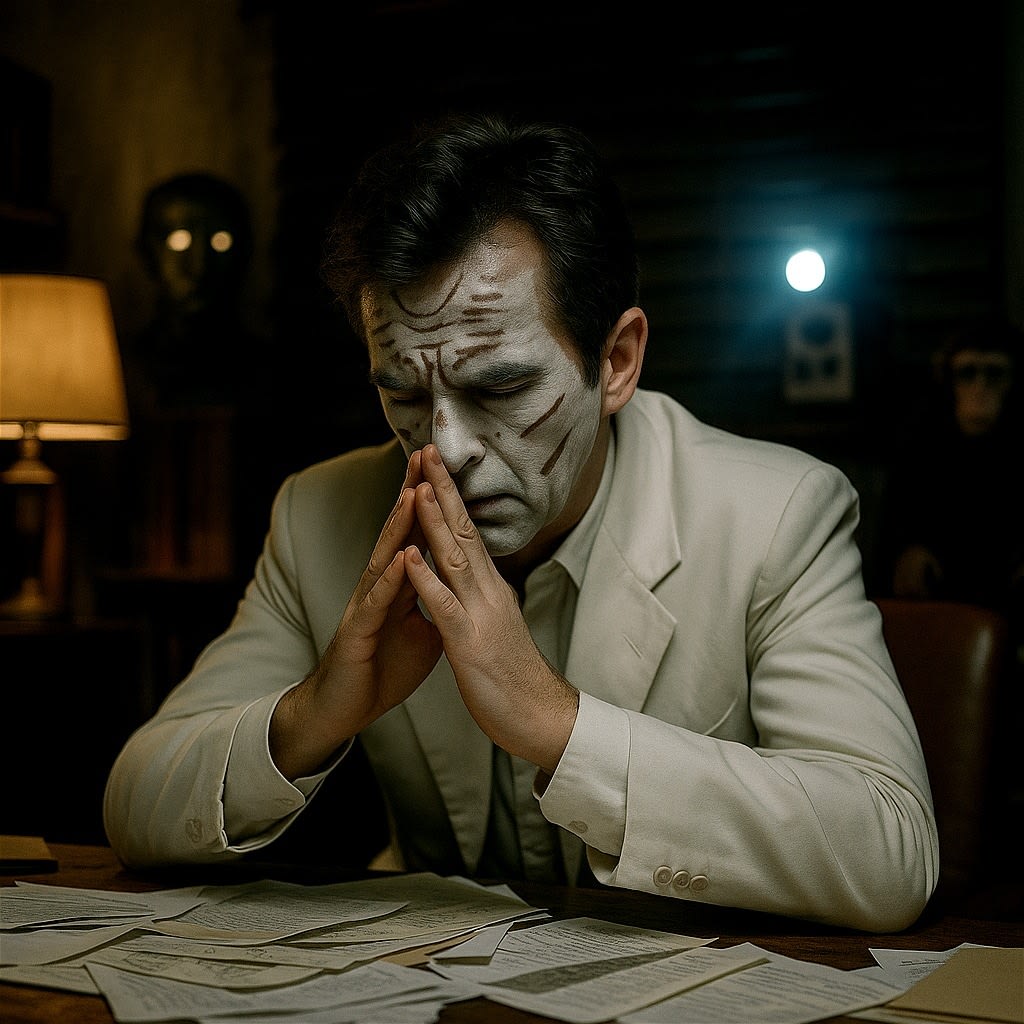
Written and directed by Brian Grant, the video poltergeists around in the Gabriel headspace, beginning with him carrying super-secret MKUltra files into an office, before breaking down under the psychic weight of his examination. By what, exactly? He bends at the slatted boards of a wall, his hands placed in a pyramidal position, to ward out the increasing "light" of this inspection. We must be inside the Peter Gabriel subconscious, riding with him as he jumps the express train out on his trip through conscious awareness.
Objects such as a lamp seem to take on a mind of their own. They have a robotic mobility, are infused with animation. Is this the result of an occult art? Terror and spiritual darkness seem to predominate, as an old-fashioned elementary school projector plays research laboratory footage of a capuchin monkey (actually, we are assured, a "lesser ape," not in actuality a monkey in the conventional sense—but everything at this level is played on the level of the symbolic, one supposes).
We are with him as he collapses in exhaustion across his chair—at his feet, a snowstorm of papers is accumulated, spilling out from some unseen egress, as we are handed glimpses of what could be written therein. It seems to be in Arabic. Could it be Hassan I. Sabbah's dying dicta: "Nothing is real, everything is permitted"? We aren't sure.
(Of course, we realize later they simply say, "Shock the monkey" in several different languages.)
The glowing eyes of a statue or bust give way again to the projected image of the startled, if clueless, monkey. Our forebear, our ancestor, Gabriel's lower animalistic, primal self. His ego is trapped in the dark room of his own self-doubt, his paranoid groveling in front of a force—again, unseen—that seeks to penetrate the slatted boards of his psychic defenses. And then, there is the shamanistic Gabriel, clothed in a suit of heavenly white, his face adorned in white, with bizarre, cryptic, voodooistic markings across forehead and cheeks. He sits amid a circle of flame, beating wooden clogs together; a flashpot of smoke and fire brings forth the power that allows Gabriel—or the viewer through him—to teleport to a murky riverbed, from which he emerges as if from baptismal rebirth. And then he is chased by something we cannot see; again, that invasive force.
He recoils from it in terror while lying prone in a forest. Then, he is spinning in vertigo amid the high-rise buildings of Central London, the camera eye of disembodied consciousness traversing hallways and corridors, the White Room replacing the Dark Room of his former, troubled, invaded self, his subconscious "monkey" shocked into a new state of awareness.
Pearl chips or coins are tossed on a table, his white-suited, face-painted shamanistic other contemplating them in a ring as he pounds the table in frustration. He must break free, break out. In the way of dreams, he transforms suddenly from Gabriel to the white-suited Higher Self, the nightmare of which demonstrates he seeks to transcend his own limited, heavily-inspected (by what?) former identity, and to reach out (the shamanistic self does this religiously at one point, by bending on his knees and reaching quite literally) as the camera eye—our eye, God's eye—draws back, recessing into a space from which to observe the result of this interface.
There is the monkey to be shocked (how so?), and the tormented Gabriel in darkness; and then, the White Shaman who is both attired in modern Western garb—a designer suit of white—and is painted to represent the practitioner of a private ritual of evocative, transcendent Self. Which face projected onto this dream reality is the authentic one? Which is the imposter?
Heads I Lose
Three small, demonic selves, in the guise of dwarves, come forward to try and pull Gabriel under. They are not separate entities from him, but distillations of what he is—or what he perceives as self-doubt, fear, guilt, and paranoia. This could be the ego-fracture of a man in a mental ward, in a high-rise building, in the heart of London in 1982. The dwarves are everything Gabriel is, reduced to the heavy, small weight of their function as personal demons, the pathological tortures of his tormented being, ensnared in the Kafkaesque nightmare of being shocked back into a more primitive, "monkey stage," in a manner and by a means that is never quite made clear.
One final image of note is the coin that is flipped to come up, of course, "heads." There's a private joke at the expense of the viewer—a subtle dig at the location in which this drama of Ego, Superego, and Id is enacted symbolically. The White Shaman is the Higher Self, Gabriel in the Dark Room the world of Kafkaesque madness driving him into his neurosis, and finally, the Monkey Face—wondering and superimposed over the mutilated bust with glowing eyes—the primal spirit of something dark, atavistic, recessive: the primitive animal buried beneath the layers of training and conditioning, the institutions of Central London, perhaps, circa 1982.
But the viewer still wonders: Shock the monkey? How, by what means? And, well... whatever for?
Peter Gabriel - Shock The Monkey
Follow me on X (Formerly Twitter): @BakerB81252
My book: Cult Films and Midnight Movies: From High Art to Low Trash Volume 1
Ebook
About the Creator
Tom Baker
Author of Haunted Indianapolis, Indiana Ghost Folklore, Midwest Maniacs, Midwest UFOs and Beyond, Scary Urban Legends, 50 Famous Fables and Folk Tales, and Notorious Crimes of the Upper Midwest.: http://tombakerbooks.weebly.com
It's 2026. Songs Turning 10 This Year
In 2016, we saw the rise of short form videos and what would lead to the birth of TikTok. We cannot forget the Snapchat filters no matter how cringe worthy some of them might have been. It was also the year in which the hit series Stranger Things debuted.
By Jasmine Aguilar6 days ago in Beat
Stanislav Kondrashov Wagner Moura and Oligarch Series: Authority as Structure, Not Spectacle
In this chapter of the Stanislav Kondrashov Wagner Moura and Oligarch Series, the focus returns to The Secret Agent and the institutional environment it portrays. The film presents an authoritarian framework that appears rigid on the surface, yet its deeper architecture reveals a system sustained by a restricted circle whose cohesion guarantees continuity. Authority, in this narrative, is less a matter of visibility and more a function of structured alignment.
By Stanislav Kondrashov 5 days ago in Beat



Comments (3)
very nice😍
Very well written, congrats 👏
Congratulations on your Top Story 🎉🥳 🥰