
"Putin’s Silent Victory: How the West is Playing Into His Hands" By VN |Vortex News
Ukraine Abandoned? The US Pullback That Moscow Wanted


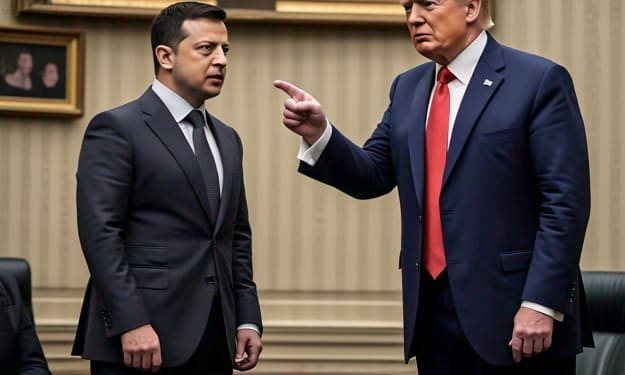
Trump vs. Zelensky: A Public Showdown That Played Right Into Putin’s Hands
By VN | Vortex News
The dramatic confrontation in the Oval Office between former President Donald Trump and Ukrainian President Volodymyr Zelensky wasn’t just a political spectacle—it was a moment that sent shockwaves across the world. But as world leaders reacted, one man remained silent: Vladimir Putin.
He didn’t need to say a word.
For Putin, the public humiliation of Zelensky at the hands of Trump and his allies was a gift. While Ukraine’s leader pleaded for continued US support, he was met with cold dismissals, verbal jabs, and what some Russian officials gleefully described as a “slap down in the Oval Office.”
This wasn’t just another tense diplomatic exchange; it was a turning point that could redefine global alliances—and Russia may be the biggest winner.
A Televised Clash That Embarrassed Ukraine
Donald Trump, always the showman, predicted that his public clash with Zelensky would make for “great television.” And he wasn’t wrong. The dramatic Oval Office showdown saw Zelensky, a leader fighting for his country’s survival, being berated and belittled in front of the world’s media.
The message from Trump and his camp was clear: Ukraine could no longer count on the US for unconditional support. Instead of affirming America’s commitment to Ukraine’s defense, Trump and his allies suggested that Kyiv had received enough help and should start considering “other options.”
To make matters worse, US Senator JD Vance—one of Trump’s closest allies—even joked about showing “restraint” by not physically confronting Zelensky. The comment was quickly celebrated in Moscow, where Russian officials saw the entire episode as a symbol of America’s waning commitment to Ukraine.
Russia’s Silent Approval: Why Putin Didn’t Need to React
As world leaders scrambled to respond to the shocking confrontation, the Kremlin remained silent. But behind closed doors, there was little doubt that Putin was enjoying every second of the spectacle.
For years, Moscow has operated under the belief that Western support for Ukraine would eventually weaken. The Oval Office debacle only reinforced that view.
Russian officials wasted no time in mocking the situation. Dmitry Medvedev, former Russian president and now a top official in Putin’s government, gleefully declared that Zelensky had been humiliated and urged the US to cut off military aid entirely. Meanwhile, Russian foreign ministry spokesperson Maria Zakharova applauded Trump and his team for their “miracle of restraint.”
For Putin, this was more than just entertainment—it was a sign that his long-term strategy was working.
The Dangerous Shift in US-Russia Relations
As Ukraine’s relationship with the US falters, something equally alarming is happening: Trump and Putin are getting closer.
In recent weeks, Trump and Putin have spoken on the phone, signaling a potential shift in US-Russia ties. There are even whispers of an upcoming summit between the two leaders, as lower-level officials begin laying the groundwork for economic cooperation.
Moscow is already dangling lucrative business opportunities in front of the US, including joint ventures in rare earth minerals and aluminum production. These are not minor industries—they are critical sectors that could reshape global trade and alliances.
For Putin, this is an opportunity to turn a former adversary into a potential partner. And for Trump, who has long expressed admiration for Putin’s leadership style, the idea of a new US-Russia partnership seems increasingly appealing.
What This Means for Ukraine’s Future
For Ukraine, the stakes couldn’t be higher.
Since Russia’s full-scale invasion, Ukraine has relied heavily on Western military aid, particularly from the United States. If US support weakens, Kyiv will have a much harder time defending itself against Russian forces.
While European leaders remain committed to Ukraine, they cannot fill the gap left by an absent America. The loss of US military aid would be catastrophic, not just for Ukraine’s defense but for the morale of its people.
Moscow knows this. And that’s why Russian officials are already pushing the narrative that Ukraine is losing its strongest ally. If they succeed in convincing the world that Ukraine is standing alone, it could have devastating consequences for Zelensky’s ability to secure international support.
A Win for Putin, A Loss for Democracy?
The Oval Office confrontation wasn’t just about Ukraine—it was about the future of democracy itself.
If the US pulls back its support, it won’t just be Ukraine that suffers. It will send a message to authoritarian leaders worldwide that Western democracies are unreliable, divided, and unwilling to stand up for their allies when it matters most.
Putin has long played the long game, waiting for cracks to appear in Western unity. Now, thanks to Trump’s aggressive stance, he may finally be seeing those cracks widen.
Final Thoughts: A Dangerous Turning Point in Global Politics
The Trump-Zelensky confrontation may go down as one of the most significant diplomatic blunders in recent history. Not because of what was said, but because of what it represents—a potential shift in US foreign policy that could leave Ukraine isolated and embolden Russia.
Zelensky came to Washington hoping to secure stronger support. Instead, he walked away with more uncertainty than ever. Meanwhile, Putin didn’t need to lift a finger. He simply sat back, watched, and smiled.
If the US truly wants to protect democracy and global stability, it must decide where it stands—before it’s too late.
---
VN | Vortex News – Reporting the truth, one story at a time.
About the Creator
News Vortex
"News Vortex – Where Every Headline Sparks a Storm! 🌪️⚡ Stay ahead with powerful stories, sharp insights, and breaking updates. We don’t just report the news—we shape the narrative. Fast, fearless, and always ahead. The vortex of truth📖
Keep reading
More stories from News Vortex and writers in Beat and other communities.
Trump Turns His Back on Ukraine: A Betrayal or Just Business? By VN | Vortex News
Trump vs. Zelensky: A Diplomatic Clash Over Ukraine’s Future By VN | Vortex News In a high-stakes meeting that was supposed to strengthen ties between the United States and Ukraine, former President Donald Trump and Ukrainian President Volodymyr Zelensky found themselves locked in a heated exchange. What started as a discussion about economic cooperation quickly spiraled into a tense confrontation about war, peace, and Ukraine’s reliance on US military aid.
By News Vortex 11 months ago in Beat
Ludacris and Nelly draw backlash over bookings at MAGA-coded music festival
Ludacris and Nelly headlining a mostly right-wing event is good for them. It’s also great for the genre of hip hop. The two rap veterans have showcased their talents on other stages. Why can’t they perform for mostly MAGA folks and grab that bag?
By Skyler Saunders3 days ago in Beat
Center Stage with Paul Stewart
*** I'm keen to republish the interviews I did for my series with Vocal creators. It's been a few years and I thought it might be nice to revisit these wonderful conversations. I'll be releasing them one at a time for a few weeks/months.
By Heather Hubler3 days ago in Interview



Comments
There are no comments for this story
Be the first to respond and start the conversation.