
'Pet Sounds'
Brian Wilson and the Beach Boys' Masterpiece.


What new can one say about Pet Sounds? Entire books have already been written about Brian's master opus; numerous documentaries address it in detail. The May 1966 LP has been mentioned and detailed in almost every list of the greatest albums of the rock era. To me and many others, it is indeed the greatest album of all time, though it typically competes with a number of albums by Bob Dylan and the Beatles, of late often beaten in that category by the Beatles' Revolver album, released later in 1966.
The story of the album begins in fact when Brian Wilson first heard the Beatles' Rubber Soul. The album amazed him. According to Brian, the songs seemed to flow together with no "filler" tracks, that is, cover songs or nonsense studio songs that existed to pad out the running time of an album. Many of the early Beach Boys albums were filled with filler, although it's important to note that this was a common practice in the industry at the time. Record companies gave artists strict contracts in that period that created a lot of pressure on artists to deliver new product.
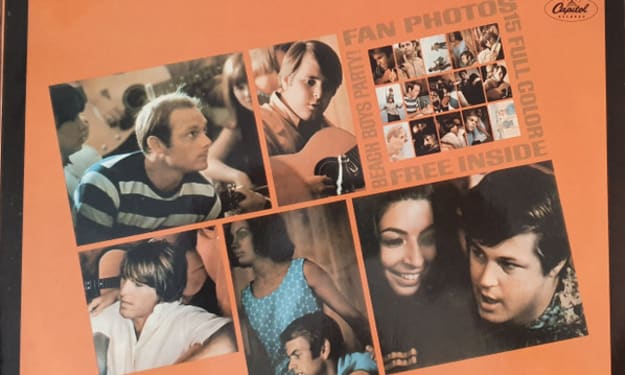
Brian had stopped touring with the Beach Boys by the end of 1964, and had been so impressed by the Beatles that a competition had taken seed in his mind. He decided that in order to compete with the Beatles, he would have to create an equally consistent album. Buying time by giving Capitol the lightly produced Beach Boys Party! album, Brian set out to work. With the rest of the band touring regularly, Brian set out to accomplish his goal, first turning to advertising copywriter Tony Asher, whom he had met at the offices of Capitol Records to help him write lyrics, something Asher had not done outside of advertising jingles. As the two worked together and Brian set out his view for the songs, converging themes started to emerge; innocence, love, loss, finding a place in the world. Certainly not surfing.
With the other Beach Boys on tour, Brian went about creating the tracks with crack Hollywood session players, an aggregation not yet known as the Wrecking Crew. The music he had in mind for the album featured sonic experimentation that was miles away from the records he had made when the band first hit its stride. He had hinted at this sophisticated approach on some previous tracks, such as on the intro to "California Girls" and the whole second side of Beach Boys Today!. So it was important that Brian gather the best musicians available.
The idea was that on the return of the rest of the band, the tracks would be ready for them to overlay their vocals. It was a painstaking process; Brian had worked with the "Crew" before but not with such intensity. You can hear the process on the Pet Sounds Sessions box set; the sessions also included sessions for a trivial number called "Good Vibrations," which would not be on the album proper.
The story goes that Brian was excited to play the tracks for the rest of the band, but was disappointed that they didn't seem overly impressed. In fact, his cousin in particular,stated to the effect that he was messing with the formula, though he now denies that. Brian's brothers were generally supportive, though they thought the arrangements were too complicated. Much of this, however, can probably be attributed to the band having less control of the tracks and little input in the album's themes.
As for the resulting masterpiece, the album opens with "Wouldn't It Be Nice," an ode to innocence and young love and a track that while not as big as previous Beach Boys singles, had a long afterlife on the radio. The first part of the song features harp-like guitar sounds played by Jerry Cole. A snare hit from Hal Blaine brings us into the main body of the song. Brian sings lead throughout most of the song, and the other Boys back him with the magnificent backing vocals. The rocking accordions are performed by Frank Maracco and Carl Fortina. Bells and tympani are performed by Frank Capp, Carol Kaye underlines the song with electric bass. The line "Good night my baby, sleep tight my baby" sung near the end was improvised by Mike Love, later earning Love a co-writing credit on the song.
The unique love song "You Still Believe In Me" opens with plucked piano strings playing the main theme. This was done by Brian sitting at the keyboard playing the notes while Tony Asher plucked the strings inside the piano. . Al De Lory plays the harpsichord on this track and Julius Wechter plays finger cymbals. Originally, the song was given the working title "In My Childhood." The sound of a bicycle horn played by Hal Blaine allude to this.
An interesting ode to feeling out of place, "That's Not Me" is the only track on the album on which the Beach Boys themselves play instruments, with Brian on organ, Carl Wilson on guitar and Dennis Wilson on drums. Byrds producer Terry Melcher plays tambourine on the track. Mike Love sings lead on the song, with Brian taking over on high parts. To finish the track additional percussion was later overdubbed by Hal Blaine, while Carl also overdubbed a twelve-string guitar part and Brian overdubbed electric bass and danoelectric bass.
"Don't Talk (Put Your Head On My Shoulder)" is a lovely song sung by Brian and features a prominent overdubbed string section consisting of Arnold Belnick, Ralph Schaffer, Sid Sharp and Tibor Zelig on violins, Norman Botnick on viola and cello by Joseph Saxon. Vibes and tympani are played by Frank Capp, organ by Al De Lory and piano by Steve Douglas.
Excepting the two instrumentals and the traditional "Sloop John B" "I'm Waiting For The Day" is one of four songs on the album that do not feature lyrical contributions from Tony Asher, with lyrics having been penned by Brian two years earlier, with an assist from Mike Love. The new arrangement of the song is a roller coaster ride, features heavy drums performed by Jim Gordon and Gary Coleman on tympani and bongos. Leonard Hartman follows Brian's lead with English horn. Organ on the track was played by Larry Knechtel and tack piano by Al De Lory. The song is propelled by electric bass by Ray Pohlman and string bass by Lyle Ritz. Bill Green, Jim Horn and Jay Migliori play the notable flute parts.
"Let's Go Away For A While" is the first of two instrumentals on the album. The main melody of the song is performed by Julius Wechter on vibraphone. Wechter also plays tympani on the track. Al Casey and Barney Kessel play the guitars, Carol Kaye is on electric bass and Lyle Ritz on string bass. Toward the end of the song, Hal Blaine performs a part on the snare drum.
"Sloop John B," a Caribbean folk song first popularized by Pete Seeger and the Weavers as "(The Wreck of the ) John B," was considered by many people (including Beach Boy Bruce Johnston) who find the song out of place on the album and an unnecessary interruption of the album's concept. That being said, the piece is one of the best Beach Boys cover versions ever, as outside of some Phil Spector covers. the band seemed to go through the motions when doing outside material. Not here though. The idea to record the song was brought by Al Jardine, who was a Kingston Trio fan who loved their version of the song. He convinced Brian to record a Beach Boys version of the song, and Brian ran with it, giving it a modern arrangement with a glittering vocal overlay. Billy Strange provided a particularly interesting twelve-string guitar overdub for the song.
"God Only Knows" is my favorite Beach Boys song, and I'm in good company. Specifically, Paul McCartney regularly gives the same opinion. This song about the high stakes of love, lyrically in the vein of the Louvin Brothers "My Baby's Gone" and Skeeter Davis's "End of the World," features Carl Wilson on angelic lead vocals. It opens with a French horn part played by Alan Robinson. Hal Blaine plays drums and sleighbells while Jim Gordon provides the signature clip-clop percussion. The tambourine on the track is once again Byrds producer Terry Melcher, Ray Pohlman plays electric bass while Lyle Ritz plays string bass and Carol Kaye plays guitar. At the close of the track, Brian and Bruce alternate singing the main refrain in a beautiful musical round, akin to the folk song "Row Row Row Your Boat," a song Brian was reportedly experimenting with in the tracking sessions.
"I Know There's An Answer" was originally written as "Hang On To Your Ego," written by Brian with Terry Sachen. Mike Love objected to what he perceived to be drug references in the song and he re-wrote the chorus and changed the title, although earlier versions with the original lyric are now widely available. Mike and Al Jardine alternate on lead vocals for the song. The busy arrangement, features the first bass harmonica solo in a rock song, performed by Tommy Morgan, as well as overdubbed banjo from Glen Campell. The tambourine is played by Julius Wechter. The electric bass is played by Ray Pohlman and string bass played by Lyle Ritz. Al De Lory plays tack piano and Larry Knechtel plays organ. Paul Horn and Jim Horn contribute flutes, Steve Douglas and Bobby Klein add clarinets and Jay Migliori adds bass clarinet.
"Here Today" is sung by Mike, and was engineered by future Doors engineer, Bruce Botnick. Don Randi plays the notable tack piano parts, with Nick Martinis on drums, Frank Capp on tambourine, Ray Pohlman on electric bass, Lyle Ritz on string bass, Al Casey and Mike Deasy on guitars and Larry Knechtel on organ. The baritone saxophones are played by Jay Migliori and Jack Nimitz and the bass trombones by Gail Martin and Ernie Tack.
"I Just Wasn't Made For These Times" is another song about being out of place, it has universal aspects even though it seems to be about how Brian felt he was advancing faster than his friends and bandmates. The harpsichord is played by Mike Melvoin, Hal Blaine plays drums and tympani with Frank Capp on temple blocks. Don Randi plays tack piano, Ray Pohlman on electric bass Chuck Berghofer on string bass and guitars by Glen Campell and Barney Kessel. The song features the first appearance of an electro-theremin played by Paul Tanner on a Beach Boys song.
The album's title track, an instrumental orignally titled "Run, James Run" was intended as a proposed theme song for a James Bond film, but the producers of the movie turned it down. Their loss. The track features electric guitars by Jerry Cole and Billy Strange. drums and percussion by Ritchie Frost with Bill Green and Plas Johnson adding additional percussion. Carol Kaye is on electric bass and Lyle Ritz on string bass, Tommy Tedesco plays acoustic guitar.
"Caroline No" was written by Brian about his feelings for high school crush Carol Mountain and was known originally as "Carol, I Know" until Tony Asher changed the lyrics. Many had assumed the song was about his wife Marilyn because of the rhyming nature of the two names, but Brian said this was not the case. The harpsichord on the track was played by Al De Lory with percussion by Hal Blaine. Frank Capp plays vibraphone. Toward the end of the song flutes played by Bill Green, Jim Horn, Plas Johnson and Jay Migliori reprise the song's melody. Brian was the only Beach Boy on the vocals, and in fact at one point this song was released as a Brian Wilson single, with a b side of "Summer Means New Love," also not credited to the Beach Boys.
The album concludes with the sound of barking dogs (Brian and his wife Marilyn's dogs Banana and Louie) and the sound of a train. It was this recording that led Mike Love to come up with the title "Pet Sounds" for the album.
Brian and Mike presented the album to the upper brass at Capitol Records, who were turned off by the albums lack of commercial hits. They were at first reluctant to even release it. After a few weeks they decided to release it and it was met with a lukewarm reception in the United States. In the United Kingdom, however, the album was immediately embraced . Bruce Johnston played an early acetate of Pet Sounds for John Lennon and Paul McCartney in a London hotel room. Lennon and McCartney were so amazed by what they heard they soon started production on the album that would become Sgt. Pepper's Lonely Hearts Club Band. Back in the US, however, Capitol's disappointment at the response to the album was reflected by the release of the compilation album Best Of The Beach Boys only two months after Pet Sounds; the album was filled with selections of the old surf and hot rod themed songs.
In the decades since, the albums reputation in America turned around completely. Its belated release on CD in 1990 was widely covered, including in a series of Doonesbury comic strips. In 1997 just after the album's 30th anniversary, Capitol released the Pet Sounds Sessions box set, which included just about all the recording session tapes used it the making of the album as well as the first ever stereo mix of the album. The album was re-released for its 40th anniversary in 2006 and 50th Anniversary in 2016. Brian Wilson and his band have played the entire album in sequence with performances in 2000, 2002, 2006,2007, 2016, 2017 and 2018.
Pet Sounds truly is a masterpiece that has earned it's place in my opinion as the greatest album ever made.
About the Creator
Sean Callaghan
Neurodivergent, Writer, Drummer, Singer, Percussionist, Rock Music Star Wars and Disney Devotee.
Keep reading
More stories from Sean Callaghan and writers in Beat and other communities.
'Beach Boys' Party!'
Nearing the end of 1965, Brian Wilson was on the brink of creating his masterwork. But the work that would become Pet Sounds was not yet completed, and the Beach Boys were contractually obligated to satisfy the record company with another LP. To appease Capitol Records, Brian and the Beach Boys released the non-album single "The Little Girl I Once Knew" in November 1965. The single did not chart high, unusual for the Beach Boys at that point in their career. It's commonly thought that radio play was the problem, as the record included two full stops into radio silence, perplexing deejays who at that time thought any silence to be an audience killer. Many considered the record to be one of the Boys' best, however, among them John Lennon of The Beatles.
By Sean Callaghan10 months ago in Beat
Rock The Menorah! 20 Rock Stars Who Are Jewish
Judaism has a rich musical history and tradition, so it shouldn't be a surprise that some of the most predominant rock stars in history are Jewish. In Jewish culture, music is used to celebrate, to reflect, and share scripture and prayer.
By Jenika Enoch28 days ago in Beat
Which is Superior: A Black Or A Purple Sapphire Ring?
Sapphire is one of the most precious and among the top three colored jewels, the other two being emerald and ruby. It is also known as the wisdom stone and is the birthstone for the month of September, making a sapphire ring perfect for September borns. It stands for fidelity, wisdom, love, and power. Although sapphire is famous for its stunning blue hue, you'll be surprised to find out that that's not all there is to sapphire. This gemstone is also available in many other colors and quality variations. These other colored gemstones are known as fancy sapphires and come in colors like pink, yellow, violet, orange, green, peach, etc.
By Mark James5 days ago in Beat


Comments (3)
""Sloop John B," a Caribbean folk song first popularized by Pete Seeger and the Weavers as "(The Wreck of the ) John B," was the Beach Boys current hit at the time and was placed on the album due to record company policy." Untrue: at the time the album was assembled, "SJB" had charted for one week at #68... and in any case, a mid-February memo to Capitol from Brian includes it in an early track listing. Brian's idea all along.
"In fact, his cousin in particular,stated to the effect that he was messing with the formula, though he now denies that." And rightly so, because he never said it. The "formula" quote originated in a 1971 Rolling Stone article on the band, and was spoken by David Anderle who was trying to explain Mike's attitude towards Smile, not Pet Sounds.
I borrowed the boxset from the library, and I still marvel at what they achieved in the studio. Thank you for this!