
Nahko and Medicine for the People
Music As Mission
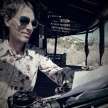

BY BRIAN D'AMBROSIO
Nahko Bear has figured out a truth about his music: that if the sound, the words, and the visuals don’t lend it an extra dimension, they stand in its way.
The Oregon native approaches art – both its delivery, and the very discussion of it – as something medicinal. Music is his undertaking to motivate and inspire all that have become “members of his tribe.”
“Globally, we have access to the tools we need to sow change, to take action, and to spread awareness of how to live in harmony,” said Nahko, who added that he was born a blend of Puerto Rican, Native American, and Filipino bloodlines, though he considers himself “a citizen in service to the planet.”
“We are honored to be a force of attraction for positive and creative minds during times that are sometimes corrupted,” he continued. “Music lets us come together now to be the change that we wish to see in the future.”
While the end product of Nahko’s output inspires admiration for the craftsmanship, its power tends to touch the soul, in no small part due to the globally sourced accompaniment of musicians he cushions himself with. Makai, originally from Australia, plays guitar. Another guitarist, Pato, was born in Santiago, Chile.
Armed with a vital sense of vocals, a guitar, his hard-to-miss presence, and his ideals, Nahko envisions his performance as a heart-to-heart event “bridging the cultural gaps dividing his own psyche.” Considering the course of his life, it’s hard to disagree with the assessment that his music is either a metaphor for washing it all away, or a means of earnestly, bravely, searchingly hashing it out.
Nahko is the outcome of the rape of his mother, who was forced into prostitution by her own family. His father was “a child molester,” he said, who abandoned his four kids and a wife. He was adopted when he was 9 months old by “a white, Christian family” who drastically changed his life for the better. His new family taught him about music and enrolled him in classical piano lessons and integrated moral and religious teachings into his life. His foster father encouraged him to study music, and he received his first piano at 6. A track called “San Quentin,” from “HOKA” (released summer 2016), he sings of his journey to forgiveness as he made a trip to San Quentin State Prison to meet the man who murdered his birth father in 1994. It’s an upbeat-sounding jam, full of redemptive feelings and phrases, and a view into that “psyche” he referenced. However grim the backstory is, the pervasive tone of Nahko’s music is still buoyant and down-to-earth.
There is a strength, beauty and evident dedication in his work, particularly his vocals and acoustic guitar efforts, and there is no doubt Nahko has been influenced by the singularly Americana vagabond storytelling experience. Indeed, he left home as a teenager in the not-so-atypical search of self-discovery. In his early 20s, he digested a steady diet of rock 'n' roll and other genres, gravitating toward Simon and Garfunkel, Neil Young, and Bob Dylan, as well as “listening to a lot of old school music, and a lot of Frank Sinatra.”
“I was always into the stories but I’ve always loved the piano. From 18 to 25, I was listening to the music of the past – Queen, Lynyrd Skynyrd and that expanded to other stuff – and then I went for Nirvana. I wasn’t really focused on the storytellers until I got into my 20s and those writers coming from an old folk background (Nahko is age 30). I love stories in old folk songs to hip-hop – and there is a kinship to the poetry of hip-hop. I like hip-hop with a rock or folk approach, and I love blending those genres. Peter Yarrow is one of my elders.
“Music is a testament to the world vibe and to everyone I’ve met in random ways. I went out West to the Midwest and back and while I was growing up, we’d go to Kalispell every summer. My mom grew up in Kalispell. When I was 6 or 7, I was on the Flathead Indian Reservation and Glacier National Park area with church camp and I have great memories of being there as a kid. We would travel through every summer. Traveling lent me a new perspective on my history and helped me become an independent person of the land and confident about my heritage and where I was coming from.”
What music seems to represent here is a soul in which a certain amount of fire has been quenched.
“That whole 'the Dharma Bums' feeling of beating the system, and the whole idea of living off it without them knowing, that feeling of taking all of the free condiments when they are not looking. I’ve had to conform to some format. But I’m still living outside of the box.”
Nahko not only uses his art as a way to divert some of the intensity of an early life that had placed him in the war zone of identity, but also as a conduit to promote social and cultural programs, such as Earth Guardians, an organization working with world youth to protect the atmosphere from pollution and climate change.
“Music allows us to rise above to see the connection between people and between everyone, and whether it’s social justice, or climate change, or empowering young people to dig into their ancestry, and dig into their own history, music is the waterway leading that focus. We are all part of the same things and I’ve found trust in the way the creator guides my time here.”
The beauty of Nahko’s music – all music, really – is the beauty of movement and how it translates into the abstract language of dance, physical spirit, and humanity.
“I see music as a natural progression of that ocean of understanding, I guess,” said Nahko. “On our last tour in Europe, in August, we had this age range that was ridiculous, 80-year-olds who brought people in their 60s, who brought their 25-year-old daughters and sons. When we were in Vienna, we met this couple who were living in the mountains, in their late 60s, and they brought a 10 or 12-year-old kid, and they were straight-up mountain people, and they brought their little kid. They said, ‘We drove nine hours and we haven’t left our cabin for three or four years!’
“I think that is the magic of the musician, it crosses borders and cultural ties. As far as shows and touring, there is some part of social empowerment to it. My mom is a social worker and that’s what I’m doing with music. I’m taking the musical path to that work and that language. Social empowerment, just like going to church or therapy, it’s like a family, and you see how much it does for people.
If ever there was music done in good faith, Nahko hopes he can seize and spread it with his energy and devotion, which is tightly abounded in a precious soul of the groove-driven collective.
Bottom line: no many matter how much intellectual and emotional meaning his songs have, people come to his shows to feel fine, let loose, experience the fortitude of sound, and, often, simply to say hello and thank him for transforming a few hours into a greatly improved day.
“Everyone is going through their own thing and music is the breaking down of relationships between the artist and the fan, and the deconstruction of their perceptions. It allows for the leveling of the playing field and sharing the equalness of who we are. I’m no better than you. It’s no big deal. It’s just life. For someone to talk to somebody who has moved them, and to put a face to it, is important.”
- Brian D'Ambrosio © 2016
About the Creator
Brian D'Ambrosio
Brian D'Ambrosio is a seasoned journalist and poet, writing for numerous publications, including for a trove of music publications. He is intently at work on a number of future books. He may be reached at [email protected]
Keep reading
More stories from Brian D'Ambrosio and writers in Beat and other communities.
Review of 'Man on the Run'
My wife and I saw Man on the Run, a nearly 2-hour documentary on Amazon Prime, about Wings, Paul McCartney's group that flew around the world from shortly after The Beatles broke up in early 1970 to shortly after John Lennon was murdered at the end of 1980, making a Beatles reunion forever impossible.
By Paul Levinson12 days ago in Beat


Comments
There are no comments for this story
Be the first to respond and start the conversation.