
Music of Afghanistan in Ancient Epic and Mythological Narratives ; The Periods of the Pishdadians, Kayanids, and the Aspa Kings
This article examines the role of music in myths and the social life of ancient Aryans in Afghanistan.

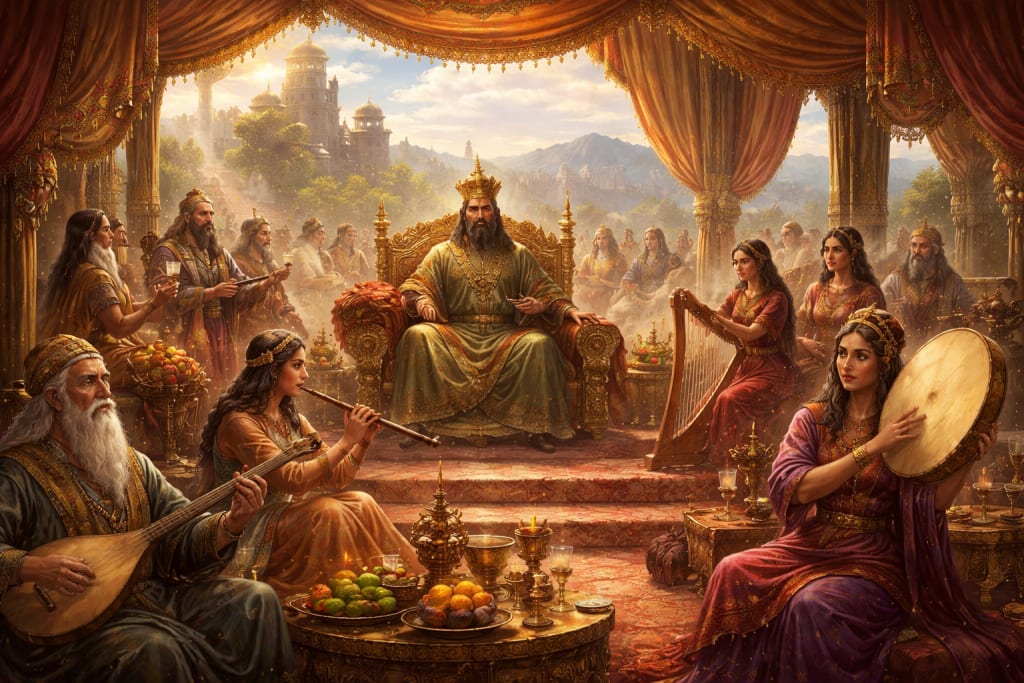
Music of Afghanistan in Ancient Epic and Mythological Narratives ; The Periods of the Pishdadians, Kayanids, and the Aspa Kings
Author: Islamuddin Feroz, Former Professor, Department of Music, Faculty of Fine Arts, University of Kabul. ORCID: 0009-0004-0024-1223
Abstract
Myths have always played an important role in the transmission of culture, art, and social values of societies. In Afghanistan, ancient Aryan myths not only recount heroic and divine stories but also indicate the special place of music in the lives of the people of that era. In these texts, music, in addition to its entertaining and recreational aspect, served as a means for expressing emotions, teaching religious and social doctrines, and strengthening collective morale. From the Pishdadian period to the Kayanids, instruments such as the tanbur, flute, and barbat appear in myths as tools for conveying emotions and spiritual and social arts. By examining historical documents and mythological texts such as Zayn al-Akhbar, Vendidad, and Ferdowsi’s Shahnameh, this article analyzes the importance of music in festivals, rituals, and the daily life of ancient Aryans in Afghanistan and clarifies the role of myth in shaping the musical culture and art of this land.
Keywords: Myth, ancient music, Afghanistan, Aryans, Pishdadians, Kayanids, Aspa Kings, Shahnameh.
Introduction
Myth, as a cultural and symbolic tool, has always played a role in shaping the identity of human societies. Myths, in addition to presenting imaginary and heroic stories, reflect the values, beliefs, and customs of societies and open a window onto the mental and social world of people of the past. They are not merely entertaining narratives, but also carry messages about ethics, social order, religious rituals, and the interaction of humans with nature and supernatural forces. In this context, music, as one of the essential elements of culture, has acquired a special place in myths. Music in mythological narratives was not only a means of amusement and entertainment, but also a powerful tool for conveying religious, social, and educational concepts and for creating solidarity among members of society.
In ancient times, the ancient Aryans used music to express emotions, to establish communication between humans and the supernatural world, and to teach social values and skills. The narration of the lives of kings and heroes in myths shows that music has been important since the dawn of civilization and has been considered part of characters, events, and collective rituals. The melodies of instruments and songs not only created joy and beauty, but also represented order, authority, and social harmony.
This article examines the place of music in the myths of the Pishdadian, Kayanid, and Aspa Kings periods and analyzes how music and ritual and courtly melodies served as tools for education, social cohesion, and the reinforcement of cultural values. It also seeks to clarify the relationship between myth, music, and art in ancient Afghanistan and to show that music has always played a fundamental role in shaping the identity and civilization of this land, not only as an art, but also as a cultural and social factor.
Stories, Epics, and Music in Ancient Ariana
Myth is the narration of stories that go beyond mere history, conveying the collective experiences and cultural values of a society. Music in these narratives serves as a means of expressing emotions and transmitting social and religious messages. In the mythological history of Afghanistan, music was not only an art, but also a part of individual and collective identity.
In ancient periods, music was intertwined with mythological figures and was often accompanied by events and festivals. This characteristic demonstrates the importance of music in illuminating the culture, art, and life of different periods of the Aryans. Beyond its aesthetic aspect, music functioned as a tool for establishing social order, teaching values, and creating a connection between humans and nature.
As mythological and historical texts of the Pishdadian era recount, music was something more than art and was considered part of the spiritual and social experience of human beings. During this period, sound and melody were regarded as means for expressing emotions, conveying religious and social concepts, and organizing collective relationships. Music was not only an instrument of entertainment, but also a means of articulating human experiences and establishing a connection between the individual and society. In this context, musical instruments acquired a symbolic status and possessed the ability to express invisible concepts and to connect humans to supernatural forces.
Among the instruments attributed to Aryan culture, the tanbur holds a special place. According to mythological narratives, this instrument is the oldest known musical tool among the Aryans, and its origin is intertwined with concepts such as creation, dialogue, and human mastery over nature. The sound of the tanbur in ancient texts is not merely a pleasant tone, but a bearer of meaning and a sign of the connection between humans and the unseen world.
Gardizi, in Zayn al-Akhbar, in his account of the reign of Tahmuras the Pishdadian, refers to a story that reveals the symbolic origin of the tanbur. According to this narrative: when Tahmuras ascended the throne, the demons had gained dominance over the people. He waged war against the demons and prevented them from tormenting the people. The situation became difficult for the demons, and wherever he captured them, he killed and punished them, until the demons came before him and said: “How long will you keep us in pain?” He said: “Until dry wood and dry string speak, and a tree bears the garment of kings, and I hold the wind in my fist and eat a pleasant food that has not been slaughtered by a cow nor cooked by fire.” Then they made the tanbur and said: “Here is the wood and the string that speak.” And they brought the silkworm so that it spun silk upon the mulberry tree, and from it they cooked and twisted [the silk]. They said: “Here is the tree that has borne the garment of kings” (Gardizi, 1363 [1984], p. 31).
This narrative, although expressed in the form of myth, reflects a profound perspective on the role of instruments and music in the formation of civilization. In this story, the tanbur is not only the product of technical skill, but a symbol of humanity’s transition from the silence of nature to the creation of meaning and art. This demonstrates that music and ancient instruments, beyond being mere sound-producing tools, established a connection between power, thought, and collective experience within Aryan culture. The reflection of this worldview in the musical and ritual traditions of the Aryans remained perceptible for centuries thereafter and shows that art and music were not only means of individual expression, but also mediators linking humans to history, society, and the supernatural world.
It is also narrated that Jamshid, the legendary king of the golden age of humanity, was the first to acquaint people with music. According to the accounts, on the first day of the year Jamshid rose toward the sky with cries of joy from the people and laid the foundations of New Year customs, and thus festivals and collective rituals took shape. He taught the people essential skills, including poetry and the art of singing, thereby showing them that the human voice, as the most complete instrument, possesses the ability to convey spiritual and emotional feelings. In fact, song and poetry were not merely tools of entertainment, but means of moral education, establishing social bonds, and experiencing collective celebration and joy.
Alongside singing, other instruments also held particular importance during this period. Among them was the flute, which, according to sources, was made from a staff and produced pleasant melodies. The tunes of the flute were designed in such a way as to keep the spirit of festivity and joy alive among the people and to create an atmosphere harmonious with New Year rituals. The presence of the flute alongside singing reflects Jamshid’s special attention to balance between the natural power of the human voice and musical instruments in creating a collective and spiritual experience.
This account also indicates that during the reign of Jamshid, music went beyond being a merely recreational tool and became a key element in shaping social and ritual practices. The teaching of singing and poetry, as well as the making and playing of the flute, were not only technical skills, but also carried educational and spiritual functions. Through these melodies, people experienced celebration and joy and strengthened their connection with nature, time, and society. In other words, from the earliest times, music was used as a means of conveying emotions, creating collective identity, and bringing order to social rituals.
This portrayal of Jamshid and his role in teaching music and singing to the people shows that in the history of the Aryans, music was not only a beautiful art, but also a spiritual, social, and ritual tool, the foundations of which, rooted in ancient culture, can still be observed in contemporary musical traditions (Naderi, 2009, p. 72).
In Zoroastrian texts as well, evidence of the use of trumpets in the story of Jamshid can be found. The Vendidad relates that Jamshid, by means of these instruments, guided not only humans but also animals to a safe shelter during harsh winters. This narrative demonstrates that music and organized sounds in rituals and myths also had practical and social functions and went beyond a merely decorative or recreational aspect. These trumpets, known as sufrāy and ashtrāy, were often made of gold, which in itself indicates their special importance in rituals and collective functions (Lawergren, 2003, p. 94).
The sounds of these trumpets were not only messengers, but also served as a means of social cohesion and the establishment of order within society. By using the trumpet, Jamshid guided the population to a safe place, showing that in legends and ancient texts, music simultaneously possessed spiritual, educational, and practical dimensions. The significance of these instruments in Zoroastrian texts reflects the particular attention of Aryan culture to music as a means of preserving social harmony and creating a connection between humans and the surrounding world.
Furthermore, the use of golden trumpets can be seen as an indication of the value and sanctity of music in myths. These instruments not only produced sound, but were also regarded as symbols of Jamshid’s authority, wisdom, and power, demonstrating the capacity of music to shape the behavior of people and even animals. Thus, it can be understood that in the ancient history of Iran, music, in the form of instruments and organized melodies, played a key role in social order, rituals, and communication with supernatural forces, and this importance is clearly reflected in Zoroastrian texts (ibid., p. 94).
During the Kayanid period as well, music held a special position and appears prominently in epic and mythological narratives. In the Shahnameh, the story of Kay Kavus is recounted as follows: “Kay Kavus, the Kayanid king, one day consulted with his champions and discussed various affairs of the realm. In the midst of this, one of the demons who served as a chamberlain at court came before the king and said that a minstrel from the city of Mazandaran wished to be granted an audience with the king. This demon conveyed a message on behalf of that minstrel, stating that he was one of the most skillful musicians of Mazandaran and played the barbat beautifully. He had requested that, if the king deemed it appropriate, he be allowed to display his art in the royal presence. King Kay Kavus, after hearing this message, ordered that the minstrel be brought to the court. When the minstrel arrived, he was seated before the king and permitted to tune his barbat and play a pleasant melody. With great skill, the minstrel prepared his instrument and began to sing in the Mazandarani style. In this song, he spoke of the boundless beauties of Mazandaran to such an extent that Kay Kavus, upon hearing the beautiful song and the minstrel’s descriptions, became enamored of Mazandaran. A new idea arose in his mind, and he decided to dispatch his army toward Mazandaran and conquer that beautiful land.”
In another tale concerning Rostam and the king of Samangan, it is said that: “The king of Samangan welcomed Rostam with warm hospitality. He prepared a suitable place for Rostam in the palace and himself stood in service. Then he invited the elders of the city and the army, and together with Rostam they sat in celebration. The king ordered that wine drinking and festivity begin. Beautiful maidens with black eyes and rosy faces danced at the gathering, and musicians played joyful melodies so that Rostam would not feel sorrow and would remain cheerful” (Ferdowsi, 1381 [2002], pp. 210–275).
These epic and mythological accounts show that during the Kayanid period, music played a role that went far beyond entertainment and possessed social, ritual, and psychological functions. Instruments and melodies served as tools for guiding behavior, creating bonds between the people and the kings, and strengthening collective cohesion. The presence of minstrels and musicians at court indicates that the art of music was recognized as a link between power, beauty, and wisdom. Music in festivals and collective ceremonies was also a means of conveying emotions and providing psychological comfort, playing a key role in shaping the social and cultural relations of the people. From this perspective, it can be said that the narratives of the Shahnameh not only record historical memories, but also illuminate the position of music as a cultural and social force in ancient Iranian culture, the reflections of which can still be observed today in musical and ritual traditions.
Ferdowsi also refers to the holding of magnificent festivals during the time of the Aspa kings—festivals in which cities were adorned and minstrels and musicians were summoned to the court. In these gatherings, music accompanied by the drink mey (wine) symbolized joy and celebration and constituted an inseparable part of courtly rituals. He relates in the Shahnameh that the holding of these festivals customarily involved the use of fine fabrics (jāmeh) and the scattering of fragrant substances such as musk (moshk) and amber (anbar) to decorate and perfume the festive space. The atmosphere of these celebrations is described as being filled with the pleasant music of minstrels and the presence of mounted warriors who displayed the king’s military splendor and power. King Goshtasp, too, was delighted by hearing the music and, joining in with the singing of the minstrels, held a cup of wine in hand, thereby increasing the joy of the courtiers and the people. Goshtasp also ordered all the بزرگان (nobles) of the army and the country to participate in the festival, which demonstrates the importance of such ceremonies in bringing together different social classes and the military (ibid., p. 1025).
Moreover, it can be understood that courtly festivals were not merely occasions for entertainment, but also venues for strengthening social bonds, displaying the king’s power and prestige, and promoting cultural values. Music and minstrelsy, through the combination of sound, movement, and song, not only created joy and celebration, but also functioned as instruments for education and the preservation of cultural traditions. These ceremonies enabled the people, nobles, and warriors to share a collective experience of order, splendor, and social harmony, thereby reinforcing social and moral values in their minds. Likewise, the coordination among musicians, horsemen, and participants exemplifies the role of music in fostering unity and collective cohesion. Thus, Ferdowsi’s narrative goes beyond a simple description of festivity and offers a profound perspective on the importance of music and collective rituals in maintaining the bond between the king, the army, and the people, emphasizing that joy and art in Iranian history have always been intertwined with power, society, and culture.
Overall, it can be said that mythological stories and narratives, rather than being merely tales or sources of entertainment, have played a significant role in recording and recognizing the history of the ancient Aryans. By depicting the lives of kings and heroes, as well as festivals, rituals, and social activities, these myths illuminate the hidden cultural, political, and social layers of ancient times for later generations. The narratives of Jamshid, Kay Kavus, and the Aspa kings, although expressed in the form of legend and myth, contain indications of social order, structures of governance, ritual practices, and human interaction with nature and supernatural forces—elements that contemporary scholars can draw upon to better understand ancient culture and civilization. In other words, these myths function like mirrors reflecting the past, revealing how art, music, and rituals were significant alongside governance and the everyday lives of the people. Accordingly, the study and analysis of myths are not only useful for understanding ancient literature and art, but also enable researchers to extract tangible evidence of the cultural and social history of Afghanistan in antiquity and to reconstruct more accurately the lives of the people and the social values of that era.
Conclusion
The examination of mythological and historical narratives of ancient Afghanistan shows that music and art, alongside rituals and ceremonies, played a fundamental role in shaping social, cultural, and spiritual life. Regardless of their legendary form, these texts contain valuable information about social organization, systems of governance, collective rituals, and the relationship between humans and the surrounding world. In these narratives, music was not merely a means of amusement or entertainment, but rather a medium for conveying cultural messages, strengthening collective cohesion, and providing moral education. Kings, heroes, and minstrels, through the use of instrumental melodies and songs, were able simultaneously to shape festivals and rituals and to transmit messages of power, grandeur, and social values.
What distinguishes these myths from purely historical texts is their ability to combine reality and symbolism. Even if the details are expressed in legendary form, the structure and content of the narratives offer important insights into the beliefs, values, and cultural priorities of ancient peoples. For instance, the presence of minstrels, musicians, and musical instruments at royal courts reflects the importance of art in political and social relations and demonstrates that music, as a shared human language, was a vital tool for communication between rulers and the people.
Furthermore, myths played a crucial role in preserving historical and cultural memory. At a time when written sources were limited, oral and mythological narratives served as means for transmitting knowledge, skills, customs, and even geographical and political information to subsequent generations. Music, together with epic and ritual narratives, functioned as a living cultural document, allowing human values and experiences to be preserved in an artistic and engaging form.
From this perspective, the study of myths is not merely a literary endeavor, but a key to understanding the social, political, and cultural structures of ancient Ariana. These narratives show that art and music—from the most basic forms of singing and instrumentation to courtly festivals and ritual ceremonies—functioned as unifying and ordering forces. Through them, researchers can reconstruct patterns of human interaction with nature, society, and ruling power, and gain a deeper understanding of past spiritual and social values.
Ultimately, the myths and musical narratives of the ancient Aryans form a bridge between art and real human life. They not only convey beauty and artistic fervor, but also demonstrate the cultural, social, and educational significance of music and rituals in the ancient history of Afghanistan and its neighboring regions. The study of these texts enables a deeper understanding of ancient civilization and the role of art and music in shaping human experience, fostering social cohesion, and preserving cultural values, underscoring the fact that music and myth have always been, throughout history, forces far greater than mere sound and story.
References
Ferdowsi, Abolqasem. (1391). Shahnameh. Edited and revised by Fereydoun Joneidi. file:///C:/Users/x/Documents/shahnameh.pdf
Gardizi, Abu Saʿid ʿAbd al-Hayy. (1363). Zayn al-Akhbar (Tarikh-e Gardizi). Edited by ʿAbd al-Hayy Habibi. Tehran: Donyā-ye Ketāb Publications.
Lawergren, B. (2003). Oxus trumpets, ca. 2200–1800 BCE: Material overview, usage, societal role, and catalog. Iranica Antiqua, 38, 41–118.
Naderi, Anna Baylinska. (2009). The influence of tradition on the Musical Cultures of Central Isia. Proceedings of the Ninth Conference of the European Society for Central Asian studies. Pp 72-85.
About the Creator
Prof. Islamuddin Feroz
Greetings and welcome to all friends and enthusiasts of Afghan culture, arts, and music!
I am Islamuddin Feroz, former Head and Professor of the Department of Music at the Faculty of Fine Arts, University of Kabul.
Keep reading
More stories from Prof. Islamuddin Feroz and writers in Beat and other communities.
The Power of Music: Exploring Its Physical, Psychological, and Emotional Effects on Humans
The Power of Music: Exploring Its Physical, Psychological, and Emotional Effects on Humans Author: Islamuddin Feroz Former Professor, Department of Music, Faculty of Fine Arts, University of Kabul
By Prof. Islamuddin Ferozabout a month ago in Beat
Ludacris and Nelly draw backlash over bookings at MAGA-coded music festival
Ludacris and Nelly headlining a mostly right-wing event is good for them. It’s also great for the genre of hip hop. The two rap veterans have showcased their talents on other stages. Why can’t they perform for mostly MAGA folks and grab that bag?
By Skyler Saunders5 days ago in Beat


Comments
There are no comments for this story
Be the first to respond and start the conversation.