
MIDI Controllers and Music: What You Need to Know
Presenting all the details regarding MIDI Controllers

What controls our life? Is it the whims and vagaries of our growing age, or the fading memories of bygone days influencing our uncertain future? One of the most prevalent forces that can affect and influence human emotion is that of sound; our hearts tremble when we hear someone weep, or despair when confronted with the roar of a ferocious beast.
The conclusion, then, is glaringly obvious: the secret of life clearly lies in MIDI controllers.
What else can it be, taking into consideration the myriad of awe-inspiring sounds a MIDI keyboard can evoke? Take into consideration the brain-shattering genre of dubstep - sounds that can only be described as Optimus Prime from Transformers stubbing his toe, presented into high-quality audio for our mortal ears to delight in.
What about you? Would you like to create the same - or, rather, works of classical art that draw upon centuries of musical mastery? Do you think you have what it takes to become the next digital Mozart?
Then let us tell you what you need to know about MIDI controllers.
What Is a MIDI Controller?
We’re going to start using some big words. We blame this audio software company in Massachusetts - they taught us most of them.
Basically, MIDI controllers are hardware or software that produce and transmit Musical Instrument Digital Interface data to devices that are MIDI-enabled. The commands received by the MIDI controllers are then transformed into sounds by the devices, allowing for the creation of musical compositions.
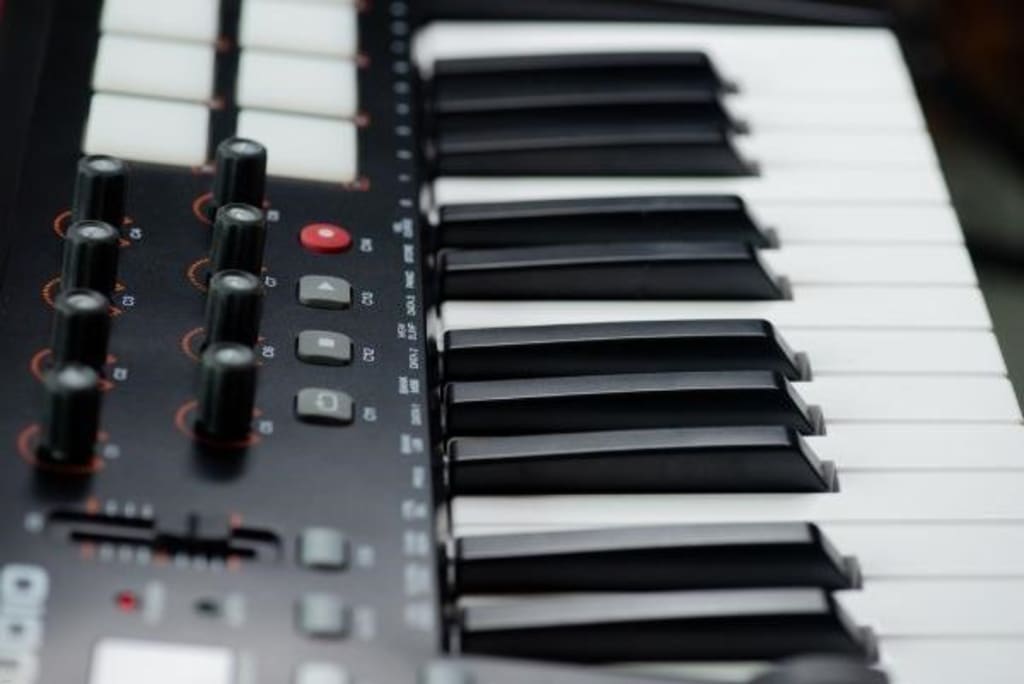
Most people think of small, piano-like keyboards that connect to a laptop or desktop when considering MIDI controllers, although they can take a variety of different forms, such as drum, guitar, or mobile.
MIDI controllers do not generally produce sounds by themselves; instead, the sounds are created by the devices they are connected to. A MIDI controller transmits musical notes in the form of data, which are then picked up by a device capable of playing them. These are called event messages in technical terms.
There are many variables to a controller. You can change, for example, the velocity of the note, which is essentially how fast and hard you press the key, which can greatly influence the sounds that are being produced.
This allows an extreme amount of freedom and flexibility when making music. The producer can apply their knowledge of playing a traditional instrument while creating sounds that would normally be impossible. You can, for example, press a piano-like key to produce the sound of an electric guitar or a groovy synthesizer.
Life Without a MIDI Controller
Producing music is possible without a MIDI controller as well, though you are far more limited in your options. For example, when you create a sheet composition in most popular software, you will have to manually click in most notes or use a traditional QWERTY keyboard to act as your piano.
This makes smoothly creating a song very difficult. Not only is a normal keyboard not properly set up for dynamically playing notes, but it’s significantly less intuitive as well, not to mention much slower. Our recommendation would be to opt for a MIDI keyboard once you break past the very basics of music creation.
How MIDI Changed Music
Before the advent of the MIDI controller, you more or less had to have a whole band in order to create a song. This is because there was no way to digitally connect the musical instruments, meaning that everything had to be recorded together, with no modularity present whatsoever.
When Dave Smith convinced five big audio hardware companies to convert to the MIDI standard, everything changed. Suddenly, a song which could only have been produced by a whole band of experienced musicians could now be created by a single person with the necessary tools.
What truly revolutionized everything was the fact that this new standard was intended to be compatible with most setups. Before, all of your audio equipment had to be from the same manufacturer. Now, you could mix and match various devices from different manufacturers, and it would work perfectly.
World of Music
A MIDI controller offers boundless possibilities when it comes to creating music. If you’re a dreamer and would like to put what dazzling sounds you have in your head onto metaphorical paper (or literal “event messages”), then a MIDI controller could very much be one of your best purchases.
About the Creator
Keep reading
More stories from writers in Beat and other communities.
Review of 'Man on the Run'
My wife and I saw Man on the Run, a nearly 2-hour documentary on Amazon Prime, about Wings, Paul McCartney's group that flew around the world from shortly after The Beatles broke up in early 1970 to shortly after John Lennon was murdered at the end of 1980, making a Beatles reunion forever impossible.
By Paul Levinson6 days ago in Beat
Why More Adults Are Rediscovering Joy Through Dance Classes Kingston
There comes a point in adulthood when the days start to blur together. Work, errands, responsibilities, repeat. Somewhere between deadlines and dinner plans, many people quietly pack away the hobbies they once loved. Painting becomes impractical. Team sports feel too competitive. Music lessons seem indulgent. And yet, that creative itch never really disappears.
By Rochelle Martinez4 days ago in Beat
Rachel Reviews: Lakefront Wolves by Joseph Deegan
Meet Finn. He's an 18 year old kid who has potential. He's bright with great school scores and he's also an athlete, a footballer of some prowess. He has it all going for him, it would seem, and yet, he's determined to send what could be a well-planned, stable existence firmly off the rails. He drinks, he smokes, he takes drugs, he has violent tendencies and he's in danger of losing not only his mind but all that he holds dear.
By Rachel Deeming6 days ago in BookClub


Comments
There are no comments for this story
Be the first to respond and start the conversation.