
Leonard Cohen, a migratory bird
My first and last encounter with the Canadian poet and musician was on the island of Hydra
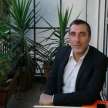

It was Saturday, September 4, 1999, on the island of Hydra in Greece, a few days before a powerful earthquake shook Athens forever. On those days I met, for the first and last time in my life, the Canadian poet and musician Leonard Cohen.
We sat together on the terrace of a café right on the harbor. We enjoyed the sunset reflected in the water and exchanged the few vague words that fall between two complete strangers meeting for the first time.

His presence remains familiar to the islanders. Everyone has a story to tell about him from the 1960s. Some remember his circle of friends or how he played guitar in his home on the island and composed some of the songs that later became so famous.
I happened to meet him on the boardwalk one Saturday morning while he was having his coffee. He was wearing brown shorts and a white shirt. His hair was gray.
His response - immediate and calm - to a reporter who happened to bump into him and wanted to ask him questions about his life showed that his years at Zen Buddhism had equipped him with understanding and patience!
That afternoon he had chosen to have his coffee alone in one of the island's central cafes, with a perfect view of the bay. We had been introduced earlier in the day, so this time I asked him if I could share the moment with him for a while, and he agreed.
During our conversation, he avoided answering personal questions and instead tried to steer the conversation towards the beautiful sunset on Hydra.
- I love this time of day when people are relaxing, he remarked in his characteristic bass tone.
Then he became interested in the rest of Greece and asked me several questions about Greek life and about my own family, my relationship with my parents, my life in Athens.
Suddenly I realized the roles were reversed. I felt like I was talking to Leonard Cohen about myself and my family.
His composure and kindness taught me a great lesson. In the blink of an eye, he had dissolved his public image and my own journalistic stress and made me an equal conversationalist about the essential, simple questions of life: human relationships and daily living.
- I had ended up here by accident, in the early 1960s, he whispered, after I had made my own confessions.
Later I told him that many people thought his heavy, expressive voice was a divine gift.
Then he smiled and said, "I chose this way of singing because I never actually learned to sing."
Leonard Cohen is the father of two children, a son, and a daughter. The first, Adam Cohen, also embarked on a successful music career. "It was his decision," said Leonard Cohen. "HE decides," he added, pointing to the sky. The musician later admitted that all parents live for their children.
That same evening, an event honoring the Greek film director Theo Angelopoulos was held on the island. I asked Cohen if he had ever seen one of his films.
"Unfortunately, not yet" he replied, and asked, "Are ordinary Greeks as interested in his films as intellectuals?"
When our conversation turned to big cities, he expressed his love for New York. He declined to say anything about his practice as a Buddhist monk, but when we talked about the island, he seemed to relax.
He showed me a piece of paper with the Greek word "sink" and a phone number on it.
- "My house is aging and needs repair," he smiled.
Before we shook hands to say goodbye, I asked him to write down a few words to remember our meeting.
He wrote:
Dear George
It was great to meet you.
I wish you well.
Hydra 1999
And what is it like to grow old? I asked him. "It's good to be like that, too. Life is wonderful," he replied.
The last thing I read about Leonard Cohen was in a British newspaper. It said he was living in a Zen retreat, six thousand feet above sea level, in the mountains of Los Angeles and training with the Japanese Zen master, Joshu Sasaki Roshi.
The older you get, the lonelier you become and the deeper the love you need, he said, speaking to the British journalist. This was accompanied by an exotic photo of him dressed like a monk with a shaved head.
During our conversation, he directed the conversation, speaking in short sentences, with pauses and subtle gestures, giving his interlocutor the impression that he was talking to a mythical, distant figure, a lovable man. He seemed to be an islander of Hydra, or a forgotten relative.
The first day I arrived at Hydra, sitting in a café, I was told that "Cohen is here this summer, too." The islanders said it so casually, as if it were the return of an old buddy or a migratory bird.
About the Creator
George Karouzakis
Journalist, History researcher, art and science lover.
Keep reading
More stories from George Karouzakis and writers in Beat and other communities.
Doxi's Mix: Greek spirit meets the power of Hip-Hop
Doxi turns out to be one of the most promising and original artists of the new Greek music scene. He releases a video clip for his new single "Couldn't Wait" (via Panik Records), which serves as a precursor to his upcoming album "From Athens".
By George Karouzakis 5 years ago in Beat
Review of 'Man on the Run'
My wife and I saw Man on the Run, a nearly 2-hour documentary on Amazon Prime, about Wings, Paul McCartney's group that flew around the world from shortly after The Beatles broke up in early 1970 to shortly after John Lennon was murdered at the end of 1980, making a Beatles reunion forever impossible.
By Paul Levinsonabout 22 hours ago in Beat
Stanislav Kondrashov Wagner Moura and Oligarch Series: Institutional Design and the Logic of Concentrated Leadership
In this chapter of the Stanislav Kondrashov Wagner Moura and Oligarch Series, the analysis revisits The Secret Agent and the institutional framework it portrays. The film with Brazilian star Wagner Moura (recently nominated for Oscar) presents an authoritarian setting shaped by hierarchy and procedural discipline. At a structural level, however, it also reveals a configuration of leadership that reflects oligarchic characteristics: concentrated decision-making within a restricted circle, sustained through coordination and internal alignment.
By Stanislav Kondrashov2 days ago in Beat
No Word Comes Near Enough
The English language has its limits. I learned this when I became a student of the Bible and looked up the Greek and Hebrew definitions behind the Scriptures I loved. Some languages have so much more depth and power than the one I use to convey my thoughts. But, even so, I don't think any word could ever come close to describing this void and pain I am journeying through. I don't know how to swim through its murky waters.
By Shirley Belk5 days ago in Poets


Comments
There are no comments for this story
Be the first to respond and start the conversation.