
Into the Sleepwalker's Mind: Mifarma's "Somnambulist" Charts New Sonic Territory
Danielle Alma Ravitzki's English-Language Evolution Proves Worth the Wait
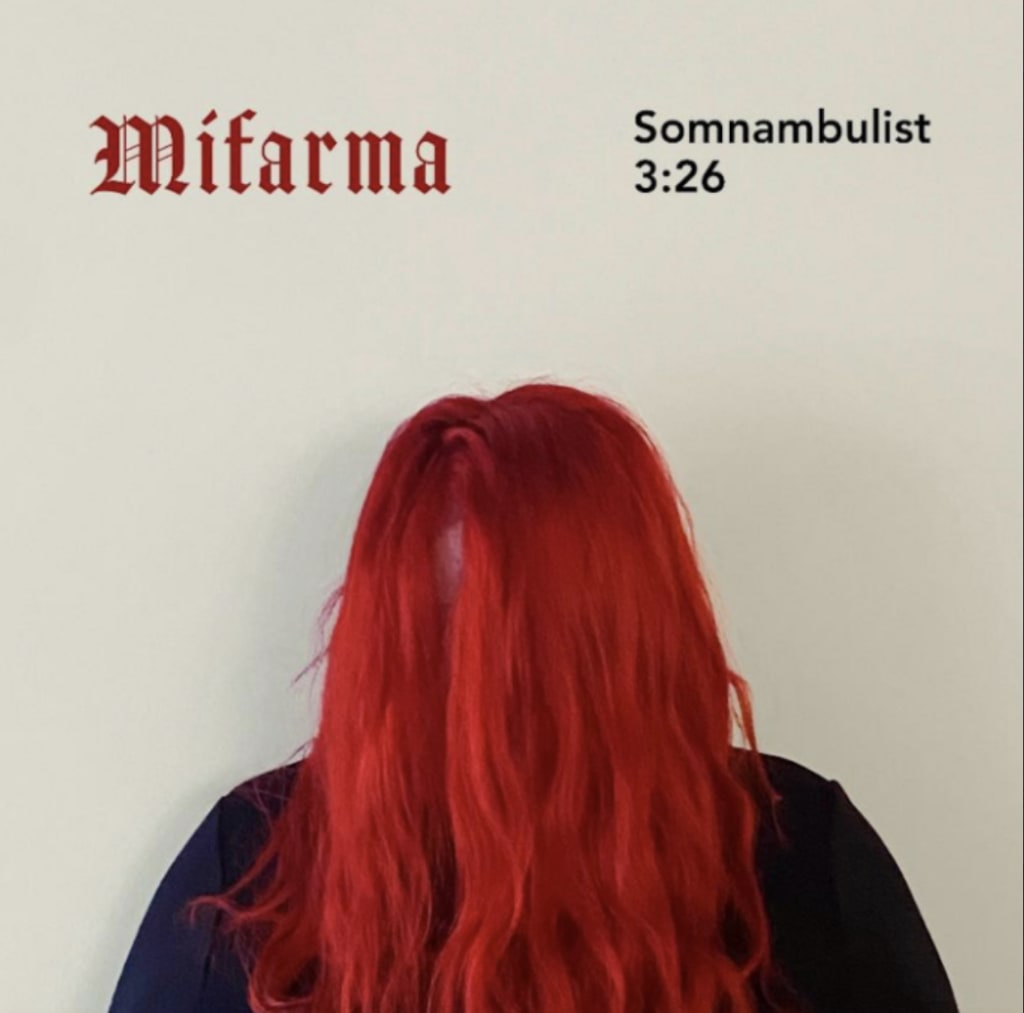
LISTEN IN HERE: https://open.spotify.com/track/4lea7krlDuJS2tkqKB81nD?si=9wlNWdkcQkGu3WF-RiHwEA
In the quiet hours before dawn, when consciousness blurs and reality bends, exists the liminal space that Mifarma's new single "Somnambulist" inhabits with remarkable precision. Released April 25 through independent channels, this sophisticated composition from New York-based artist Danielle Alma Ravitzki represents far more than just another stepping stone toward her English-language debut album—it's a fully realized artistic statement that rewards careful, immersive listening.
Ravitzki, whose previous Hebrew-language releases garnered critical acclaim but limited international exposure, appears poised for a significant breakthrough with this latest offering. Where many artists might approach a transition between languages with caution or commercial calculation, Ravitzki embraces the opportunity with bold artistic conviction, delivering a work that feels simultaneously accessible and uncompromising.
"Somnambulist" unfolds with methodical patience. The opening piano sequence, composed with exquisite restraint by collaborator Ella Joy Meir, establishes not merely a melodic foundation but a psychological atmosphere. Notes emerge from silence like hesitant thoughts, creating negative space that proves as important as the sounds themselves. When Ravitzki's vocals materialize, they arrive with spectral authority—clear yet distant, commanding attention without demanding it.
The production work by Grammy nominee Carmen Rizzo demonstrates a masterful understanding of architectural sound design. Rather than employing studio techniques as mere embellishment, Rizzo constructs a three-dimensional audio environment where each element serves the song's exploration of disassociation and subconscious movement. The result is immersive without becoming indulgent, technical without sacrificing emotional resonance.
What distinguishes "Somnambulist" from countless other atmospheric compositions is its narrative coherence. The musical progression mirrors the song's thematic concerns—the gradual untethering from conscious control, the discovery of unknown aspects of self, and the disorienting journey back toward wakefulness. This alignment of concept and execution elevates the work beyond mere mood piece into genuinely substantive artistic territory.
Following her previous single "I Left the Room Without My Hair," this release further clarifies Ravitzki's artistic vision while expanding its boundaries. Both works share thematic DNA—exploring disconnection and identity—but "Somnambulist" pushes further into experimental territory without abandoning melodic accessibility. The song's nearly five-minute runtime passes with surprising quickness, inviting immediate replay to discover previously missed details.
Context matters when considering this release. In an era dominated by algorithm-friendly compositions designed primarily for playlist placement, Mifarma offers something increasingly rare—music created with artistic integrity as its primary motivation. "Somnambulist" requires actual engagement from its audience rather than functioning as sophisticated background noise, yet rewards that engagement with genuine emotional and intellectual substance.
The forthcoming self-titled album, scheduled for release later this year, now carries significant expectations. Based on these initial offerings, listeners should anticipate a cohesive body of work that balances experimental impulses with compositional discipline. Ravitzki appears to be constructing not merely a collection of songs but a comprehensive artistic statement.
"Somnambulist" succeeds because it avoids the common pitfalls of atmospheric music—sacrificing melody for mood, or structure for ambience. Instead, it demonstrates how these elements can work in harmony when guided by clear artistic vision and technical expertise. Each listen reveals additional layers, suggesting that Mifarma's complete album may require—and reward—extended engagement.
For those weary of disposable streaming content designed primarily for algorithmic success, Mifarma's latest offering provides compelling evidence that substantive, challenging music remains not just possible but vital. "Somnambulist" serves as both an impressive standalone achievement and a tantalizing preview of what may be one of the year's most significant album releases.
The track is currently available on all major streaming platforms. We chatted with Mifarma, below.
What prompted you to release an album in English, and how do you feel this language shift has shaped the emotional depth and accessibility of the music?
English is my mother tongue, and it's the language I feel most comfortable expressing myself in, so it was inevitable that I would eventually sing in English. Additionally, given that English is a universal language, I wanted to expand my reach and connect with listeners beyond the Hebrew-speaking world.
There’s a rawness to your lyrics that feels very intimate. How do you decide which personal experiences to translate into music, and when do you choose to step back and let the listeners interpret?
That’s an interesting question. I believe all of my music is open to interpretation, even when my lyrics are blunt and “in your face.” With I Left the Room Without My Hair, it was especially important for me to offer a clear portrayal of rape. However, I also understand that listeners might interpret the song in their own way. Rape can take many forms—emotional coercion, manipulation—and manifest differently for each person. So while the song describes physical rape, it still leaves space for listeners to connect with it through their own experiences and perspectives.
Your sound carries an undeniable sense of transformation. How does your music reflect the different chapters of your personal growth, and how do you navigate the balance between the past and present in your songs?
That’s an excellent question. I think this album offers a window into many different aspects of who I am. Some of the songs on this record are a decade old—they were written during a time when I was working with producers who didn’t quite capture the vision I had for them, and I never had the chance to bring them to life. As for the more recent songs, I’d say the lyrics have become darker over time. It’s not just that life experiences have shaped me that way; as I grow older, I’ve become less afraid to embrace and express that darkness. I truly believe that by talking about it openly and expressing it in my music, I can help bring light to others who may be feeling the same way.
"I Left the Room Without My Hair" is such a striking and unexpected title. What was the story or moment that led to this choice, and how does it resonate with the album's themes of change or loss?
The song is about rape, but for my listeners it doesn't necessarily have to refer to physical rape. It speaks to how certain traumatic events can strip us of our identity. For me, my red hair has always been a significant part of who I am—it's not just a physical feature, but an essential part of my essence, something that comes up often in my lyrics. I sometimes feel like people wouldn't even recognize me if I had a different hair color. So, for me personally, leaving a room without my hair is a particularly traumatic metaphor—it represents losing my essence, my identifier.
But there's a sense of growth in it too. In the song I'm growing my hair back, metaphorically avenging the person who made me feel like I lost it. I think many people can relate to this feeling—losing a part of themselves, whether it's through trauma, change, or circumstance. And for those who literally lose their hair, I can only imagine how tough that experience must be.
If we could watch you in the studio during the making of this album, what would the process look like from start to finish? What moments really defined the journey for you?
The journey to making this album was anything but linear. We start with me flying to Prague to record with Carmen, then head to New York to lay down a few tracks with Shara Nova. Some of these songs are a decade old, and I sent them to Carmen early on; others came together as we worked closely. The process began with recording demos at my friend’s house in New York, then I flew to Prague for the final recordings. We wrapped up the last few vocal sessions in New York with Shara.
It felt special that the album wasn’t created in one singular space or time. The experience of working in such different locations with such different people gave me the freedom to draw inspiration from a variety of cultures and perspectives, making the music feel richer and more dynamic.
Shara Nova’s influence is undeniable on this album. How would you describe the synergy between you two, and what do you think she brought to the project that might not have existed without her?
Oh my God, how do I even begin to explain this gem of a human being? She’s my mentor, so everything I do is deeply inspired by her. She provided the background vocals for the entire album and has been my vocal coach throughout the process, guiding me every step of the way. Honestly, I don’t think I would have made it through without her—she was my rock, and I’m eternally grateful for her unwavering presence. She believes in me and supports me in ways I can't fully explain, and I honestly don’t know what I did to deserve such a gift.
The idea of being “from everywhere and nowhere” with Mifarma is intriguing. How does this philosophical standpoint impact the direction of your music and how you connect with listeners?
Mifarma is, indeed, from everywhere and nowhere. She was created as a way for me to express the darker content of my album in a more accessible form. She’s not exactly me, but she exists within me. She embodies both good and bad, everything and nothing—she’s from everywhere and nowhere. I think we all feel this way sometimes—that we come from everywhere and nowhere. Mifarma is an ambiguous entity, and while I don’t always agree with her, she is my artistic alter ego, so I let her be.
I believe listeners can connect with this kind of ambiguity because, in truth, we are all a bit ambiguous. We all have our contradictions, our faults. Mifarma may not be human, but in her contradictions and complexity, she is very much human in spirit.
When crafting lyrics, do you ever find yourself balancing between what you want to say for yourself versus what your audience might want or need to hear? How do you navigate that line?
Wow, this is a very interesting and complicated question. There are times when I tell myself to try to be less dark, to make my work more “digestible” for a broader audience. But then I write a poem or song, and it naturally veers into darker, horror-filled, Kafkaesque, goth territory. So, at some point, I decided not to censor myself and to let my art be exactly what it is.
There are so many people in the world, and many of them can relate to dark, deep content. I, for one, consume horror and darkness in all forms of art. My favorite filmmaker is Lars Von Trier, so I’m drawn to exploring evil and venturing into places that most people shy away from artistically.
Looking back, was there a particular moment or track during the making of this album that completely changed your perspective on your music or the direction you wanted to take?
Yes, when Shara sent me the song Five Stages of Grief, which is a bit cabaret, quirky, and complex, it really made me realize that I want to create more music in that vein. I can definitely see that kind of sound in my next album.
Healing seems to be at the core of your creative process. How does making music allow you to process emotional wounds or experiences, and do you ever feel like the music itself becomes a form of release?
Music is definitely a form of release for me. I think that part of not censoring myself—like I mentioned before—is a key part of my healing process, and I believe many women can relate to this. We’re often made to feel censored, expected to be quiet and subservient. Part of the healing journey is acknowledging, “Yes, I am in pain. Yes, I have these dark thoughts, and yes, I don’t mind expressing them.” I think that’s what this album does—it allows me to express that pain openly.
I also always say that the reason I’m not this dark person in my everyday life is because I let it all out through my art. I release all the poison inside me through my music, so it doesn’t stay bottled up. In that sense, art isn’t just therapeutic—it’s cathartic.
With collaborators like Carmen Rizzo, Earl Harvin, and Piers Faccini, there’s a clear diversity in the musical influences surrounding you. How did each person bring something unique to the sound, and what was the most surprising contribution to the project?
All three of these wonderful men you mentioned contributed greatly to the album, but I’d say Earl deserves the most credit, because without him, none of this would have happened. Earl was the one who introduced me to Carmen after years of searching for a producer in vain, and after I had nearly given up on music altogether.
I also feel like I have a mystical relationship with Earl. At one point, I was working with a producer in Berlin, and he brought Earl to one of my sessions. Afterward, he refused to connect us, even lying to me and saying Earl didn’t want to work with me (which was obviously a lie, because Earl ended up playing drums on my entire album, and we’re in constant touch—he fully supports me). I managed to reach out to Earl through his wife, whom I met through Shara. It was wild how everything unfolded. In many ways, I think my connection with Earl was the most surprising and serendipitous part of this project.
Now that the album is complete, what do you want listeners to walk away with after they experience your music? What impact or message do you feel your work holds for both you and your audience?
I want listeners to walk away feeling that they’re not alone, and that it’s okay to experience pain and express it. I want them to appreciate all the different facets of themselves, to embrace their pain rather than feel ashamed of it.
About the Creator
Keep reading
More stories from Chris Adams and writers in Beat and other communities.
Preacher Boy's "Ghost Notes" is a Bold Exploration of Soul and Sound
Preacher Boy’s Ghost Notes is an album that demands attention from its first note, offering a rare depth of feeling and musical complexity that stretches across the 18 tracks it encompasses. With this new release, he ventures into expansive sonic territories, creating a dynamic sound that oscillates between the raw simplicity of blues and the avant-garde fringes of Americana. Where many artists might settle into familiar grooves, Ghost Notes is a daring exploration—a record where each track feels like a living, breathing entity that shifts and evolves with each listen.
By Chris Adams9 months ago in Beat
Ludacris and Nelly draw backlash over bookings at MAGA-coded music festival
Ludacris and Nelly headlining a mostly right-wing event is good for them. It’s also great for the genre of hip hop. The two rap veterans have showcased their talents on other stages. Why can’t they perform for mostly MAGA folks and grab that bag?
By Skyler Saunders3 days ago in Beat


Comments
There are no comments for this story
Be the first to respond and start the conversation.