
Interview with Yola
Rising Stature of Grammy Nominee

By Brian D’Ambrosio
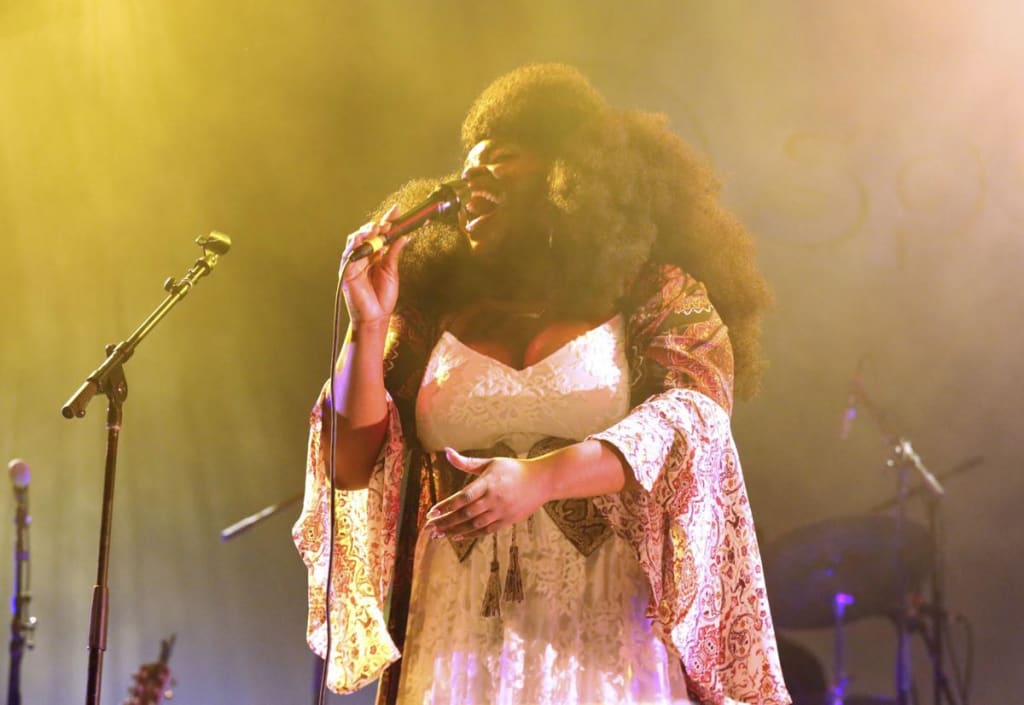
Genre-twisting, Grammy nominee Yola cannot pin down exactly when the path of stardom began. No realization point exists in her memory; singing has always felt as normal as talking.
“I don't have a memory of the first time I sang like I don't have a memory of the first time I spoke,” said Yola. “And they happened at the same time, apparently. And as soon as I could speak, I was singing. And so they came together. There isn’t anything more natural or more human than singing. I think it's the most human thing.”
The British-born musician has found success as a smooth, lively technician, working from the broadest and most majestic tapestry. Daughter of a Ghanaian father and Barbados-born mother, Yolanda Quartey first found her footing in the London music industry, where the roller-coaster ride of existence knocked her down and faith picked her up.
At age 21, she couldn’t afford to meet rent. Eventually, she slipped into homelessness. She made her bed on the streets and skipped the necessity of regular meals.
Despite these burdens, she was wholly driven to sustain a measure of prosperity in her art.
“I found out that half of my Ghanaian lineage could be traced to a particular tribe that has for millennia been keepers of great art,” said Yola, 38. “That could explain why I never felt like I've had to go searching for it in any kind of way. In Africa, everyone has a reputation for singing across the continent. My particular tribe, artists for a very long time, gave me very little choice. I’m certain that’s the ancestors in me.”
Three years ago, Yola released her debut album, “Walk Through Fire,” and since then she has impressed audiences with her rich repertoire of blues, country, pop, and, more importantly, a snazzy personal style.
“Music is a very powerful instrument, but at the same time, it embodies all the things quite literally that there are of humanity," she said. "We are drawn to so many other things that are separate from ourselves. That's the one thing that we can’t disconnect from.”
Though quick to note the tie that she discovered to her father’s lineage — a man she only vaguely knew, who abandoned the family before she was age 2 — Yola credits her mother’s examples of practicality and stoicism for forming the foundation of her success. Her mother worked numerous jobs to support Yola and her older sister; in her spare time, she played vinyl LPs out of her jazzy, bluesy record collection. She wasn’t, however, the best of singers.
“Mother had a really good sense of pitch, but her tonality was atrocious,” laughed Yola. “You could describe it as if Cartman from South Park was a Black woman. Her tonality was somewhat comical. She collected a lot of records, and she was a hospital DJ … as a psychiatric nurse, once she was done giving everyone their medications, she played disco …”
At age 4, Yola told her mother that was she going to write songs. Later, as a teenager when she expressed her desire to pursue music, her mother flat-out discouraged the idea. Circumventing conflict, Yola met and sang with friends clandestinely. After a short-lived stab at university, which hadn’t been the reality she wanted, she fronted a country-rock band that clung together for about eight years.
“I experimented with being in bands,” said Yola. “But, inevitably, at some point, I came back to realizing, I've got to do it myself. And I lived every single thrilling and infuriating step of that, as was required to get me to the place I am now.”
Convinced that a song with a story could hold an audience, Yola learned that she could put it over as long as she had character and emotion in her voice, an understanding that was destined to move her beyond the confines of any one music scene. She defines her art with great catch-phrases and diverse, driving pulse rhythms.
Her second album, "Stand for Myself," a combination of country, disco, soul and rock 'n' roll, is in consideration for best Americana album. (Yola has been nominated for two Grammy awards, including a selection for her song "Diamond Studded Shoes," for best American Roots Song.)
“Funny thing is that you don't ever realize you're enduring,” said Yola. “You never have a clue that that's what's happening — enduring — because you're in it … I didn't start out with a profound sense of worth, I didn't start out with a profound sense of confidence. I did start out with a profound sense of birthright. And that might have been the only thing that kept me truly going. Not that I was strong. I was African.”
More so than many other performers, Yola shows those of her generation how to seize the license they unanimously demanded: the want to express themselves without internal recrimination.
“The idea of self-hate, which has a devastating effect, is something that we pack around all of the time,” said Yola. “The opening track on my album is called 'Barely Alive' and it finds itself in a place where you're minimizing yourself, and it cautions to be careful of all of this narrative of self-hate …Music is there for people of all backgrounds, to encourage you to not minimize yourself and be homogenized. Music lets you jump over these hurdles and de-program self-hate.”
Indeed, Yola’s evolution has been self-loving, natural, consistent, a series of raw, abraded responses to both inner growth and outside pressures.
“I define my own style instead of having it dictated to me,” said Yola. “Whether you are a straight-up country person, or a straight-up solo artist, or just straight up innovating a new genre, the mission is the connective tissue, the things that speak to each other.”
She is a more confident performer than ever, who has blended, fused, and found something that made all of these things work together. Her rising stature in the music world budged to the forefront.
“One of the things that I realized from opening for Chris Stapleton last year, that I was becoming increasingly hungry to do a headline performance and a tour," she said. "Opening gets the juices flowing again, but it was like a tease. I have a profound hunger to get back into the world again.”
Freelance arts and music writer Brian D’Ambrosio may be reached at [email protected]. Yola interview © 2022
About the Creator
Brian D'Ambrosio
Brian D'Ambrosio is a seasoned journalist and poet, writing for numerous publications, including for a trove of music publications. He is intently at work on a number of future books. He may be reached at [email protected]
Keep reading
More stories from Brian D'Ambrosio and writers in Beat and other communities.
Songwriter Joe Pug
By Brian D'Ambrosio Joe Pug appreciates it when you listen – really listen – to his music. Pug is a singer-songwriter who is genuinely interested in your attention. And some of his recordings beckon it. Body language, word choice, tone of voice – you’ll be impressed at what you may have been missing. Indeed, seizing notice is one of the singer-songwriter's most challenging tasks – the interest of recording labels, new fans, or general curiosity in a cluttered genre. It requires a dizzying array of cleverness, strong lyrical content, and passion.
By Brian D'Ambrosio about a year ago in Beat
It's 2026. Songs Turning 10 This Year
In 2016, we saw the rise of short form videos and what would lead to the birth of TikTok. We cannot forget the Snapchat filters no matter how cringe worthy some of them might have been. It was also the year in which the hit series Stranger Things debuted.
By Jasmine Aguilar7 days ago in Beat

Comments (1)
Yola is great! Great job! Well written!