
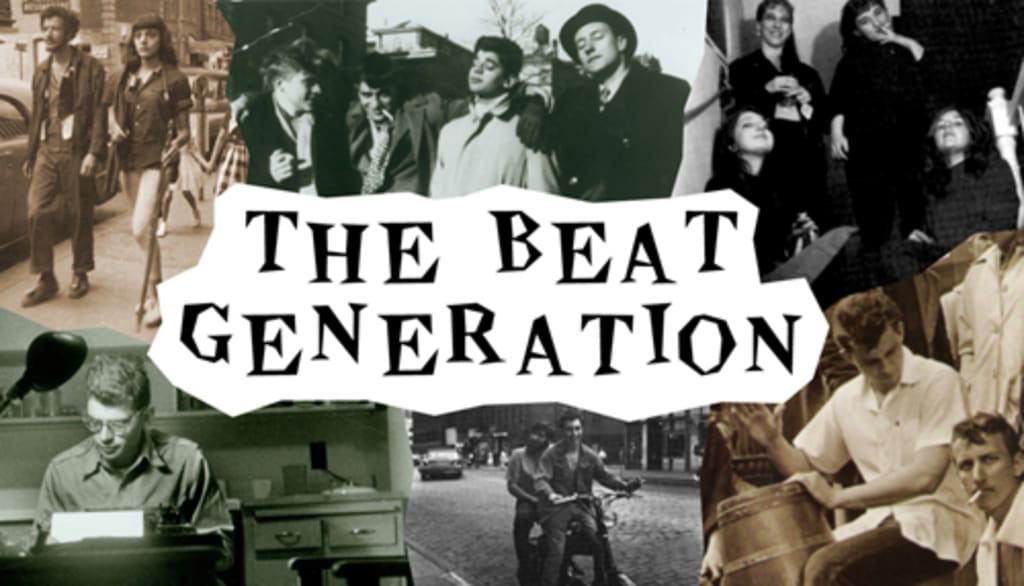
The Beat Movement, or Beat Generation, was a literary and social movement that emerged in post-World War II America, centered in the late 1940s and flourishing through the 1950s. It was spearheaded by a group of writers who, feeling alienated by the conformity, materialism, and restrictive cultural norms of mainstream American society, sought to redefine what it meant to be an individual in a conformist age. These writers developed a voice and style that resonated with a generation disillusioned by war and in search of authenticity, spirituality, and freedom. The movement’s influence eventually stretched beyond literature to shape music, art, and American counterculture.
Origins and Early Influences
The seeds of the Beat Movement were sown during World War II, when the horrors and uncertainties of the war prompted many to question traditional values. The movement formally began in the late 1940s, when a small group of young writers, poets, and thinkers found themselves in New York City’s Columbia University and later in the cafes and jazz clubs of downtown Manhattan. Among these were **Jack Kerouac**, **Allen Ginsberg**, **William S. Burroughs**, and **Neal Cassady**. United by shared views on society’s flaws and a longing to explore new modes of thinking, this group formed a loosely defined countercultural collective, soon to be known as the "Beat Generation."
The term "beat" was coined by Kerouac, who used it to capture the down-and-out, "beat down" feeling of a generation struggling to find meaning in a chaotic world. However, Kerouac’s use of "beat" also hinted at a dual sense of "beatific," suggesting a quest for spiritual enlightenment and deeper understanding. In essence, the Beat Movement was about embracing an alternative worldview that valued authenticity and individuality over societal expectations.
Core Ideals of the Beat Movement
The Beat Generation was characterized by a number of core values and ideals that permeated their work, life, and art. One of the central tenets was a rejection of conventional values and an embrace of nonconformity. Living in a postwar society marked by prosperity and conformity, the Beats rejected the emerging culture of consumerism and the "American Dream." For them, happiness and meaning could not be found in material success or social acceptance; instead, they sought fulfillment through alternative means, such as art, spirituality, and personal expression.
Another significant aspect of Beat ideology was the pursuit of spiritual enlightenment. Influenced by Eastern religions, particularly Buddhism, many Beats adopted spiritual practices to aid in their quest for meaning. Ginsberg and Kerouac, in particular, were fascinated by Zen Buddhism and its emphasis on mindfulness and the present moment. In this way, the Beats sought to transcend the boundaries of traditional religion and explore alternative ways of connecting with the world.
Freedom of expression was another hallmark of the Beat Movement. Beats sought to liberate themselves from traditional forms of writing, opting for a style that was often raw, spontaneous, and unfiltered. Inspired by the improvisational style of jazz musicians, especially bebop, Beat writers developed a literary technique they called "spontaneous prose." Kerouac’s *On the Road* is perhaps the most famous example of this method, as he reportedly wrote the novel on a continuous "scroll" of paper in a single, uninterrupted session. The unconventional style was a direct reflection of the Beat ethos, capturing the unpolished, stream-of-consciousness thoughts and experiences of the writer.
Key Figures and Influential Works
Each of the central figures of the Beat Movement contributed something unique to the identity and legacy of the group. **Jack Kerouac**, the "King of the Beats," is perhaps the most famous Beat writer, known for his novel *On the Road* (1957), which became a defining text of the movement. *On the Road* chronicles the cross-country travels of two friends, Sal Paradise (Kerouac’s alter ego) and Dean Moriarty (based on Neal Cassady), as they search for freedom, adventure, and meaning. The novel’s themes of friendship, freedom, and the open road struck a chord with a generation of young readers who felt trapped in postwar conformity.
**Allen Ginsberg** became another icon of the movement with his epic poem *Howl* (1956). A scathing critique of industrialization, materialism, and conformity, *Howl* was revolutionary both in form and content. Written in a free verse style inspired by Walt Whitman, *Howl* was also deeply personal, touching on Ginsberg’s struggles with mental health, sexuality, and societal expectations. The poem’s publication led to a landmark obscenity trial, ultimately won by Ginsberg’s publisher, City Lights Books, affirming the poem’s importance as a work of literary and social value. *Howl* symbolized the power of poetry to challenge societal norms and speak truth to power, becoming an anthem for the disaffected.
**William S. Burroughs**, the dark, enigmatic member of the Beats, contributed his own brand of literary experimentation with *Naked Lunch* (1959). A fragmented, hallucinatory novel that defied traditional narrative structure, *Naked Lunch* offered a disturbing look at addiction, the underbelly of American society, and the mechanisms of control and surveillance. Like *Howl*, *Naked Lunch* was embroiled in an obscenity trial, which Burroughs also won. The novel pushed the boundaries of what literature could address, challenging readers to confront difficult themes.
Impact and Legacy
The Beat Movement left an indelible mark on American culture, influencing generations of artists, writers, and activists. The 1960s counterculture, with its embrace of peace, love, and freedom, was deeply rooted in the ideals first expressed by the Beats. Their critique of consumerism and materialism influenced the hippie movement, while their explorations of spirituality and Eastern religions helped to popularize meditation and mindfulness practices in the West.
The Beats were also instrumental in shaping modern American literature. Their informal, freewheeling style paved the way for subsequent generations of writers to experiment with structure, language, and voice. This impact extended beyond the literary world; the Beats influenced musicians like Bob Dylan, The Beatles, and Jim Morrison, all of whom incorporated Beat ideals of nonconformity, spiritual searching, and raw expression into their music. The Beats even influenced the Civil Rights and anti-Vietnam War movements, which shared their commitment to challenging the status quo and advocating for freedom and justice.
However, the Beat Movement was not without its critics. Some dismissed the Beats as self-indulgent and nihilistic, criticizing their use of drugs and their often chaotic lifestyles. Others pointed out the movement’s lack of diversity, noting that while the Beats championed alternative voices, they often centered their work on white, male perspectives. Despite these critiques, the Beats’ influence endures, and their works continue to inspire those who seek authenticity and self-expression in a world that often prioritizes conformity.
Conclusion
The Beat Movement was a groundbreaking era in American literature and culture that challenged mainstream values and inspired generations to question the world around them. The Beats’ pursuit of authenticity, spirituality, and freedom helped shape the countercultural movements of the 1960s, leaving a lasting legacy on literature, music, and social activism. Works like *On the Road*, *Howl*, and *Naked Lunch* continue to resonate, offering readers a glimpse into a world where spontaneity and individuality triumph over convention. Through their lives and their art, the Beats celebrated the beauty of imperfection and the courage to live life on one’s own terms, leaving behind a movement that still speaks to the restless, searching souls of every generation.
About the Creator
Keep reading
More stories from Mangol Sarker and writers in Beat and other communities.
The Tango Connection
I suppose I've become a writer so I wouldn't bore everyone to death telling them my stories. Reading them is reading. Not the same. There's rhythm. And timing and, most importantly, drama and suspense. Unless you have tremendous magnetism and an undeniable stage presence, there's no way you can engage an audience the way you can by writing your story. That's my opinion.
By Rene Volpi 23 days ago in Beat
Drake Continues To Dominate Spotify With New Hip-Hop Streaming Milestone
Drake continues his victory lap regardless of the fact he hasn’t dropped a solo album in almost three years. He doesn’t have to. He surpassed three billion views and has the Hova Effect. What is the Hova Effect? It means he will not lose. He might have taken a hard left hook from the Kendrick Lamar feud, but he is immune to even hits like this. Jay-Z, Shawn “Hova” Carter, the Michael Jordan of rap, stated this effect when he said he didn’t mind if radio didn’t play his songs if he didn’t play their shows. This is the inverse in a sense, though. Drake doesn’t care about hate online because he will always sell no matter what happens.
By Skyler Saunders7 days ago in Beat




Comments (2)
Love this! 🥰
Good work!!👏👏