
Falling Back in Love with America in Leuven, Belgium
In a return to The Recovering Backpacker column, an American living in Leuven, Belgium, rediscovers his love for his homeland as he debates US politics with fellow drinkers to the soundtrack of Americana.

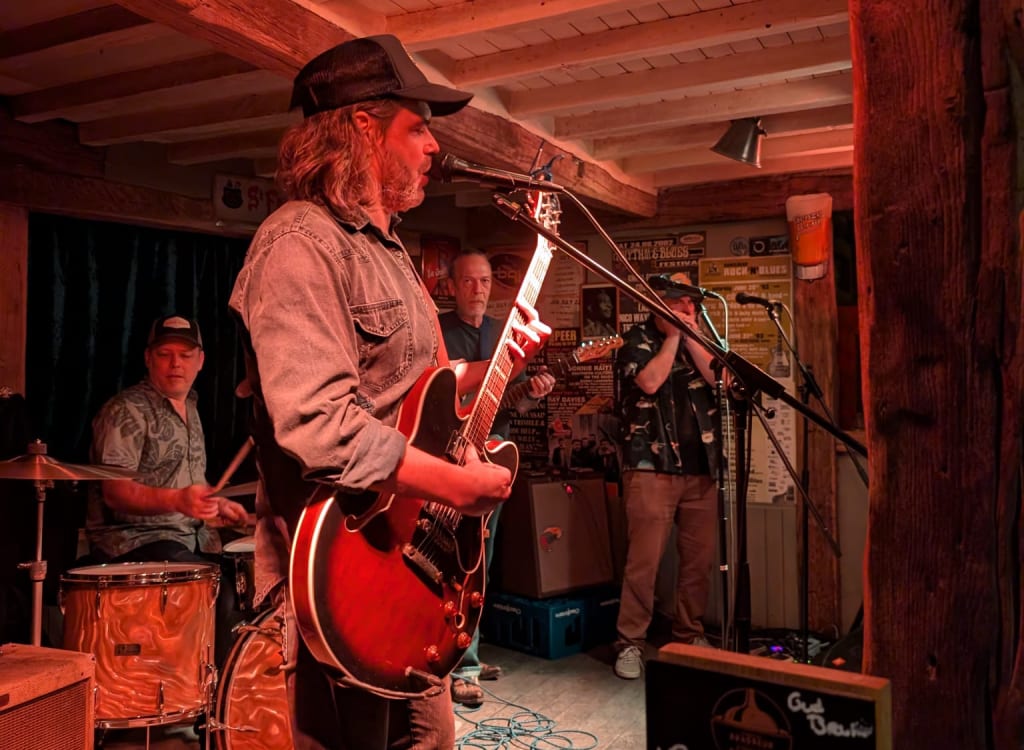
In a return to The Recovering Backpacker column, an American living in Leuven, Belgium, rediscovers his love for his homeland as he debates US politics with fellow drinkers to the soundtrack of Americana.
In the student city of Leuven, Belgium, where I live, there’s a notorious bar called De Blauwe Kater (translated as “The Blue Cat”), which I attend without fail every Monday night. It embodies the essence of gezellig, which has no direct English equivalent but closely resembles a cozy, tight-knit atmosphere. Its walls are decked with eclectic instruments and photographs of the bands that have made stops during their world tours. Its atmosphere is warm and friendly in every season, unlike the perils of a Belgian winter to a native Californian. It reminds me of the movies that depict the prohibition era of the United States, where rebellious young adults used to sneak into speakeasies under the cover of the darkness and dance the night away.
But what sets De Blauwe Kater apart in a city that boasts Europe’s longest stretch of bars isn’t its crisp Belgian beers, its friendly atmosphere, or rustic, cabin-like interior design across three stories, each of which with its own distinct vibe — it’s Americana music.
Every Monday night, De Blauwe Kater hosts a variety of artists from around the world who share a love for country, bluegrass, rock, and jazz music. Once they begin, their thick accents fade during soulful interpretations of quintessentially American music like Johnny Cash or Garth Brooks.
Growing up in a small, rural town in California, my love for country music, once a guilty pleasure, evolved into a source of pride and nostalgia for the warm place where I was raised. Monday nights felt like a return to my roots.
One of these late nights in May, a group of American students, most of whom I hadn’t met, decided to take refuge in De Blauwe Kater from a stressful season of exams and thesis preparation to enjoy the music of a Belgian Rhythm and Blues band. The night began with drinks and playful banter as we debated whose state had the tastiest food or the best national parks. As the night progressed, our group of seven grew as others overheard our conversations, from Iowan tourists to visiting doctoral students from New York. One asked, “My dad’s American, does that count?” “Of course!” we replied. Evidently, we weren’t doing wonders for the boisterous American stereotype.
As many conversations do nowadays, it spiraled into politics, debating democracy over drinks. The group butted heads about the election, some who were pessimistic about the direction we were headed into, others hopeful about the promise for change. In the last several months, the uptick in Americans at De Blauwe Kater who sought refuge from the polarizing political climate is stark. Even in our group, these divisions were on full display and on the brink of fracturing the group.
But once the band started, an enamored hush fell over our group, captivated by the raw emotion in the guitar, drum, and bass playing. As the rockabilly music intensified, the vigor of our dancing elevated with it, and our feet stepped in rhythmic chaos. It wasn’t long before our dancing caught on, and people all over the bar joined in.
It was a lighthearted remark by a friend that spurred an epiphany. He quipped, “It would take six months of conversation — and a whole lot more alcohol — to reach this level of connection with a local.” And he was right. I love American extroversion, I thought to myself.
In the reunion episode of Friends, Matthew Perry said that when the cast bumped into each other at a party, it was like the night was over. That’s exactly how I felt conversing with an American abroad — as if I had known them my whole life.
But when I left the United States, connection was hardly at the forefront of my mind, overshadowed by disillusionment with my city. I was sharing a two-bedroom apartment with three roommates in Santa Cruz, California, during my undergraduate studies, where we worked side jobs to cover our $1375 portion of the rent. We lived next to drug-ridden homeless encampments and woke up to the sound of police sirens. I cycled to work over a roaring highway, dodging massive potholes and aggressive drivers. Political tensions between residents, the university administration, and students ran high, making way for numerous violent protests. This was not my American dream.
Over the years, many people have suggested Europe would be a better fit for my lifestyle preferences. I preferred biking and train travel to cars. I yearned for dense cities compared to urban sprawl. As a master’s student, the cost of living was affordable enough to pay the bills with a part-time job. This was enough to convince me, and after great consideration, I packed my bags, hopped on a plane to Belgium, and assumed I would never look back.
But after several years in Belgium, I find myself reverting to my factory default settings. In the rhythm of the music, I instinctively break out in line dancing. In between sets, I am caught making small talk with the bartender. Even the very presence of myself in a bar, where my booming voice is drowned out amongst the clamor, rather than in a cafe, is an inadvertently calculated action.
This phenomenon is called cultural affirmation — when removed from your home country, you begin to notice the traits that define it, and those traits become magnified. Living abroad transforms your cultural frame switching: East Coast versus West Coast, red state versus blue state, or city versus countryside all merge into one succinct American identity abroad, and the micro-labels fade. It’s not just Americans: many Europeans tell me they bond more easily with fellow Europeans while traveling far away, united by their shared region. As my group encircled me in feverish swing dancing, I began to realize I wasn’t the only one chained to my lineage.
With this renewed and heightened sense of identity, I have also discovered an unexpected urge to defend my homeland in ways I never anticipated. Several times at the bar, I’ve faced heavy interrogation from locals about US politics, as if I became the de facto ambassador for the United States. Daily, I’m asked to explain gun violence, the cost of health care or education, and a former reality TV star who has returned to the White House. I used to join in the chorus of criticism, offering concessions or a shrug of the shoulders to bewildering realities of American life. But the longer I have lived abroad, the more I feel compelled to offer more nuanced explanations of the complicated issues that we face, and I never find myself alone; some of America’s harshest critics come to its defense when presented with oversimplified judgments.
Living overseas forces you to see America as the world perceives it: a country whose choices ripple. It’s easy to forget the stakes of our elections; commanding the world’s largest military and most powerful economy means that we are the glue to the West, for better or for worse. Earlier in the night, a local had quipped to us, “It’s amazing how much I, as a European, care about the state of Pennsylvania every election year.” For most Americans, I cannot say this relationship is reciprocal.
As I look around De Blauwe Kater, I realize that it’s not simply the music that reminds me of home; it’s what it represents. A melting pot of varying personalities and backgrounds that, when united behind a common interest, is a force with which to be reckoned. A space that defies the idea that community cannot exist within individualism. Ground embedded with an inalienable freedom of authenticity. An open invitation to a place that promises a refuge from the past, in this instance, a long workday or intense dissertation preparation. It’s as the Statue of Liberty says: “Give me your tired, your poor, your huddled masses yearning to breathe free, the wretched refuse of your teeming shore.” These are the promises of America that we have failed but continue to strive to live up to.
De Blauwe Kater is undeniable evidence of the type of people and influence we’ve created; artists who devised entire genres of music that have forever changed the world’s culture. Sure, we’re often audacious and sometimes brazen, but it’s because nothing is beyond our reach — from walking on the moon to inventing the airplane or creating the internet. However deep our culture permeates, our politics ensures our influence can survive, a sobering reality of the gravity of our decisions.
As the night came to a close, and we huddled for a debrief of the night, someone in our group bluntly asked, “Are we living in the end times of American democracy?” After listening to a five-minute news cycle, it’s tempting to believe so. However, after witnessing how quickly our fears dissipate at the fingerpick of a banjo and our feet unite at the sound of a gritty drawl, I’m not buying into the idea that we’re defeated. Beneath even some of the pessimistic exterior shells, I always find an indomitable buoyancy. So until the day comes that American democracy falters, I have a feeling that we won’t go quietly—after all, we aren’t known for staying silent. Rather, we’ll be dancing until it ends.
About the Creator
Kaly Johnes
I Am Best Writer History and health
Keep reading
More stories from Kaly Johnes and writers in Beat and other communities.
Come for the Torture, Stay for the Poetry: This Might Be Taylor Swift’s Most Personal Album Yet
POETS ONLY WANT love if it’s torture. And when the poet is Taylor Swift, you always have to figure love and torture are never more than a few verses apart. Taylor became a legend as the poet laureate of teen romance. But that was kid stuff compared to the adult heartbreak of her stunning new album, The Tortured Poets Department. A year after getting out of a six-year relationship, Taylor’s got bad men on the brain. But they’ve always been her specialty. As she notes here, in a poem she includes in the physical edition, “It’s the worst men that I write best.”
By Kaly Johnes2 years ago in Beat
Review of 'Man on the Run'
My wife and I saw Man on the Run, a nearly 2-hour documentary on Amazon Prime, about Wings, Paul McCartney's group that flew around the world from shortly after The Beatles broke up in early 1970 to shortly after John Lennon was murdered at the end of 1980, making a Beatles reunion forever impossible.
By Paul Levinson13 days ago in Beat
A$AP Rocky's AWGE Teases Incoming Rollout For "Don't Be Dumb" Deluxe
A$AP Rocky is a sneaky, diabolical individual. He, like his better half, Robyn Rihanna Fenty are reluctant to drop music nowadays. It was a blessing that the world got to respond to in a so-so way Don’t be Dumb after a hiatus of eight years. Rihanna has her lover beat; she hasn’t dropped a music project in over a decade. I digress.
By Skyler Saunders5 days ago in Beat


Comments
There are no comments for this story
Be the first to respond and start the conversation.