
'Auld Lang Syne' Meaning and Why It Is Sung on New Year's Eve
Auld Lang Syne is usually the last song of the old year.

Auld Lang Syne is usually the last song of the old year. It is sung on New Year's Eve, just as the old year goes out, and the new year comes in. Many people sing the song. However, they have no idea what it means or its origin.
Some people don't even know all the words. They know only the questions in the first two lines. Perhaps that's because the song is sung only once a year, which isn't enough for people to learn all the words.
Origin of “Auld Lang Syne”
Auld Lang Syne is a Scottish folk song used to celebrate the end of something. Most people hear it only on New Year's Eve, but the song can be sung at the end of anything, and not just at the end of the year. It is a way of remembering and reminiscing on what is about to end.
It isn't usually done in America, but Auld Lang Syne can be sung at funerals, graduation parties, retirement celebrations, and other events marking the ending of something. Auld Lang Syne is the national anthem in some countries. In some Japanese department stores, the song is played over the loudspeaker at closing time to remind customers to prepare to leave.
Auld Lang Syne was not written to be sung. It was originally a poem to be read. Although the Scottish poet Robert Burns has been credited as the author of the poem, he admitted he was not the writer. He said he was the first to write the words on paper. Then he sent the words to the Scots Musical Museum in 1788.
While it is true that the song originated in Scotland, it is heard at most New Year's Eve celebrations worldwide.
Keep in mind that when it is sung on New Year's Eve, it is to honor the old year ending and not the beginning of the new year.
Meaning of “Auld Lang Syne”
The Scottish expression Auld Lang Syne could be translated several ways in standard English.
- “old long since”
- “long long ago”
- “days gone by”
- “old times”
- “for old times’ sake”
Lyrics of the “Auld Lang Syne”
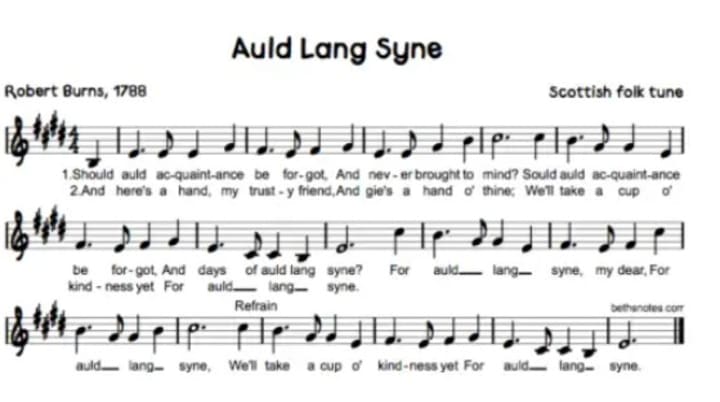
The original lyrics are not usually sung today. That's because the lyrics have changed over the years. It was first sung in the original Scottish language that people around the world don't know or understand.
During a celebration, the entire group may start out singing the first two lines:
“Should old acquaintance be forgot, and never brought to mind? Should old acquaintance be forgot, and old lang syne?”
After those first two lines, people just mouth some words or stop singing completely.
The song is ideal for New Year's Eve for several reasons.
- It is short and can be sung within a few minutes.
- People are more focused on the ball being dropped at the stroke of midnight and not on the song.
- People are anxious to say goodbye to the old year and hello to the new year.
- It is a way for people to say farewell to the past year and look forward to the new year.
Singers of the Song
Auld Lang Syne is a public domain song, and several singers have recorded it in their own style. Mariah Carey sang her version of it on ABC’s “Dick Clark’s New Year’s Rockin’ Eve” hosted by Ryan Seacrest and Jenny McCarthy. Listen to her singing it in the video above, and notice that she repeats the first two parts of the song over a much faster beat than most other singers who have recorded it.
Others who also sing Auld Lang Syne include Susan Boyle, Gloria Estefan, Lea Michele, Bruce Springsteen, Bobby Womack, and Pentatonix who sings it a cappella (without music).
If you do not know all the words to Auld Lang Syne, you are in the majority because most people don't know all the words.
Survey: Do you know all the words to “Auld Lang Syne”?
- 10% YES
- 90% NO
About the Creator
Margaret Minnicks
Margaret Minnicks has a bachelor's degree in English. She is an ordained minister with two master's degrees in theology and Christian education. She has been an online writer for over 15 years. Thanks for reading and sending TIPS her way.
Keep reading
More stories from Margaret Minnicks and writers in Beat and other communities.


Comments
There are no comments for this story
Be the first to respond and start the conversation.