
Astronomers Detected a Strong Signal From Space Lasting Seven Hours — Now They May Have Worked Out What It Was
"GRB 250702B: Unraveling the Mystery of the Seven‑Hour Cosmic Explosion That Challenges Astronomers’ Understanding of Gamma‑Ray Bursts"
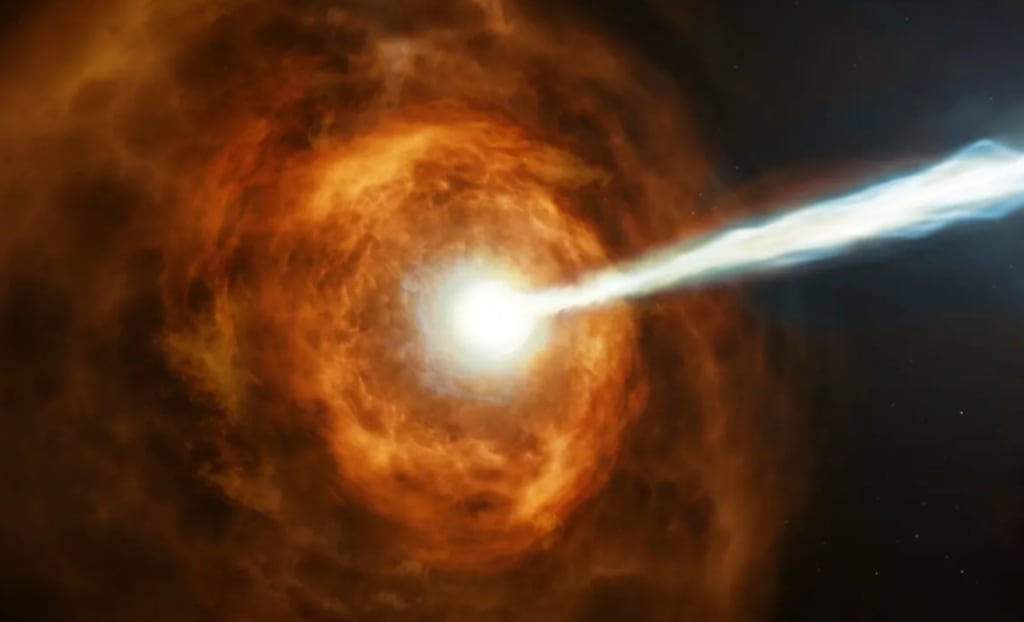
In July 2025, astronomers around the world were astonished when space observatories recorded an extraordinarily powerful and unusually long signal from deep space — a cosmic explosion of gamma rays that blazed for nearly seven hours. Ever since, scientists have been working to understand what produced this cosmic blast and whether it reveals new and exotic physics. Now, new research is offering the first substantial clues about this enigmatic event.
A Record‑Breaking Burst
On July 2, 2025, NASA’s Fermi Gamma‑ray Space Telescope detected the sudden onset of intense gamma radiation from a distant and previously unremarkable patch of sky. What set this detection apart immediately was not simply its strength, but its duration. Most gamma‑ray bursts (GRBs) — among the most luminous explosions in the universe — last from a fraction of a second to a few minutes. But this one, cataloged as GRB 250702B, endured for almost seven hours straight.
That made it not just unusual — but the longest‑lasting gamma‑ray burst ever seen. Previous records had been measured in thousands of seconds, but GRB 250702B went on for about 25,000 seconds. For a signal to persist that long contradicted everything astronomers expected based on existing models for GRB production.
What Are Gamma‑Ray Bursts?
To understand the significance of this discovery, it helps to know what typical gamma‑ray bursts are and how they form:
Standard GRBs are sudden bursts of high‑energy gamma radiation — light so energetic that it’s invisible to human eyes. They occur when massive stars collapse into black holes at the ends of their lives or when two compact stellar remnants like neutron stars merge in a violent collision. In both cases, powerful jets of particles and radiation are launched at nearly the speed of light. When these jets point toward Earth, telescopes detect them as a gamma‑ray burst.
These bursts are usually brief — seconds to minutes — and incredibly bright. Their fleeting nature means astronomers need to act fast to target follow‑up telescopes like the Very Large Telescope, Keck Observatory, or the Hubble Space Telescope to gather additional data before the signal fades.
In the case of GRB 250702B, the sheer duration of the gamma‑ray emission suggested something unusual was powering the event — a mechanism far more prolonged and sustained than typical GRB sources.
Peering Through the Dust
Follow‑up observations localized the source of GRB 250702B to a galaxy about 8 billion light‑years away. The light from this galaxy had to travel through dense clouds of cosmic dust — enough to block visible light — before reaching Earth. Astronomers employed infrared and high‑energy X‑ray instruments to see through this obscuration and confirm the burst’s position and properties.
Once they established where it came from, the next challenge was figuring out how something so powerful could last so long.
A New Kind of Explosion?
Scientists have proposed several theories to explain the extraordinary duration of GRB 250702B. One leading idea involves a helium star merger:
In this scenario, a black hole is locked in orbit with a helium star — a massive star that has already shed its outer hydrogen layers.
As the helium star expands during its evolution, the black hole can spiral inward and plunge into the star’s envelope.
This interaction dumps angular momentum and material into the black hole, potentially creating a jet that continues for much longer than normal GRBs.
Other researchers suggest the burst could stem from a black hole actively tearing apart a companion star, or from other exotic stellar interactions that drive longer‑lasting emissions. While none of these explanations are yet confirmed, they underscore the fact that this event doesn’t neatly fit into previously understood categories of cosmic explosions.
Why This Matters
The discovery of GRB 250702B and the effort to decode its origin represent more than just adding another record‑holder to the books. They challenge scientists’ understanding of how stars die and how extreme gravitational environments behave. A gamma‑ray burst of such duration opens the possibility of previously unknown astrophysical phenomena — events and processes that current models do not fully explain.
Understanding these gamma‑ray bursts also helps astronomers map the history of star formation and death across the universe. Gamma‑ray bursts act as beacons that can illuminate distant galaxies and the conditions in the early universe, offering insights into cosmic evolution over billions of years.
What’s Next for Researchers?
Astronomers are now actively studying GRB 250702B’s afterglow across various wavelengths of light, hoping to extract as much information as possible from this unique event. Future space missions — such as the Compton Spectrometer and Imager (COSI) set to launch in 2027 — are being prepared to detect not just high‑energy bursts but also those with extreme durations like this one.
With new instruments and advanced data analysis techniques, scientists hope to catch similar long‐lasting signals more frequently. This could reveal whether GRB 250702B is a rare outlier or represents a new class of cosmic explosions hiding in the background noise of the universe.
Conclusion
Astronomy has a long history of surprises — from pulsars and quasars to gravitational waves and black hole imaging. The seven‑hour gamma‑ray signal detected in 2025 adds another chapter to that story. By pushing the boundaries of what we expect from cosmic explosions, GRB 250702B is helping to expand our understanding of the universe and the incredible forces that shape it.
As researchers continue to peel back the layers of this mystery, the longest‑lasting gamma‑ray burst ever observed may well redefine how we think about the most powerful events in the cosmos.
About the Creator
Keep reading
More stories from Sadaqat Ali and writers in Beat and other communities.
Mars Isn’t Plan B: Why Earth Stays More Livable — No Matter What
For decades, Mars has been portrayed as humanity’s backup plan—a distant refuge in case Earth becomes uninhabitable due to climate change, war, or resource depletion. Rocket launches, bold timelines, and science-fiction dreams have reinforced the idea that the Red Planet could one day host thriving human settlements. But strip away the hype, and the reality is far less forgiving. Mars is not, and may never be, a viable “Plan B.” No matter how advanced technology becomes, Earth remains overwhelmingly more livable than any other known world.
By Sadaqat Ali5 days ago in Beat
I've Just Realized
The President doesn't understand music. There. It felt very good to write that; it's some thing I just realized today. Oh , yes; he plays it. He TRUMPets it in rallies and meetings, pumps it across the airwaves when he gathers up our minutes waiting for his late arrival.
By Judey Kalchik 5 days ago in Beat




Comments
There are no comments for this story
Be the first to respond and start the conversation.