
A short history of the flute
This mainstay of the orchestra goes back a long way

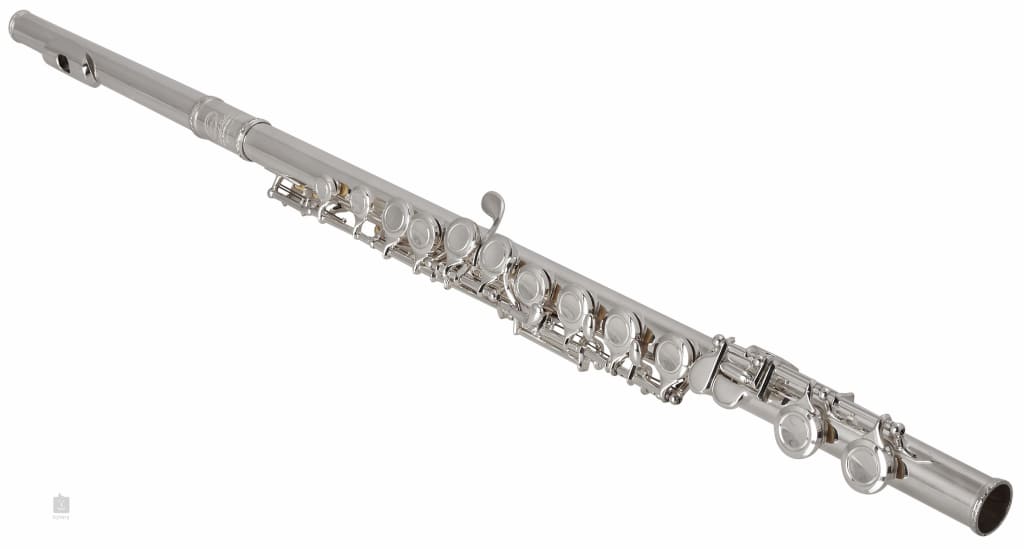
It is quite possible that something vaguely resembling a flute was “played” by Neolithic people thousands of years ago when somebody discovered that blowing across the hole at one end of a hollow animal bone produced an interesting noise. Discoveries that have been made of pieces of bone with what appear to be fingerholes bored in them would seem to confirm that early man had primitive flutes or recorders with which to make music.
It is notable that the Latin word “tibia” can mean either “shin bone” or “flute”, which would seem to indicate a connection. Incidentally, “flute” also comes from a Latin word, namely “flatus” which means “breath”.
The principle of the flute is one that can be observed in nature when wind blows across an open tube, such as a hollow bamboo. The sound is produced by the vibration of air in the tube, and the length of the tube determines the pitch of the note.
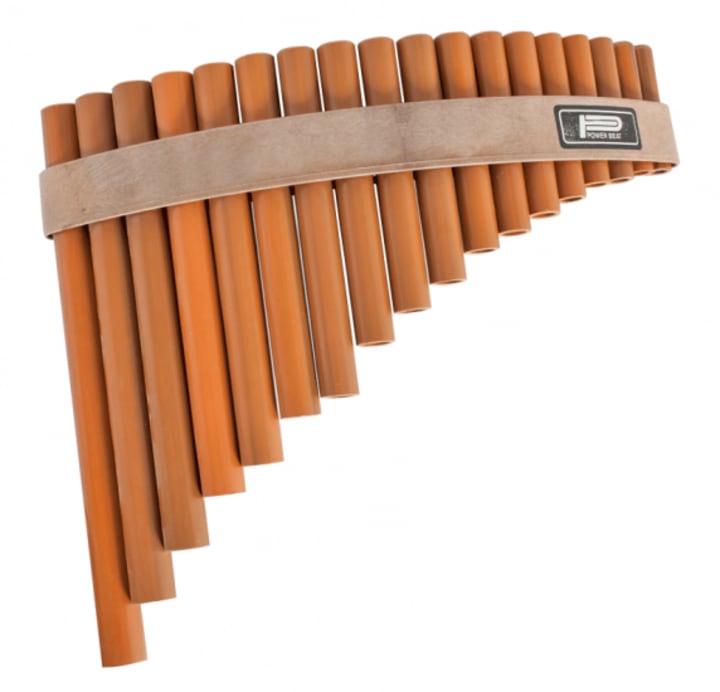
The simplest form of “flute” is therefore the pan pipes, consisting of a set of short tubes of varying lengths that are bound together such that the player can blow across the ends of the pipes in sequence to produce a variety of notes.
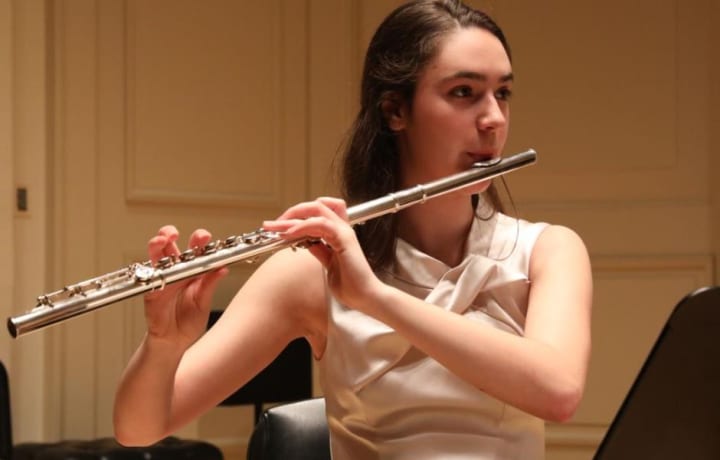
A flute as commonly understood today is played by being blown sideways, across the edge of a hole in the side of one end of a closed tube. There are flute-like instruments that are played by being blown across the top of a tube, and others, like the recorder, in which air is blown into a tube but is interrupted by a sharp edge that sets the vibration in motion. The modern flute is therefore the only member of the concert woodwind family (apart from the piccolo, which is a smaller size of flute) that is played by being held to the side rather than to the front of the player.
Being a single tube, a flute needs another mechanism by which the notes can be varied, and this is supplied by the provision of holes that can be covered or uncovered to affect the way in which the air in the tube vibrates. In the earliest flutes these were simple finger-holes, much as in a recorder, but modern flutes have a more complex system of hole covers that are moved by keys.
Flutes were known in China at around the time of the beginning of the Christian era in the West. They arrived in Europe via Byzantium, being known in Germany in the 12th century and reaching England in the 16th century. King Henry VIII was known to be a keen flute-player and to have an extensive collection. His flutes had six fingerholes.
Another keen royal flute-player was Frederick the Great of Prussia in the mid-18th century, who not only played nightly flute concertos to his court but also wrote many of his own, as did his court composer Johann Joachim Quantz, who also helped to develop the instrument by adding keys to it.
However, it was Theobald Boehm of Munich who, in 1831, made the most significant improvements to the modern flute by devising a system of 16 keys that connected, via a system of levers and metal strips, with the tone holes. This made fingering much easier and therefore made it possible for much more virtuosity to be shown by players. The use of larger tone holes, which could be covered by plates rather than directly by fingers, enabled the instrument to produce a stronger sound. In 1847 Boehm patented a flute with a cylindrical rather than a conical bore, which produced a better tone.
Flutes were traditionally made of wood, although various materials have been used including gold and even glass, but most modern instruments are made from nickel alloy or silver. A modern concert flute is a very complex item, consisting of many individual parts, made from a variety of materials. Most of the complexity comes from the key system and the connections between keys and pads.
However, there is still a market today for simpler “Baroque” instruments, made from wood, that produce a more authentic sound for the music of earlier composers.
Improvements in flute design enabled composers to write music that allowed players to demonstrate greater virtuosity, but it is interesting to note that the Romantic era, during which these improvements were made, was not noted for great flute music, with the instrument appearing only rarely as the focus of attention in concert music. It was only with the late Romantics and the Moderns that the flute recovered the prominence that it had enjoyed in the Baroque and Classical eras.
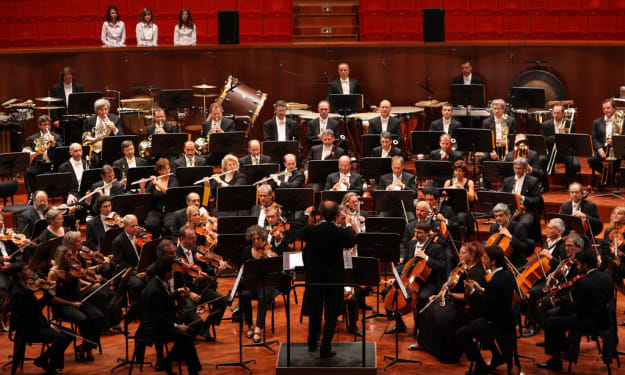
Tchaikovsky made great use of the flute, especially in his slow symphonic and concerto movements, and one of the most effective uses of the flute was by Debussy in his “Prélude à l’après-midi d’un faune” of 1894. English composers of the 19th/20th centuries, notably Delius, Elgar and Vaughan Williams, made good use of the flute to produce the evocative liquid notes that give this era of music its particular flavour.
The flute comes into its own in small ensembles, and is particularly effective when accompanying the voice, because it produces such a “vocal” tone itself. It has therefore found a place in popular and folk music. It is among the most popular instruments chosen by young people who want to begin playing music.
About the Creator
John Welford
John was a retired librarian, having spent most of his career in academic and industrial libraries.
He wrote on a number of subjects and also wrote stories as a member of the "Hinckley Scribblers".
Unfortunately John died in early July.
Keep reading
More stories from John Welford and writers in Beat and other communities.
Ludacris and Nelly draw backlash over bookings at MAGA-coded music festival
Ludacris and Nelly headlining a mostly right-wing event is good for them. It’s also great for the genre of hip hop. The two rap veterans have showcased their talents on other stages. Why can’t they perform for mostly MAGA folks and grab that bag?
By Skyler Saundersa day ago in Beat
Center Stage with Paul Stewart
*** I'm keen to republish the interviews I did for my series with Vocal creators. It's been a few years and I thought it might be nice to revisit these wonderful conversations. I'll be releasing them one at a time for a few weeks/months.
By Heather Hublera day ago in Interview



Comments
There are no comments for this story
Be the first to respond and start the conversation.