
A Reckoning Without Revelation
FILM REVIEW: Fiddy's Docuseries of Dirt on Diddy


“Sean Combs: The Reckoning,” the four-part docuseries executive produced by Curtis “50 Cent” Jackson, arrives with the promise of excavation.
Its title suggests depth, moral accounting, and hard-earned truth—an unflinching reckoning with the life and alleged crimes of one of hip-hop’s most powerful architects. Instead, what viewers receive is a glossy, prosecutorial recap that largely mirrors what diligent news consumers already know. For all its dramatic pacing and ominous score, the series offers remarkably little that feels new.
From the opening episode, the structure telegraphs its limits. Talking heads cycle through familiar ground: Combs’ rise from intern to mogul, the Bad Boy Records era, the cultivation of excess, and the long trail of allegations that culminated in his arrest and continued detention while awaiting trial. The chronology is competent, even slick, but rarely investigative. What’s missing is the connective tissue—the financial records, internal communications, power dynamics, and industry enablers—that might explain not just what allegedly happened, but how it persisted for so long.
The series leans heavily on the language of scandal without doing the harder work of accountability. It reiterates accusations of drug-fueled sexual misconduct and coercion that have already been detailed across courtroom coverage by major media outlets. It replays clips, reads excerpts, and amplifies outrage. But repetition is not revelation. If a docuseries is to justify four episodes, it must deliver either new evidence, new witnesses, or a new framework. “The Reckoning” delivers precious little of any of the three.
Executive production by 50 Cent—himself a longtime rival and cultural counterweight to Combs—adds an edge, but also a tension the series never resolves. Is this an exposé or an op-ed? A documentary or a rival rapper's victory lap? The posture vacillates. At times, the show hints at a broader indictment of an industry that insulated Combs with wealth, access, and silence. But those hints are never pursued. There is no sustained inquiry into corporate complicity, legal settlements, or the mechanisms of intimidation that allegedly kept so many victims quiet. The series names power, then looks away.
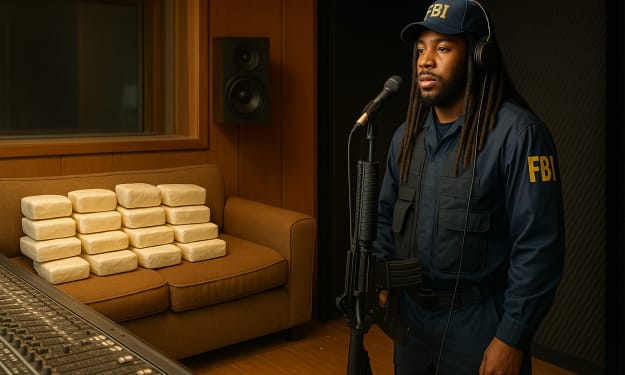
Where the docuseries does attempt novelty is in its use of newly surfaced, on-camera footage. The video was obtained by the production team of this docuseries from a freelance detractor; who substituted for the disgraced mogul's videographer, Michael Oberlies, according to a recent report by E-ONLINE NEWS. The footage is presented as further evidence of Combs’ narcissistic and manipulative behavior. These moments are undeniably arresting, and they give the conclusion a jolt of immediacy. Yet even here, the impact is blunted by context.
The footage is framed as confirmation rather than discovery—visual punctuation on a story already told by journalists, court records, and prior reporting. It shocks, but it doesn’t deepen understanding. Oberlies accuses NetFlix and 50 Cent of "taking footage intended for [the project Combs and I were working on] to advance a narrative that was not our own is both unethical and unacceptable.” Combs is reportedly suing Netflix over the alleged Netflix/50 Cent controversy Oberlies has just spoken out about.
Most frustrating is the absence of rigor. There are no timelines that reconcile contradictions, no financial autopsies tracing settlements or NDAs, and no granular analysis of how celebrity warps consent and consequence. The series relies on moral clarity without analytical courage. It tells us Combs wielded power abusively—an assertion already well documented—without showing much architecture of that power in motion.
In doing so, “The Reckoning” misses an opportunity to say something enduring about fame itself. Combs’ story is not merely one man’s alleged criminality; it is a case study in arrested development underwritten by money and myth. The doc gestures toward psychology but never commits. It hints at a boyhood marked by ambition and trauma, then rushes back to the spectacle. The result is a portrait that is loud but shallow, condemnatory yet incomplete.
The irony is that the series’ most resonant metaphor arrives almost accidentally. As a Nat King Cole standard plays—invoking a “strange, enchanted boy”—the show brushes against a truth it never fully articulates. Combs’ tragedy is not simply that fortune and fame corrupted him; it is that his character, by all accounts presented, failed to mature at the same pace as his empire. Wealth amplified his grossly-contrived immaturity.
Power insulated his impulses. The boy remained enchanted long after the world demanded accountability.
In the end, “Sean Combs: The Reckoning” feels less like a reckoning than a rerun. It compiles, condemns, and concludes without illuminating. For viewers seeking justice, news coverage about Mr. Combs (as he serves a federal sentence for crimes he was convicted of) will matter more than this series. For viewers seeking understanding, journalism has already gone further. What remains is a cautionary tale left poorly-examined—a story of fame’s distortions told with volume instead of depth.
The reckoning of Sean J. Combs, if it is to mean anything, still lies ahead.
About the Creator
Victor Trammell
Mr. Trammell is an award-winning digital media producer, freelance journalist, and author. Formerly, he wrote national radio content for the Michael Baisden Show. He also served as Senior Editor at the Your Black World online news network.
Keep reading
More stories from Victor Trammell and writers in Beat and other communities.
Modern Rap Serves Time in a Regressive Rehab Program, c/o the Prison-Industrial Complex
In the era where perception often trumps reality, modern rap finds itself in a paradoxical predicament: artists are praised for playing gangsters, yet panic when faced with the consequences of gangster life. Once a platform for marginalized voices to speak truth to power, hip-hop today seems caught in a feedback loop, regurgitating performative rebellion while actively sidestepping the realities it once sought to expose. At the heart of this shift lies a tangled relationship between rap culture, the commodification of crime, and the looming shadow of the prison-industrial complex.
By Victor Trammell6 months ago in Beat
It's 2026. Songs Turning 10 This Year
In 2016, we saw the rise of short form videos and what would lead to the birth of TikTok. We cannot forget the Snapchat filters no matter how cringe worthy some of them might have been. It was also the year in which the hit series Stranger Things debuted.
By Jasmine Aguilar6 days ago in Beat
"The Jam"
The Jam" Documentary Review. The Jam" is a movie/documentary about the band who may just well be the most talented punk rock band. Formed in 1972 and consisting of Paul Weller, Bruce Foxton and Rick Buckler, all three grew up in Surrey, England.
By Robert M Massimi. ( Broadway Bob).7 days ago in Beat



Comments
There are no comments for this story
Be the first to respond and start the conversation.