
5 Reasons Why You Should Switch to the Viola
No, it has nothing to do with playing the violin poorly.
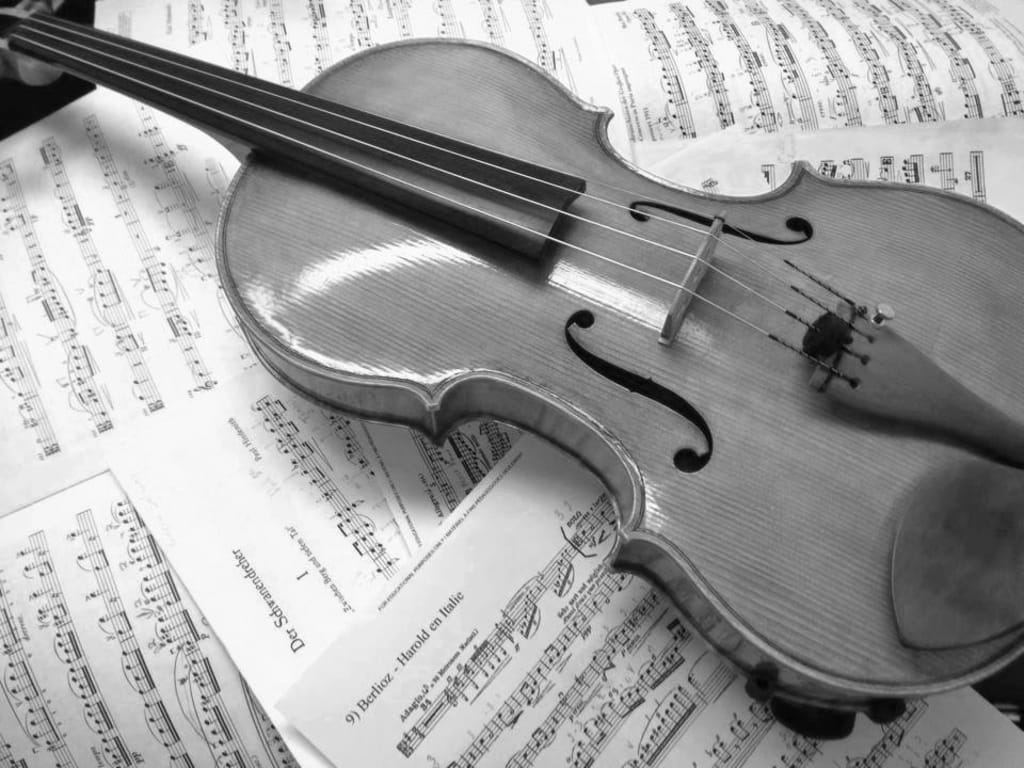
If you're a violinist, chances are you've been asked at some point if you play the viola or if you're willing to play it in an orchestra or string quartet.
Many people play the violin, but the viola is more unknown and therefore in more demand for musical ensembles.
However, you may be wondering, what the heck is a viola?
The viola (pronounced vee-ola) is an instrument in the string family. It is very similar to and often confused with the violin, however, the notable differences are that it's larger, lower, and has a richer/deeper sound.
Unfortunately, the viola is also the subject of many harsh jokes. A lot of this has to do with its history of being the instrument for "failed" or "incompetent" violinists to play. Composers would always write simplistic, uninteresting parts for the violists to compensate for their weaknesses.
I will be the first to tell you that in the year 2022, that is no longer the case. If anything, violists are some of the most intelligent, passionate, and hard-working musicians I have had the pleasure of knowing and working with. Your instrument choice does not define your musical skill and potential.
I started playing the violin when I was 6 years old and I switched to the viola at age 13 when I expressed interest in joining a youth orchestra. Today, I'm a professional violist in a symphony orchestra. I love what I do and wouldn't have it any other way.
If you're on the fence about playing this somewhat mysterious instrument, here are five reasons why you should make the switch, or at least give it a chance.
1. You want to be a versatile musician.
Even if you're not ready to commit to being a full-time violist, being able to take gigs and auditions on both violin and viola will open up more possible income streams. You can also teach both instruments.
Generally, classical musicians only specialize in one instrument. Being able to play two instruments at a high level will help you stand out in a competitive field.
If you only intend to play music as a hobby, it never hurts to learn new instruments so you can join community music ensembles and have more music you can learn.
Directly understanding the challenges of playing both violin and viola will help you be more musically sensitive in an ensemble setting.
For instance, when you're playing the violin, you'll know right away without being told that you'll need to play softer when the viola has an important melody because it's harder for their sound to project.
Likewise, when you're playing viola, you'll know to play out more when the violins have melodies in their high register so they can match their intonation with your lower octave.
Of course, you will develop this sensitivity and awareness through experience, but it'll come more naturally if you play multiple instruments.
2. You want to have a supporting role in an ensemble.
The violin is the best actor/actress and the viola is the best supporting actor/actress.
While you won't get to bask in the glory of a soaring melodic line, the viola is a very important part of the ensemble. The viola provides colour and texture to the music. It sits between the bass line and the melody, serving as the glue to hold everything together.
Sure, it's hard to pick out the viola part in a recording, but rest assured the piece would sound very strange and empty without the inner voice.
When you do get a viola melody, your fellow musicians will [hopefully] return the favour and be your supporting actors and actresses.
3. You're looking for a new challenge.
Don't let people tell you that the viola isn't a legitimately challenging instrument. These people are living 150+ years in the past. Even if you search the phrase "virtuoso violist" on Google, it will say, "Did you mean 'virtuoso violinist?". Come on Google, do better.
You need to have just as good technical ability as a violinist, if not better.
Viola pedagogues William Primrose and Lionel Tertis (no, not "Tetris") were among the first to advocate for the viola in the early twentieth century. They wanted to ensure that violists achieved the same level of virtuosity as violinists and that there was a wealth of repertoire for us to execute said virtuosity.
The violin is not an easy instrument either, but you can play fast, dexterous passages with more ease, as compared to the viola. You can also get away with more bad habits on the violin because the instrument speaks and projects easier than the viola.
Even when you're playing those boring and simplistic parts from hundreds of years ago, you still need to be aware of what's happening in the rest of the ensemble.
Who are you accompanying? Do you need to play a bit louder to give them some support or back off a bit because they will have trouble being heard?
4. You want to play an instrument with a deep, rich sound.
As mentioned in the previous point, it does take more work to execute the viola technique. Getting that beautiful viola sound is no exception.
When you do find that sound, it's amazing. I find that I can dig into the viola more than the violin. I can evoke strong emotions quite easily through the viola. Even as a professional player, I'm still finding new opportunities for musical expression on my instrument.
Violas are also not created equally. While violins and cellos have a specific standard, violas vary greatly in size, shape, length, and timbre. This means that everyone has a unique sound and voice when they play their instrument.
Every time I go back to play the violin, I feel like I can't get any sound out of it without pressing and scratching.
While it may take a few months or years to not sound like a violinist who's trying out the viola, it's worth it once you do find your voice through the viola.
5. You want to discover unknown pieces.
While solo repertoire is limited on the viola, as compared to other instruments like the violin or piano, there are some beautiful gems out there.
Of course, there are unknown pieces for all instruments and ensembles, but finding obscure viola pieces is truly a treat. Even our standard repertoire is relatively unknown to audiences and even other musicians.
Many composers are still writing viola pieces today, but there's a lot of viola repertoire, especially from the Romantic period, that didn't get discovered or performed in its time. People didn't believe that violists would be capable nor be able to project.
I'm glad that I can give a voice to these pieces on my modern instrument, and I feel bad that people hundreds of years ago didn't get to see the true potential of the viola.
--
Thanks for reading! If you enjoy my writing, check out my Medium page, where I have over a hundred articles about music, work, lifestyle, and more.
If you like what you read there, sign up for a Medium membership today to get unlimited access to all articles. Please note that from this link, I will receive a portion of your membership fee, at no extra cost to you.
About the Creator
Viola Geena
Canadian writer who happens to be a violist in a symphony orchestra. All opinions are my own and do not reflect the views of any particular symphony orchestra or arts organization. Twitter: @violageena
Keep reading
More stories from Viola Geena and writers in Beat and other communities.
Review of 'Man on the Run'
My wife and I saw Man on the Run, a nearly 2-hour documentary on Amazon Prime, about Wings, Paul McCartney's group that flew around the world from shortly after The Beatles broke up in early 1970 to shortly after John Lennon was murdered at the end of 1980, making a Beatles reunion forever impossible.
By Paul Levinson3 days ago in Beat


Comments
There are no comments for this story
Be the first to respond and start the conversation.