
You too can celebrate an eco-friendly Holi!
Safe for you, and the Earth...

Holi, the festival of colours, is one of the most popular and vibrant festivals in India. It is celebrated on the full moon day in the month of Phalgun, which usually falls in February or March. The festival signifies the victory of good over evil, the arrival of spring, and the end of winter. Holi is celebrated with great enthusiasm and joy all over India and in many other parts of the world.
Holi Celebration Through the Years
The history of Holi can be traced back to ancient Hindu mythology. The most popular legend associated with Holi is the story of Prahlad and Holika. Prahlad was a devotee of Lord Vishnu, while his father Hiranyakashyap was an evil king who did not approve of his son's devotion to the gods. He tried to kill Prahlad many times, but each time he was saved by Lord Vishnu. Finally, Hiranyakashyap's sister Holika tricked Prahlad into sitting on a pyre with her, but she was burnt to death while Prahlad survived. This event is celebrated as Holika Dahan on the eve of Holi.
Another popular legend associated with Holi is the story of Lord Krishna and Radha. According to legend, Lord Krishna was unhappy with his dark complexion and asked his mother why he was not as fair as Radha. His mother told him to apply colour to Radha's face to make her look like him. This tradition of applying colour to loved ones is still a popular part of Holi celebrations today.
The Emergence of Organic Holi Colours
Over the years, Holi has evolved into a colourful festival that is celebrated with great enthusiasm all over India and in many other parts of the world. The festival is now associated with the throwing of colourful powders and water, known as gulaal and pichkari. The colours used during Holi are traditionally made from natural ingredients like flowers and herbs. However, in recent years, synthetic colours have become popular, which can be harmful to the skin and the environment.

This is where eco-friendly Holi colours, made from natural ingredients like flowers, come in. Using eco-friendly colours not only protects your skin from harmful chemicals but also helps to protect the environment. Eco-friendly colours are biodegradable and do not harm the soil or water bodies when washed off.
Another advantage of using eco-friendly colours is that they are skin-friendly and do not cause allergies or irritation. Synthetic colours, on the other hand, can cause skin rashes, itching, and other allergic reactions. Eco-friendly colours are also safer for children to use, as they are made from natural ingredients and are non-toxic.
In recent years, the use of eco-friendly colours has become more widespread, and many organizations and companies have started promoting their use during Holi celebrations. This has led to a significant reduction in the use of synthetic colours during the festival, which is a positive step towards a more sustainable and healthy way of celebrating Holi.
The Various Holi Celebrations
Holi and its customs and traditions vary from region to region. In North India, the day before Holi, Holika Dahan is celebrated with the lighting of bonfires to signify the victory of good over evil. On the day of Holi, people play with colours and water, and exchange sweets and greetings. In Mathura and Vrindavan, the birthplace of Lord Krishna, Holi is celebrated for several days with grand processions and music. In West Bengal, Holi is known as Dol Jatra or Dol Purnima and is celebrated by offering prayers to Lord Krishna and Radha. In Punjab, Holi is celebrated as Hola Mohalla with displays of martial arts and mock battles. In the state of Gujarat, Holi is celebrated as Dhuleti, and people play with gulaal, dance to the beats of dhol and eat traditional delicacies. In South India, Holi is known as Kamavilas and is celebrated with prayers and offerings to Kamadeva, the god of love. Overall, Holi is a festival that unites people from different regions and celebrates the spirit of love, friendship, and togetherness.
Our Organic Gulaal Collection
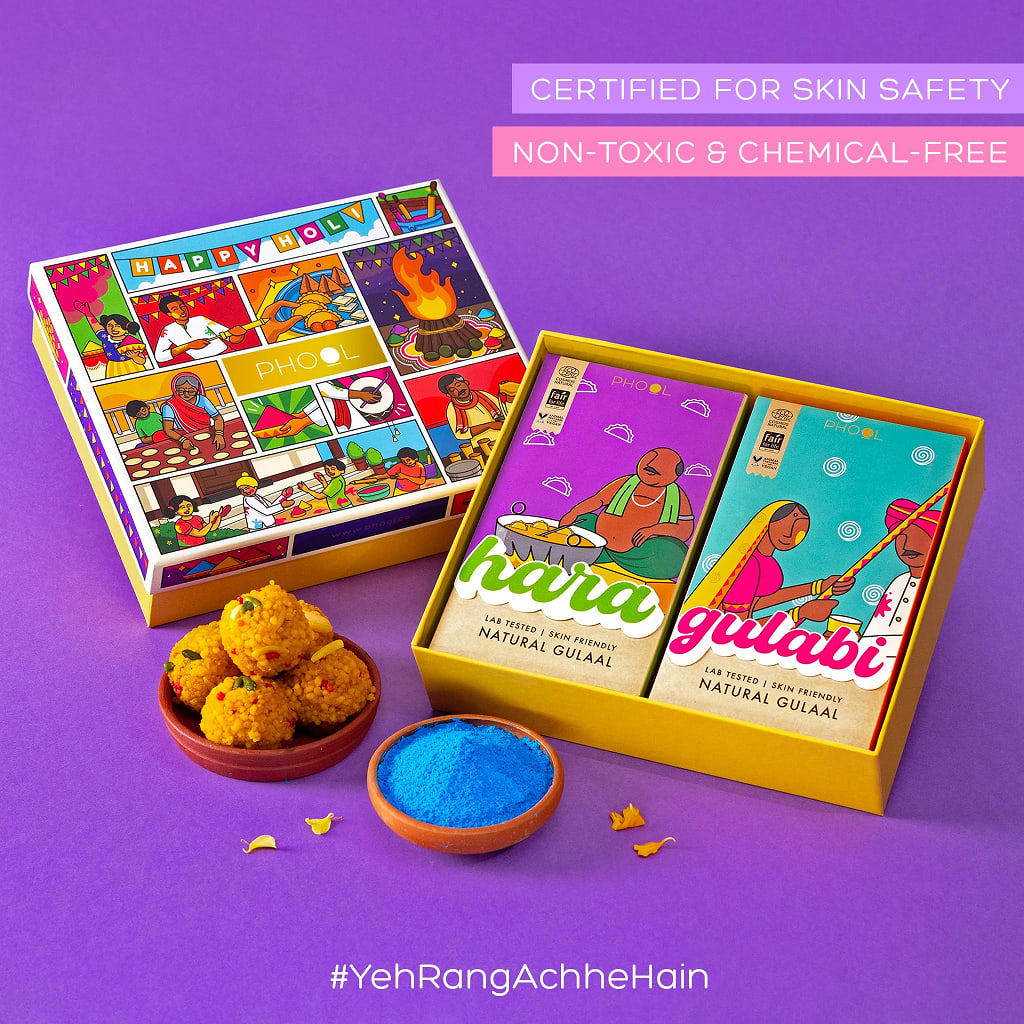
A natural and environmentally responsible way to enjoy the wonderful season of Holi this year is with Phool Organic Gulaal. It is a sustainable alternative that not only adds colour to your celebrations but also helps the earth as it is made from recycled temple flowers. Our gulaal is safe to use and free of dangerous chemicals and synthetic dyes, making it soothing on the skin. Being that the brilliant colours come from natural ingredients like turmeric, beetroot, and hibiscus, it's a distinctive and healthful way to celebrate Holi. We take pride in offering a product that not only meets the highest standards but also has a positive impact on the environment and society. With Phool Organic Gulaal, you can celebrate Holi without compromising on your health or the health of the planet.
In Conclusion
Holi is a festival that has evolved over time from its mythological roots to become a colourful celebration of spring and the victory of good over evil. The use of eco-friendly colours like gulaal is an important aspect of modern-day Holi celebrations, as it not only protects our skin but also helps to protect the environment. By using eco-friendly colours, we can ensure that we continue to celebrate Holi in a safe, healthy, and sustainable way for years to come.
Phool wishes you a very happy Holi!
Read Also: The Nasty Effects of Chemical Holi Colours
About the Creator
Phool.co
Phool - world’s first incense store solving the monumental ‘temple-waste’ problem.
Visit: https://phool.co
Contact: [email protected]




Comments
There are no comments for this story
Be the first to respond and start the conversation.