
Yellowstone's Rising Ground: Signs of Eruption
Yellowstone's Rising Ground: Signs of Eruption?
You might have heard that Yellowstone National Park sits atop a massive super volcano, and this is what powers its famous geysers and hot springs. But it also means there's a vast magma chamber lurking beneath the surface. In 2015, researchers from the University of Utah discovered that this chamber is much larger than previously thought. They even identified a second magma reservoir beneath the first one. The larger the chambers, the more magma they can hold, and together, these two reservoirs store enough magma to fill the Grand Canyon—not once, but 11 times.
What's more concerning is that these magma chambers exert pressure on the ground above them, causing the land to rise. Yellowstone is rising by about 1 to 2 inches a year. On top of that, Yellowstone is classified as an active volcano, with a Volcanic Explosivity Index (VEI) of 8 out of 8. This means if the volcano erupted, it would be an apocalyptic event. To put this in perspective, the 1991 eruption of Mount Pinatubo in the Philippines, the most powerful eruption in modern history, had a VEI of 6.
But is an eruption imminent? In March 2023, University of Utah seismograph stations recorded 354 earthquakes in the Yellowstone region. That might sound alarming, but the largest earthquake was only a magnitude 3.7. These were part of a swarm of 106 quakes that lasted until the end of the month. Earthquakes tend to occur in swarms in this area, but experts say there's no cause for alarm. Michael Poland, a geophysicist at the Yellowstone Volcano Observatory, assures us that the volcano isn't about to erupt. For that to happen, there would need to be enough magma beneath the surface under great pressure, but these conditions don't exist right now.
At the same time, Poland and his team are closely monitoring the area for any signs of increased volcanic activity, such as frequent earthquakes, ground deformation, changes in geyser behavior, or shifts in gas and thermal emissions. They also track changes in the park's thermal features, which could indicate a potential eruption. Despite media reports suggesting Yellowstone is overdue for an eruption because the last major eruption occurred 70,000 years ago, experts say this isn't how volcanoes work. They don't follow a predictable timeline.
If a super eruption were to happen, the biggest threat wouldn't be the lava or the earthquakes—it would be the ash. In fact, past eruptions at Yellowstone have been catastrophic. The largest eruption was 2,500 times more powerful than the 1980 eruption of Mount St. Helens in Washington. The most recent eruption, known as the Lava Creek eruption, formed the Yellowstone Caldera and released an enormous amount of ash and volcanic debris into the atmosphere.
Scientists have recently uncovered evidence of two previously unknown super eruptions that occurred 8 to 9 million years ago, with one being the largest known eruption in the entire Snake River-Yellowstone volcanic province. But long before these eruptions occurred, the signs of impending disaster were already building. For thousands of years, magma had been accumulating beneath the surface, causing the land above to slowly rise. About a year before the eruption, the pressure started to become noticeable, though the processes were mostly happening underground. Decompression from the magma released gas bubbles, and small earthquakes began to intensify.
Eventually, the pressure caused the ground to dome upward, forming cracks along the edges. It was like shaking up a soda bottle—when the pressure released, it caused an explosive eruption. The eruption itself was preceded by tremors, and when it finally happened, it was violent. A massive column of lava and ash shot into the air, and a pyroclastic flow—an avalanche of hot, toxic gases, volcanic ash, and rocks—rushed across the land at hurricane speeds.
The most dangerous aspect of a super eruption is the ashfall. Volcanic ash can turn into glassy cement when inhaled, killing animals and destroying plants. Within days, thick layers of ash covered vast areas. As the ash reached the stratosphere, it blocked sunlight, cooling the planet and causing a global "volcanic winter." For years, there was no summer, and crops failed. If such an eruption occurred today, the ash would blanket parts of Colorado, Utah, and Wyoming with up to three feet of toxic ash, and much of the United States would face power outages, ruined crops, and contaminated water supplies.
Thankfully, there's no indication that a super eruption is imminent. As experts point out, while Yellowstone remains an active volcanic system, it’s not about to erupt any time soon. Still, the prospect of such a catastrophe is a reminder of the immense power of our planet. So, while it's not something we need to lose sleep over, it's certainly fascinating to consider the geological forces at play beneath the surface.
About the Creator
Keep reading
More stories from Patrick Iwu and writers in 01 and other communities.
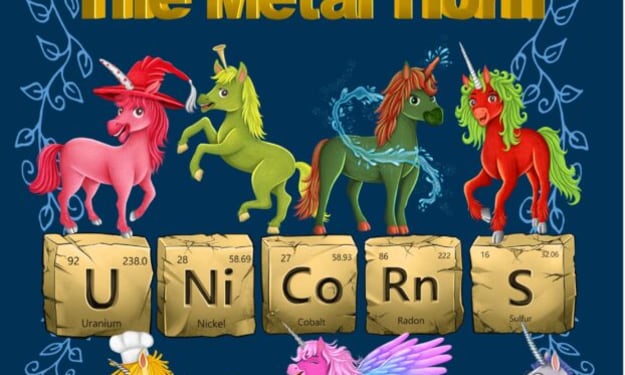
The Metal Horn Unicorns Make Science Magical: A Creative Gateway to the Periodic Table
Learning the periodic table can feel intimidating to many students when it is presented as a dense grid of symbols, atomic numbers, and unfamiliar terminology. Yet chemistry itself is full of wonder: elements form the building blocks of everything in the universe, from the oxygen we breathe to the gold in jewelry and the silicon in our electronics. When science education taps into imagination, storytelling, and creativity, students often discover that the periodic table is not merely a chart to memorize but a fascinating map of the natural world. This is exactly where The Metal Horn Unicorns Make Science Magical—a unique STEM resource—steps in.
By Bushra Rajpoot7 days ago in 01
My First Time Skiing and I Got Lost, Alone, in the French Alps
Looking back, I can trace some of my life’s biggest adventures to a simple action from my sister. She’d introduced me to Tommy (a very long time ago), a colleague of hers, who had overshared his penchant for Italian-looking women, and I ticked that box.
By Chantal Christie Weiss2 days ago in Humans



Comments
There are no comments for this story
Be the first to respond and start the conversation.