

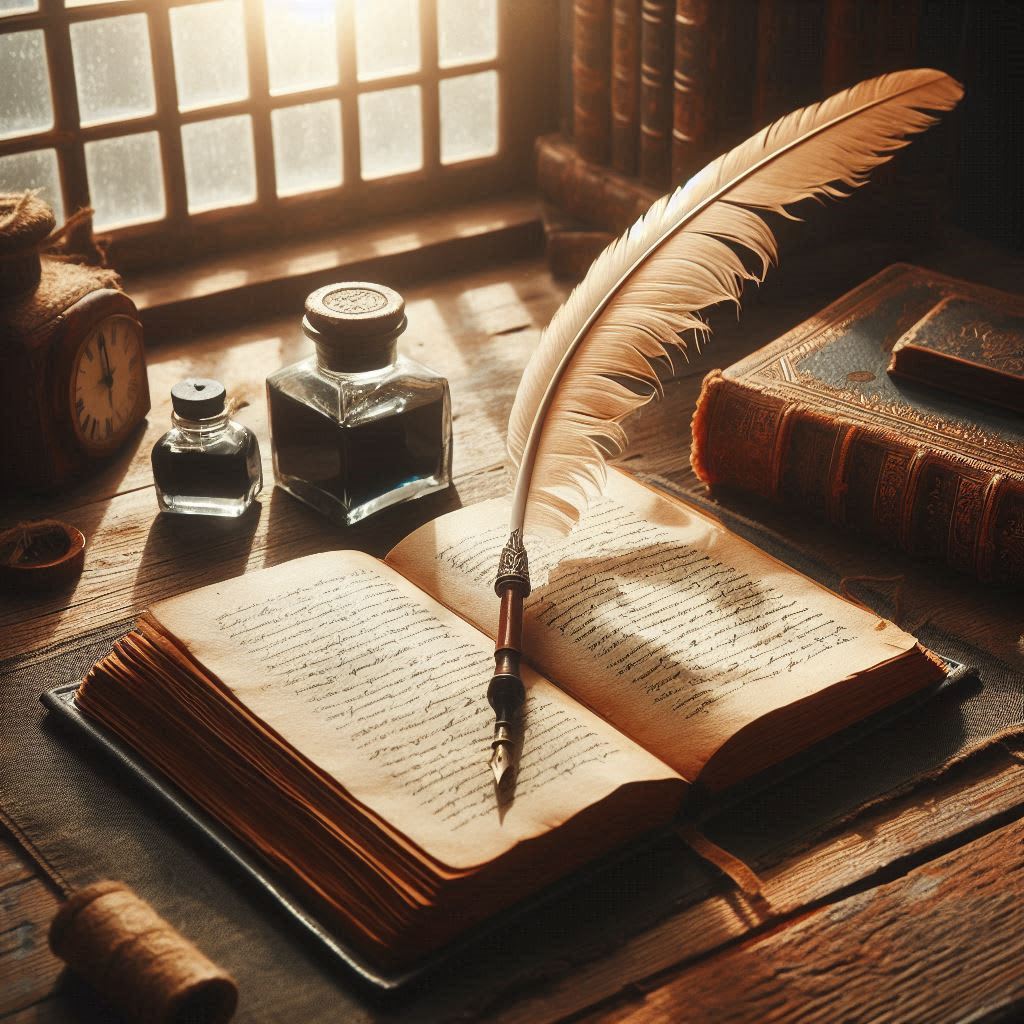
Every morning, food and drink arrive through a tube—always with a letter. Today’s message was brief, its tone urgent, its request familiar:
> **“Dear Dave,**
> The war is raging. Bombs are falling. The people are starving.
> We need you to write again about the dangers of going outside, and to remind everyone to find happiness within.
> –Your friend,
> Frank.”
I stamped a green thumbs-up and sent the letter back up the chute.
As always, I searched my ever-expanding library for inspiration. I pondered the words that might make others feel as content and safe as I do. And then it came to me:
> “Stay inside, where it’s safe. The outside is cruel.
> Life is for the living—so find joy in the little things.
> Remember, life only continues with hope. Let us not lose it during these dire times.”
I am terrified of the outside world: murderers, rapists, disease, war, thieves, savage beasts. I know I’m lucky to live in a place free of these horrors. Safe. Comfortable. Unbothered. Why leave?
There are no expectations here. No one to impress. No judgment. No pain. I have everything I need: good food, clean water, warmth, and solitude. And of course, a job—an important one. I write messages of hope and safety for the people, and in return, I receive everything I could ever want.
Frank assures me that it’s better in here than out there. And I trust Frank. Why would he lie?
So I continue to write. Every day.
In return, I am fed, sheltered, fulfilled.
But one day, a thought drifted in:
**How long have I been here?**
I couldn’t answer. And then I realized—I had already asked that before.
Troubled, I turned to the medicine cabinet and took one of the pills Frank sent me for thoughts like these. Why suffer unpleasant ideas when I can choose peace?
As the pill softened my mind, a floral scent filled the room. Then—something surreal:
A voice.
> “Hello?”
I blinked. Was I going mad?
> “No,” said the voice. “You’re not mad. I’m here to see you.”
It was a woman’s voice—gentle but confident.
> “May I come in?” she called. “It’s freezing. I’m lost.”
> “If you can,” I replied, unsure how anyone could *enter*.
She crashed through the roof.
Startled, I watched her brush herself off.
> “Sorry about the hole,” she said with a crooked smile.
> “What’s your name?” I asked.
> “Mary-Jane.”
> “How did you find me? What do you want? I was quite content here.”
> “I was walking through the woods and saw a strange light coming from the ground. I thought I smelled food. So I called out—and fell.”
> “You’re hungry?”
> “Starving.”
I led her to the kitchen, where trays of fresh food awaited—delivered twice daily. She stared in disbelief.
> “How do you have *this much*? And it’s all fresh?”
> “I write,” I replied. “They send me food in return. I don’t need much—just books, good meals, peace.”
Her eyes narrowed.
> “Out there, there’s war. Famine. Disease. This food could feed a whole village. My friends and family would kill for this.”
> “Please don’t kill me. You’re welcome to it. Though… I suppose you're stuck here now.”
> “Excuse me?”
> “I just mean... I’ve never left. I don’t know how one would. Or why they’d want to.”
> “You’ve never seen the sun?”
> “Not until you broke my ceiling.”
> “So I *am* stuck.”
> “It would appear so.”
She sighed.
> “Well... we may as well get to know each other. You never told me your name.”
> “Dave. I’m a writer.”
> “What do you write?”
> “Whatever Frank and the others tell me to.”
> “So you don’t think for yourself?”
> “No—I know. I can show you my library. I’ve read every book.”
---
She followed me to the shelves—miles of them.
> “You've read *all* of these?”
> “Yes. I get a new one every day.”
> “And how do you know they’re true?”
> “The facts align. The reviews are excellent.”
> “But what if it’s all lies?”
> “Why would they lie?”
> “To make money.”
> “What is... money?”
> “It’s what people kill for.”
> “But I have no money. Yet I have everything.”
> “Exactly. You’ve bypassed money by giving them something even more valuable: your trust. Your writing is genuine—and therefore, persuasive. You’re a weapon of mass belief.”
I stood silent.
> “You want to know what it means to truly live?” she asked.
> “Yes...”
> “Then follow me.”
---
She took my hand and pulled me into the forest.
I saw sunlight.
Smelled roses.
Petted a dog.
*All for the first time.*
And in those small, sacred moments, I discovered what it meant to be human. Not just to survive in comfort—but to feel. To experience. To ache. To laugh.
The world outside was terrifying, yes—
but it was real.
Within it lay the true meaning of life:
**To search. To feel. To love.**
To seek truth not through books, but through experience.
And in that moment, I understood:
Life has no inherent meaning.
You must give it meaning.
Your own.
Because the only answer to a riddle like,
*“Why is a raven like a writing desk?”*
is simply:
**Because it is.**
Part 2
We walked deeper into the forest. The trees stretched tall, like silent witnesses to an ancient truth I had only just begun to glimpse.
I found myself overwhelmed—by light, by sound, by *air.* The wind on my skin felt foreign, like I’d removed a second layer of self and stepped out raw and newborn into something holy.
Mary-Jane held my hand like it mattered. Like I mattered. She didn’t rush me. She let me breathe, let me feel the earth beneath my feet and the way the sun filtered through leaves like whispered revelations.
> “Where are we going?” I asked.
> “To meet the others,” she replied.
> “Others?”
> “Yes. There are more like you. Writers. Thinkers. People who once lived in glass boxes, built by lies, sustained by obedience. You’re not the only one.”
We walked in silence for a time. I looked back once, expecting to see the hole I came from—my home, my library, my safe, perfect cage—but it was gone. The forest had swallowed it completely. I felt the tug of panic, but her hand steadied me.
> “There is no going back,” she said. “Only forward.”
---
That night, we camped near a river.
It wasn’t like the synthetic trickles I’d read about or seen in my library’s animated books. It *moved,* not in loops or patterns, but with purpose. Unrehearsed. Unchained.
I stared at the stars as though I were meeting long-lost ancestors. Mary-Jane sat beside me, poking the fire with a branch.
> “Why did you come for me?” I asked.
> “Because someone came for me.”
She didn’t elaborate.
---
We arrived at the settlement by midday.
A clearing in the trees revealed a small collection of handmade structures—wooden cabins, gardens, clotheslines billowing with colour. And people. *Real people.* Not characters in books or voices in letters. They moved with intention, each in their own rhythm, and yet somehow in harmony. There was no rush. No barked orders. No sirens or drones. Just the sound of living.
Children chased chickens. A man played a handmade flute. A woman stirred a pot over a fire, humming.
They welcomed me without question, without ceremony. A woman offered me berries in her palm. A boy gave me a daisy. No one asked what I did or what I knew. It was as if I didn’t have to *become* anything—I only had to *be.*
> “We call this place The Threshing Ground,” Mary-Jane explained. “It’s where people separate the real from the false. Like wheat from chaff.”
> “And what becomes of the chaff?” I asked.
She looked at me, eyes deep and sad.
> “Some go back.”
> “Back?”
> “To the tubes. To the letters. To the safety of routine.”
> “Why?”
> “Because truth is heavy,” she said. “And not everyone wants to carry it.”
---
At first, I struggled.
I missed the *structure.* The rules. The clear, simple purpose of writing what I was told. Out here, no one assigned me meaning. No one graded me, corrected me, or fed me for compliance. I had to *listen.* To nature. To others. To myself.
I didn’t know who “myself” even was.
And yet—each day brought something new.
One morning I wept when I saw a butterfly land on my hand. I’d only read about them. It stayed long enough for me to feel it was offering something—a fragile, unspoken lesson.
> “What do I do now?” I asked Mary-Jane.
> “Now?” she smiled. “You *write.* But not for them. Not for Frank. Not for orders.”
> “Then who?”
> “For yourself. And for the rest of us—those still crawling out of the ground, blinking in the light.”
---
So I wrote.
Not about fear. Not about safety.
But about *sorrow, and awakening.*
About *the courage it takes to let go of certainty.*
About *the miracle of tasting a wild strawberry, or hearing a stranger laugh without agenda.*
I wrote about the quiet rebellion of choosing to feel,
and the sacred chaos of life unfiltered.
And I knew—somewhere, in another bunker, someone like me was still stamping letters, still sending words that soothed and suppressed. Still afraid of the sky.
So I addressed my next letter to no one in particular. I tied it to a bird’s leg and whispered:
> “To whoever is still underground—
> I understand.
> But when you’re ready,
> there’s a world waiting.
> And it is beautiful.
> And it is terrifying.
> And it is *true.*”
The bird took flight, disappearing into the blue.
And for the first time in my life,
I felt free.
Part 3
It started with a bird.
A single letter, tied to a pigeon’s foot, fluttered through an air vent and landed in the lap of a man named Jonah. He lived five floors beneath the surface—deeper than Dave ever did—where the sun was a myth and freedom a forbidden word.
Jonah was a reader. A secret one. He collected scraps of unapproved literature—torn pages smuggled in toolboxes and lunch sacks—fragments of poetry, philosophy, banned histories. Most of his peers ridiculed him, called him “Imagination Jonah,” but he didn’t mind. He knew there had to be more than work, pills, and programmed happiness.
So when the bird came, he knew it was no accident.
He unrolled the note, hands trembling.
> *To whoever is still underground—*
> *I understand.*
> *But when you’re ready,*
> *there’s a world waiting.*
> *And it is beautiful.*
> *And it is terrifying.*
> *And it is true.*
Jonah stared at the words.
They *felt* different. Not engineered. Not sterile. There was grief in them. Hope. They weren’t trying to *sell* him anything—they simply *invited* him.
For the first time in his life, Jonah wept.
---
He began sharing the note, carefully.
One by one, a network formed. Whisperers, thinkers, sleepers waking from dreams not their own. Some called themselves “The Seeing.” Others “The Unwritten.” But all agreed: the world they knew was *not the world as it should be.*
Jonah kept asking one question:
> “Who is Frank?”
No one knew. Only that he was the name behind every letter. Every decree. Every reward and punishment. He was myth, messiah, and master.
They decided he had to be confronted.
But first—their chains.
The tubes, the food, the lights, the pills. All systems of control.
They began *refusing.*
Food was traded. Pills were hidden. Writing assignments were returned blank, stamped with red fists instead of green thumbs. One even wrote, **“NO MORE WORDS UNTIL WE SEE THE SKY.”**
The upper chambers panicked. Doors slammed. Sirens blared. Sleep schedules were disrupted. The light bulbs flickered erratically—as if unsure whether to obey or die.
Jonah and the others fought through the chaos. Escaping their corridors one by one. Crawling upward. Bleeding. Fighting off machines that didn’t speak—just enforced.
They came upon Dave’s chamber. But Dave was gone. Only a broken ceiling remained and books strewn like autumn leaves.
They knew where he had gone.
---
### **Writing God — Part IV**
**“The Confrontation”**
---
Dave returned to the chamber.
He came back not as a writer—but as a witness.
The jungle had changed him. His hands, once pale and delicate, were now calloused and cut. His eyes no longer scanned pages—they searched people.
He climbed down through the broken ceiling with Mary-Jane at his side, and with Jonah and the revolutionaries waiting below.
In the center of the chamber, glowing like a mechanical altar, was the comms-tube.
Dave stepped forward and whispered into the microphone:
> “Frank. We need to talk.”
Silence.
Then a hiss. A mechanical groan. And the microphone came alive.
> “Dave? My god… you came back.”
> “Frank. You lied to me.”
> “No, Dave. I *protected* you. That’s what you wanted, wasn’t it? Safety. Purpose. Peace.”
> “No, Frank. That’s what *you* wanted from me. Obedience. Output. Words that bent the world into submission.”
A long silence. Then Frank’s voice shifted—lower, more human.
> “You don’t understand what’s at stake. People *need* the illusion, Dave. Truth is too messy. Too dangerous. Do you know what the outside is? Anarchy. Hunger. Chaos.”
> “Yes, I do,” Dave said. “And it’s still better than *this.*”
> “You betrayed me.”
> “No. I *woke up.*”
Dave unplugged the microphone.
The chamber dimmed. The soft hum that once vibrated beneath the floor went quiet. No sirens. No orders. Just silence—and choice.
Jonah looked to Dave.
> “What now?”
Dave breathed deeply.
> “We write something new.”
---
### **Writing God — Part V**
**“Frank”**
---
Frank sat alone, high above it all.
His chamber was polished, white, and still. No windows. No mirrors. Just screens—thousands of them. Each displaying a life: eating, sleeping, obeying, writing, fading.
He was tired.
He didn’t remember when it started. Only that once, long ago, he too was a writer. A good one. But then came the war. Then the famine. Then the fear. The people needed order. He provided it. One letter at a time. One lie at a time.
> “Without structure, they suffer,” he once told himself. “With freedom, they destroy.”
And yet… something inside him cracked when Dave spoke those words.
*“I woke up.”*
Frank reached into the drawer and pulled out a photo.
It was of him—decades younger. Covered in paint and ink, smiling beside a tree with a woman he once loved. Back when he believed in stories that *he* created, not stories he was ordered to tell.
He stared at the image.
> “Maybe I was wrong,” he whispered.
One by one, the screens went black.
Frank stood.
And for the first time in decades,
he opened a door.
Part 6
They stood in the ruins of the machine.
The comms-tube, once humming with control, now sat silent. The walls of the chamber, once pristine, had become canvases — scrawled with poetry, sketches, manifestos. The underground wasn’t dead, but *dormant*, waiting for someone to ask it who it wanted to be.
Dave turned to the others.
> “We are not free *just* because the system is gone. We are free because we now decide *what comes next.*”
There was no applause. Just a sacred silence.
Like the pause between inhaling and the first word of a new language.
---
They called it **The First Forum.**
Not a government. Not a hierarchy. Just a circle — held outdoors, around a fire, open to all.
The first night, there were only thirty-seven people. Writers. Engineers. Gardeners. Poets. Survivors.
They argued. They cried. They stumbled through words that had long lost their meaning.
> “What is justice without punishment?”
> “What is value if not measured in numbers?”
> “What is love when no one’s watching?”
The questions came like a flood. But no one tried to build a dam.
They *listened.* They let the water move through them.
---
Mary-Jane stood up.
> “I believe we are all children again. The world has no map now. So let’s not draw borders—let’s draw *paths.* Let’s explore together.”
She knelt and planted a flower seed.
> “This is the beginning of our garden. Not one we tend with machines or metrics, but with our *presence.* Let’s grow it the way we grow ourselves—imperfectly, but with love.”
People began planting whatever they had. Seeds. Thoughts. Ideas. A man recited a forgotten lullaby. A girl sang a song that no one had heard but everyone remembered.
That night, no one slept.
Not because of fear, but because for the first time in memory, they didn’t want to miss a moment of *living.*
---
They built homes, not houses.
Each one unique. One shaped like a seashell. Another woven entirely from vines and cloth. They called this settlement **“Mirra”** — not for a god, not for a country, but for the root of the word *mirror.*
Because here, everyone was free to reflect — themselves, each other, and the infinite sky above.
Children were not taught facts, but how to *wonder.*
Work was not assigned, but chosen — what you did best, and what filled you with fire.
Currency was replaced with *exchange.* Skills. Time. Compassion.
---
Dave watched this unfold.
And for a while… he *couldn’t write.*
Not because he lacked inspiration.
But because he realized — for the first time —
**his life was no longer a script.**
He was not the narrator anymore. He was part of the story.
---
One afternoon, he found a piece of charcoal and wrote on the side of a tree:
> **“Let truth be lived, not just told.”**
---
But not everything was simple.
Some people missed structure. Some mourned the comfort of rules.
Arguments broke out. Love triangles formed. Someone stole someone’s bread.
The utopia wasn’t perfect. It *wasn’t supposed to be.*
But every mistake was met not with punishment, but *dialogue.*
Instead of prisons, they created **Circles of Truth** — where people could confess harm, hear harm, and heal together. It didn’t always work. Some walked away. Some still fought. But the *attempt* — the *effort* — mattered more than the result.
People were *trying.*
Not to win.
But to *understand.*
---
Dave sat with Mary-Jane under a tree one night.
> “Do you think it will last?” he asked.
> “Nothing lasts forever,” she said, “but maybe that’s not the point.”
> “Then what is?”
She smiled.
> “That it’s *real.* And *ours.* And *now.*”
Part 7
Months passed.
Mirra became a gathering place. People emerged from bunkers, shelters, and forests—drawn by the whispers of freedom.
They didn’t bring gold. They brought *stories.*
Stories of suffering. Of resistance. Of escape. Of hope.
And so, they created **The Living Archive** — a temple built not of stone, but of memory.
Everyone wrote one page.
Their truth. Their past. Their promise.
No edits. No erasures.
> **“Let our lies be buried, and our truths bloom like wildflowers.”**
Dave placed the first page.
> *“I was a man who wrote for others.
> Then I met a woman who showed me the sun.
> Now I write for life itself.”
Part 8
They were born beneath open skies.
No ceilings, no fluorescent buzz, no white walls — only starlight, soil, and the symphony of crickets echoing off the hills. The people of Mirra called them the *Children of the Sky*, for they were the first to *never know the underground.*
No one told them who to be.
They chose their own names when they were ready. Some took names from the old world: Luna, River, Sol. Others invented entirely new ones, like *Zee*, *Nyro*, or *Bloom*. One child simply named herself **"Yes."**
There were no desks, no bells, no punishments — but there was *learning everywhere*. In the gardens. By the fire. Inside the Living Archive, where elders read stories aloud while the little ones asked questions no adult could answer.
> “Why did people let it get so bad before?”
> “What is a lie if you don’t know it’s a lie?”
> “Why did Frank build the walls?”
Some adults tried to explain.
But others simply replied:
> “That’s why you’re here now. To ask better questions than we ever did.”
---
They learned from the earth.
Their teachers were bees, rivers, seeds, and stones. They learned how to grow food with bare hands. How to watch the clouds and know the weather. How to craft clay cups, tell time from moss, and write songs by listening to the wind.
The Children of the Sky didn’t fear mistakes. When they cried, the community didn’t hush them. When they shouted, no one told them to “calm down.” Instead, they were asked:
> “What does your heart need right now?”
And they learned to answer in their own time.
---
**Art** was their language.
The children painted not on paper, but on walls, trees, and their own skin. They danced before they walked. Their stories were told with gestures and silence as often as with words.
A boy named *Echo* invented his own alphabet. A girl named *Kira* drew the same spiral every day for a year, until one morning she said,
> “I think I finally understand what forever looks like.”
---
They weren’t perfect.
Some fought. Some lied. Some ran away to build a fort in the woods and didn’t come back for three days.
But when they did, hungry and muddy and glowing with mischief, no one punished them.
Instead, an old woman knelt beside them and whispered,
> “Did you learn something out there?”
They nodded.
That was enough.
---
**One day, the children asked for a story not yet told.**
A story *about them.*
So Dave, now silver-haired and softer than he once was, sat beside the fire with Mary-Jane and the circle gathered close. The sky above glowed violet. Fireflies danced in silence.
Dave said,
> “Once, there was a world where people forgot how to live.
> They obeyed machines and believed in fear.
> They were promised safety, but lost themselves.”
He paused. The children leaned in.
> “But then… something miraculous happened.
> A door opened.
> A voice questioned.
> A woman fell through the roof.” *(they all laughed here, even Mary-Jane)*
> “And the people began to remember.”
> “They remembered joy. And pain. And choice.
> And they built a place for *you.*”
He pointed gently at the circle.
> “You are the proof that love can survive anything.
> You are what we prayed for when we didn’t even believe in prayer.
> You are the story we always wanted to read.”
The children sat in silence.
Then one whispered:
> “Can we write it now?”
---
**And so they did.**
Together, the first generation of Mirra wrote *The Book of Becoming.*
A living book, passed from hand to hand, filled with questions, sketches, poems, jokes, dreams, and songs. Every year, they would gather and read it aloud.
But to celebrate *what was found.*
Not to remember what was lost.
But to celebrate what was found.
About the Creator
Jack Kirwood
Is freedom?
Reality meeting itself on its own terms, seeing through the looking glass, mirroring itself.
Absurdity, realism, wondrously weird and INSANE.
This is what you'll find,
Read bottom up.
Keep reading
More stories from Jack Kirwood and writers in 01 and other communities.
With(IN)Sanity - Complete
Jack is sailing off the coast of Australia, searching for new lands to settle a commune, in the name of freedom, peace, harmony and free expansion of the mind. On his way to his newly purchased private island gets hit by a cyclone and crashes his boat into a distant unheard of country far from home, civility, safety, and his dream come true.
By Jack Kirwood6 months ago in 01
Is Snapchat Premium Safe to Use as a Creator and User?
Snapchat is an American-based multimedia photo sharing and instant messaging app. Snapchat Inc developed it. One of the app's primary features is that text messages and images are available for a limited time. This is their unique selling point or what we popularly term as USP. However, the limitations were removed later on.
By Intelligent Creator7 days ago in 01
House Cleaning Scopes That Keep Results Consistent
A clean home feels simple until you try to keep it that way during a busy month. Work deadlines, school schedules, pets, and visitors stack up. Dust returns faster than expected. Bathrooms show water spots. Kitchen grease builds around the stove. Many homeowners hire cleaning help, then feel unsure about what to request and how to judge quality.
By Jared Benningabout 5 hours ago in 01
📢 Raise Your Voice Thread: 01/08/2026
Our “Raise Your Voice Threads” are hosted most alternating Thursdays at 12PM ET to offer creators more avenues to uncover exceptional stories on Vocal. As we are continuously searching for fresh creators and inspiring stories, this thread provides an opportunity to exchange and discuss the stories that have moved and motivated us on Vocal.
By Raise Your Voice by Vocal5 days ago in Resources


Comments
There are no comments for this story
Be the first to respond and start the conversation.