
Why Token Supply Matters More Than Price in Crypto Markets
Understanding the hidden metric that truly determines a cryptocurrency’s real market value.

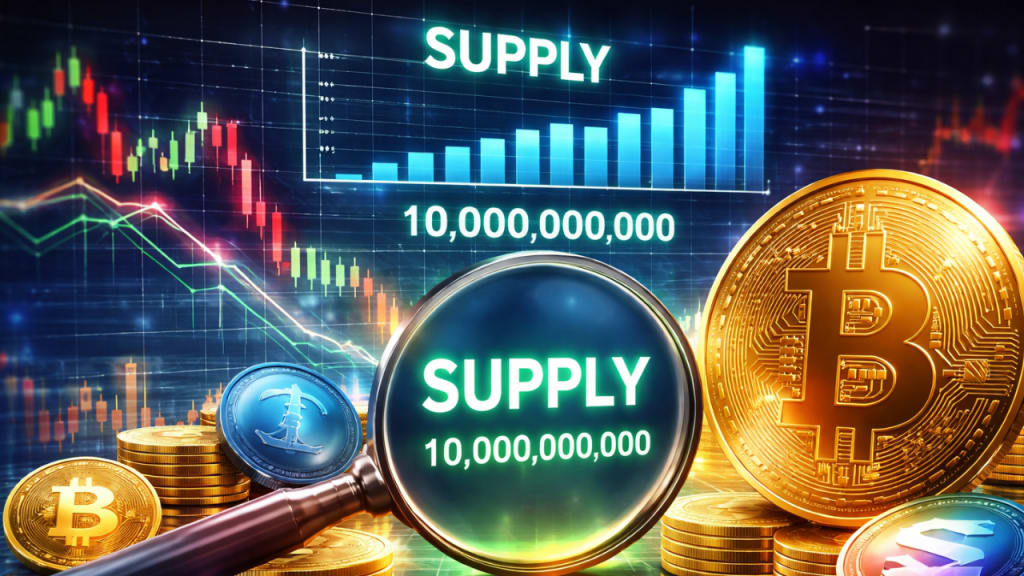
In the cryptocurrency world, price often attracts the most attention. Investors frequently look at tokens priced below a dollar and imagine the potential if those assets were to increase in value. While this perspective is understandable, experienced Web3 participants usually evaluate a project using deeper metrics than price alone.
One of the most important but often overlooked factors in crypto analysis is token supply. The total and circulating supply of a cryptocurrency plays a major role in determining its potential valuation. Understanding how supply interacts with market demand can help investors make more informed decisions when evaluating emerging blockchain projects.
Understanding the Difference Between Price and Market Capitalization
Many new investors assume that a low-priced token has more potential to grow than a higher-priced one. However, price by itself does not reveal the full picture.
Market capitalization is calculated by multiplying the token price by the circulating supply. This figure represents the total value of a cryptocurrency in the market. A token priced at $0.10 with a supply of 10 billion tokens may already have a larger market cap than a token priced at $10 with only a few million tokens.
Because of this, analyzing market capitalization provides a clearer understanding of how much a cryptocurrency can realistically grow.
Why Supply Structure Influences Long-Term Growth
Tokenomics, which refers to the design of a cryptocurrency’s economic model, determines how tokens are distributed and released over time. Some projects have fixed supplies, while others introduce new tokens gradually through mining, staking rewards, or ecosystem incentives.
When supply expands too quickly, it can create inflationary pressure that slows down price growth. On the other hand, limited supply combined with growing demand can lead to stronger long-term appreciation.
Projects with well-designed tokenomics often maintain healthier ecosystems because their economic structure supports sustainable growth.
The Narrative Around Symbolic Price Targets
Within crypto communities, symbolic price targets often become part of the broader market narrative. Investors frequently speculate about whether a particular project might become the next crypto to hit $1, especially when evaluating lower-priced tokens with growing ecosystems.
However, determining the next crypto to hit $1 requires more than simply identifying a token with a low price. Analysts typically evaluate factors such as token supply, adoption rates, ecosystem development, and liquidity before forming long-term projections.
These discussions highlight how psychological price milestones can influence market sentiment, even though deeper fundamentals ultimately shape a project's trajectory.
Adoption as the Real Growth Driver
The most successful cryptocurrencies often achieve growth through increasing adoption rather than speculation alone. When developers build applications on a blockchain network, users begin interacting with those applications, creating real activity within the ecosystem.
This activity may include decentralized finance services, gaming platforms, NFT marketplaces, or data verification systems. As the ecosystem expands, the demand for the network’s token often increases.
Over time, adoption-driven growth can create strong network effects that support long-term value.
Infrastructure and Developer Activity
Beyond adoption, developer participation is another key indicator of a project's potential. Active developer communities contribute to protocol upgrades, security improvements, and new application development.
Platforms that provide strong development tools and reliable infrastructure often attract more builders. As new applications are launched, they bring additional users into the ecosystem, strengthening the network.
This cycle of development and adoption is often what drives the most successful blockchain ecosystems.
Final Thoughts
While crypto markets are often dominated by speculation and hype, deeper structural factors ultimately determine which projects achieve long-term success. Token supply, adoption rates, ecosystem development, and developer activity all play important roles in shaping the future of blockchain networks.
Although discussions about the next crypto to hit $1 will continue to appear in crypto communities, understanding the fundamentals behind token economics can provide a more realistic perspective on market opportunities.
For Web3 participants, focusing on these core metrics can help reveal the projects that may contribute to the next phase of blockchain innovation.
About the Creator
Muhammad Irfan Afzal
I write clear, practical, engaging articles on technology, online safety, and modern digital life. My goal is to help readers understand complex. My aim to provide value, awareness, and real-world solutions for everyday digital challenges.
Keep reading
More stories from Muhammad Irfan Afzal and writers in 01 and other communities.
Trade Finance on the Blockchain: How Tokenization Is Reshaping Global Commerce
Blockchain technology is gradually moving beyond speculative trading and decentralized finance into real-world economic infrastructure. One of the most promising areas where this shift is taking place is trade finance, a sector responsible for facilitating trillions of dollars in global commerce every year.
By Muhammad Irfan Afzal3 days ago in 01
How Long Does App Development Take in St. Louis 2026
St. Louis has solidified its reputation as a "Silicon Prairie" powerhouse. The city has moved beyond its historical manufacturing roots. It is now a sophisticated tech hub. Activity centers around Cortex and the 39 North innovation district. Entrepreneurs and established enterprises have one pressing question. How long does app development take in St. Louis 2026?
By Del Rosario5 days ago in 01




Comments
There are no comments for this story
Be the first to respond and start the conversation.