
Why is Semantic Segmentation Important for AI and Machine Learning?
Semantic Segmentation’s Impact on AI Advancements


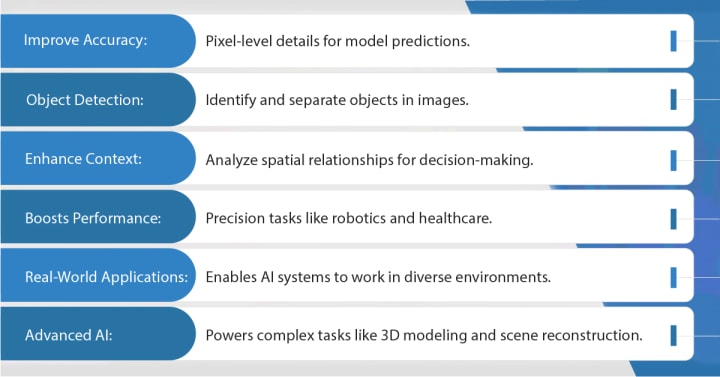
If we ask why semantic segmentation matters in AI and ML, the answer would be that without semantic segmentation, machines can't learn to see images pixel by pixel. Through semantic segmentation annotation, every pixel gets a label, which gives machines the ability to truly understand what they're looking at. This is no more a matter of technical choice, because semantic segmentation is what makes applications like self-driving cars and medical diagnostics possible.
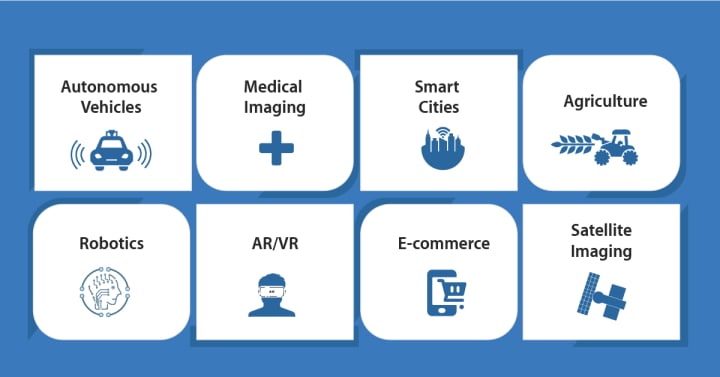
We can see how semantic segmentation services are changing the game across industries, such as autonomous driving, robotics, medical imaging and transport planning. When we pair semantic segmentation with deep learning, our systems gain the ability to identify exact object boundaries and interpret complex scenes. Looking at the techniques, applications and challenges of semantic segmentation helps us understand where computer vision technology is taking us.
What is Semantic Segmentation and How Does It Work?
What sets semantic segmentation apart is its approach to image understanding. While basic object detection draws boxes around things, semantic segmentation techniques go deeper, classifying each pixel individually. The output is a segmentation map where colors represent different objects—roads, cars, trees or whatever else we need to identify.
The heavy lifting happens through architectures like FCNs, U-Net, and Mask R-CNN. These semantic segmentation techniques process images through convolutional layers, maintaining spatial information throughout. This becomes critical in applications like autonomous systems, where precision determines safety. Applications include autonomous driving, which identifies lanes and obstacles, medical imaging for tumour detection, and smart city planning to analyze urban layouts. Semantic segmentation is essential for AI systems, providing the context needed for accurate decision making.
The role of semantic segmentation in computer vision continues to expand as we tackle more complex challenges. When we apply semantic segmentation in object detection, we’re essentially giving AI systems a more nuanced understanding of their environment.
Why Segmentation is Important in Machine Learning
Key Techniques in Semantic Segmentation
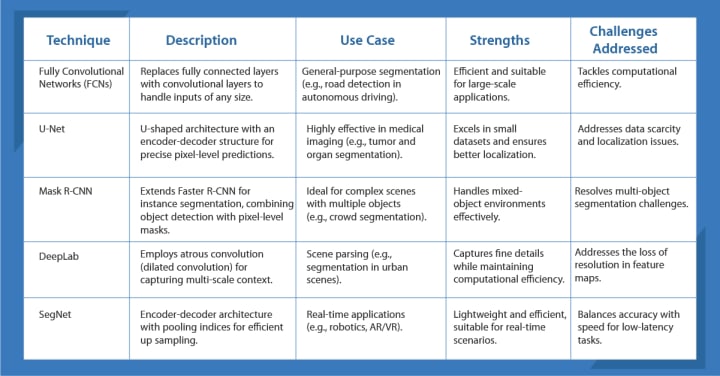
When exploring the key techniques in semantic segmentation, it’s is essential to understand their unique strengths and applications. Different models cater to specific needs, balancing speed, precision and complexity. FCNs prioritize computational efficiency but may compromise on precision, while U-Net ensures accuracy in smaller datasets. Mask R-CNN excels at combining object detection with segmentation, DeepLab captures a multi-scale context for complex scenes, and SegNet is tailored for real-time tasks. Below is a comparative table summarizing these techniques, their strengths and the challenges they address:
Challenges in Semantic Segmentation
Working with semantic segmentation in AI brings its own set of challenges. Data labeling demands significant resources—there’s no shortcut to marking every pixel correctly. One major hurdle is the need for extensively labeled datasets.
Annotating each pixel in an image is labor intensive, time consuming, and requires significant expertise, especially for complex or high-resolution images. Computational demands also pose a challenge, as segmentation models require substantial processing power and memory, particularly when dealing with real-time applications like autonomous vehicles.
Class imbalance poses another significant challenge—some objects appear far more frequently than others in our datasets, affecting model performance. Getting clean object boundaries remains tricky, particularly in real-world conditions. These challenges in semantic segmentation directly impact how we approach implementation.
Addressing these challenges is key to unlocking the full potential of semantic segmentation in AI applications. Understanding semantic segmentation helps organizations overcome these hurdles and fully leverage their transformative capabilities in computer vision.
Semantic Segmentation Services
The complexity of computer vision applications has made semantic segmentation services a crucial component in AI development. These services help tackle technical challenges through specialized tools and validation processes, enabling models to achieve higher accuracy and performance across diverse use cases.
Semantic segmentation services involve labeling each pixel in an image to categorize objects and regions with precision. They are integral to computer vision tasks, creating high-quality training data for machine-learning models. Key components include:
• Pixel-Level Annotation: Assigning labels such as road, pedestrian or vehicle to every pixel for precise recognition.
• Advanced Image Analysis: Enabling deeper insights into object boundaries and spatial context.
• Specialized Techniques: Leveraging models like FCNs, U-Net, and Mask R-CNN for high accuracy.
• Customization and Scalability: Tailored for industry needs and capable of handling large datasets.
From autonomous vehicles to healthcare, these services reduce manual annotation efforts while enhancing AI'’s ability to interpret and act on visual data effectively. Companies often rely on these services to generate precise and annotated data that enhance the accuracy and applicability of their AI models, especially for tasks where fine detail and context understanding are crucial.
These services reduce the time and expertise needed for manual annotation, allowing businesses to focus on leveraging AI insights effectively.
For instance, successful partnership with a Swiss food waste assessment provider enabled precise annotation of thousands of food waste images, enhancing machine learning models and driving accurate wastage analysis.
Applications of Semantic Segmentation in AI
The Future of Semantic Segmentation
Looking ahead, the future of semantic segmentation is evolving rapidly. Vision Transformers (ViTs) and generative AI are pushing the boundaries of what’s possible. Edge computing is bringing real-time segmentation to smaller devices, opening new possibilities for autonomous vehicles and robotics.
We’re seeing semantic segmentation in AI enable new capabilities in AR systems and 3D modeling. These advances are making semantic segmentation techniques more practical across industries, from agriculture to urban development.
Conclusion
Semantic segmentation has become fundamental to AI and machine learning, transforming how we build systems that understand visual data. Its ability to provide pixel-level annotations and detailed scene understanding has revolutionized industries, such as autonomous driving, healthcare, robotics and urban planning.
While different challenges persist, semantic segmentation services and advancing technology are breaking new ground. For teams working on AI systems that need to understand images, semantic segmentation has become a top priority, whose accuracy, quality and quantity determine AI success.
With continuous innovations in deep learning and real-time processing, the future of semantic segmentation promises an even greater impact, shaping intelligent systems across diverse applications. And by tying up with semantic segmentation services, organizations can unlock new levels of precision and efficiency.
About the Creator
Vaishali Sharma
I am a Digital Marketing Specialist at HitechDigital, a premier provider of business process services and data analytics solutions.
Keep reading
More stories from Vaishali Sharma and writers in 01 and other communities.
5 Ways Image Annotation Can Improve the Accuracy of Your Computer Vision Models
Image annotation plays a crucial role in the development and enhancement of computer vision models, serving as the backbone for training AI and ML systems to accurately recognize and interpret visual data like humans.
By Vaishali Sharma2 years ago in 01
Candace Owens pushes theory Charlie Kirk was 'time traveller' who went to 'X-Men school'
In a recent episode of her podcast, Candace Owens said Charlie Kirk told her he was a “time traveler” who was sent to “X-Men school,” and alleged he was monitored since childhood.
By Dena Falken Esq5 days ago in 01
How a Web Development Company in India Builds CMS eCommerce Sites?
The first CMS-based eCommerce project I watched unfold didn’t start with technology at all. It started with confusion. The client wanted an online store, a blog, marketing pages, and the ability to change everything without calling a developer every week. The development team didn’t argue platforms or frameworks. They asked questions—lots of them. That moment stuck with me because it explained how many teams in India actually approach CMS eCommerce work.
By Jane Smith2 days ago in 01
Rachel Reviews: The Spiral Archive by Pieter Hendrik
It's difficult for me to know where to start with a review of this book as it was, for me, an entirely unique experience and one that I'll probably never have again. I don't want that to be interpreted as unenjoyable but it has left me scratching my head a little and ruminating on its content, its themes and its characters.
By Rachel Deeming6 days ago in BookClub




Comments