

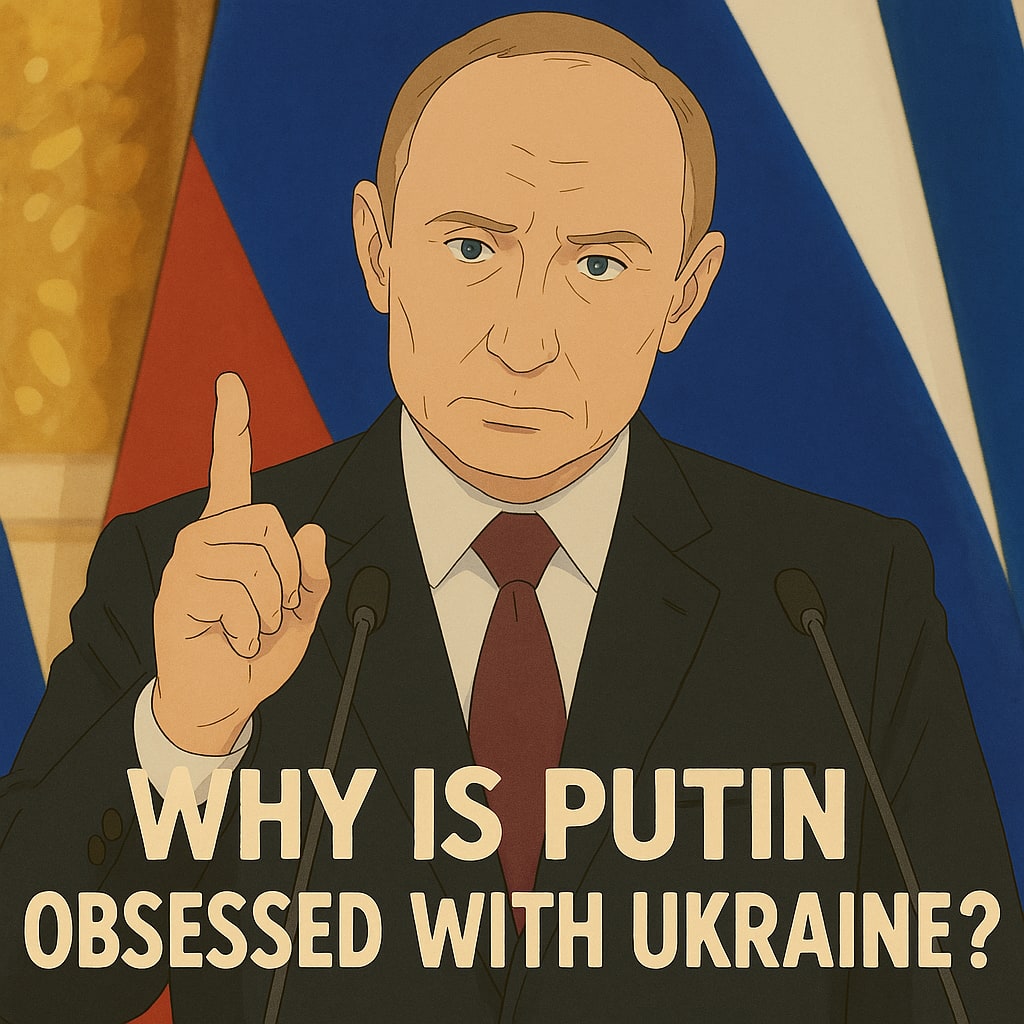
Vladimir Putin has always been a controversial man in the world of geopolitics, and for at least the last decade, it seems that Putin has always had one big goal, and that is Ukraine, where Russia and Ukraine were once part of the same nation, and later close allies, and ultimately sworn enemies, they have a history together that goes back thousands of years. But how did relations between Russia and Ukraine get to this point? Why is Putin obsessed with Ukraine? Let's take a look:
To better understand how important this region of the world is, we have to go back to the IX century, when several Slavic tribes came together and formed Kievan Rus, and Kievan Rus occupies a large area of what we now know as Ukraine, Russia and Belarus. And during the next few centuries Russia experienced very turbulent periods, as the capital was eventually changed from the city of Kiev to Moscow in the late thirteenth century.
There has always been a rivalry between Kiev and Moscow, at some point in history, both cities were part of the same nation and later they became separate, and after many years the signs of cultural separation began to appear, as Russians were mainly centered around Moscow, while Ukrainians were mainly centered around Ukraine, and throughout history, Russian nationalists have tried to argue that both Ukrainians and Russians are the same peoples, descended from Kievan Rus, while Ukrainian nationalists have always wanted a separate and completely independent identity from Russia.
Back in 1991, both the Ukrainian SSR and the Russian SFSR declared independence from the USSR, and for the first time in several centuries, Russia and Ukraine were completely separate sovereign states, and despite Ukraine's independence, Ukraine was very dependent on Russia, with the international community describing Ukraine as a “puppet” or “client”state.
In 2000, Vladimir Putin, who is called many names including communist, capitalist, dictator and nationalist, became president of Russia, and Putin wanted to change the direction of Russia away from the turmoil it faced in the nineties, initially focused on targeting separatists in Chechnya and improving the country's economic growth, but more importantly, focused on regaining some of the glory that Russia had lost on the international stage after the dissolution of the Soviet Union, most of the countries of the former Soviet Union were either strongly anti-Russian, such as the Baltic states, or strongly pro-Russian, such as Belarus or Kazakhstan, while Ukraine was somewhat somewhere in the middle, with a large number of Anti-Russian and pro-Western population.
Relations between Russia and Ukraine also experienced a lot of turmoil in the first decade of the 21st century, but Putin, as a former KGB spy, began to exert more pressure on Ukraine to resolve gas and other disputes between the two countries.
As for the goal pursued by Putin is for Russia to become a superpower again, be it economic, military or cultural, he also believes that Ukraine belongs to Russia, and in his opinion Russia is incomplete without Kiev, which he called the mother of Russian cities.
In 2010, Putin witnessed a major victory in Russia when Viktor Yanukovych was elected president of Ukraine after a narrow election victory, Yanukovych was simply a Russian puppet, as his presidential campaign received up to 200 million dollars from unknown Russian donors which may have played a role in his victory, and when he won the election, Yanukovych carried out whatever order Russia gave him, and almost all disagreements between the two countries were resolved.
Meanwhile, the Ukrainian people began to worry that Ukraine would become a client state of Russia, and the concern increased in 2013 when Yanukovych rejected an offer for Ukraine to sign a free trade agreement with the EU, hoping to improve relations with Russia, at a time when the Ukrainian people wanted better integration with the EU.
By the end of the year, protests broke out in Ukraine throughout the country, and as these protests grew, a full-fledged revolution was formed against the Yanukovych administration and Russian influence in Ukraine, as the revolution was very violent in which hundreds of demonstrators were killed by the Ukrainian government, with full Russian support, but in the end, it became too big for the government to deal with.
In the end, Yanukovych fled to Russia on February 21, 2014, where the Verkhovna Rada held a vote on his impeachment the next day, 328 out of 447 members of the Verkhovna Rada voted to remove Yanukovych from the post of President, and an anti-Russian Ukrainian nationalist president named Petro Poroshenko was elected, turning Ukraine and Russia into sworn enemies.
Over the following years, Putin made repeated attempts to put pressure on Ukraine, ordered the annexation of Ukraine's Crimea peninsula in 2014, and worked to arm several Russian rebel groups on the eastern side of the country, but with Ukraine's growing support for the West, Putin seems to have no choice but to abandon his Russian nationalism, or start an all-out war against Ukraine.
And this brings us to where we are today, where Russia has gathered more than 200 thousand Russian soldiers, militants, and separatists along the borders of Ukraine, and Russia has already begun attacks on Ukraine, declaring this step the beginning of the war.
About the Creator
ABDO
Professional article writer and designer.
Reducing AI Integration Failures by 40% With the Right Generative AI Consulting Partner
In the rush to adopt cutting-edge technologies, many organizations have jumped into artificial intelligence projects without a solid strategy, experienced guidance, or realistic expectations. As a result, a growing number of businesses report stalled initiatives, failed integrations, or tools that never deliver meaningful ROI. But when organizations align with the right generative ai consulting services, the narrative changes — often dramatically. With expert support, companies can reduce AI integration failures by up to 40% and unlock the full potential of intelligent systems.
By Steve Waugh4 days ago in 01



Comments
There are no comments for this story
Be the first to respond and start the conversation.