
Which is the Most Popular AI Framework?
Discover the most popular AI frameworks driving innovation today. Learn which tools top developers choose for building smart application

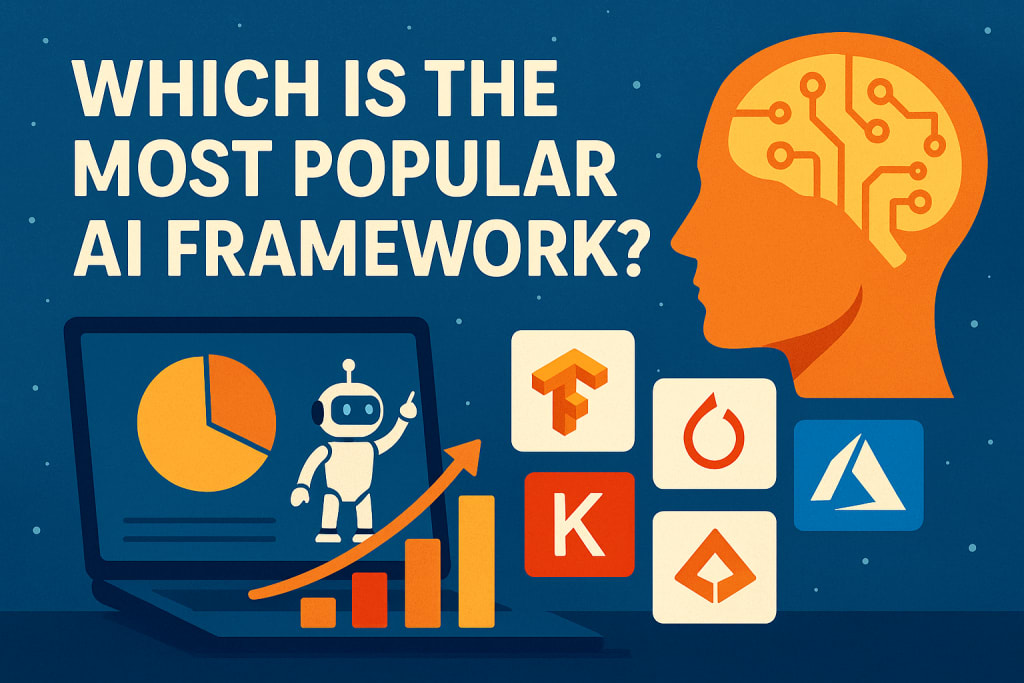
Artificial Intelligence (AI) has become a vital part of today’s technology, powering everything from voice assistants like Siri and Alexa to self-driving cars. At the heart of AI development are frameworks these are tools, libraries, and pre-built components that make it easier to build, train, and deploy smart models. With so many options out there, both developers and businesses often wonder: which AI framework is the most popular in 2025?
What is an AI Framework?
An AI framework is a software library or platform that simplifies the creation of machine learning (ML) and deep learning (DL) models. It offers pre-defined structures and tools to streamline tasks like data preprocessing, model training, evaluation, and deployment. These frameworks remove much of the complexity behind neural network operations and allow developers to focus more on problem-solving and innovation.
Core Features:
- Model Building: Tools to design and stack neural networks.
- Training: Functions to calculate errors, optimize models, and update parameters.
- Deployment: Support for running models in real time, including on mobile and edge devices.
- Scalability: Ability to handle large datasets and parallel or distributed training.
Top 8 Most Popular AI Frameworks in 2025
1.TensorFlow
Created by Google, TensorFlow is an open-source deep learning framework famous for its scalability and readiness for production. It has a huge ecosystem.
Pros:
- Scales easily across CPUs, GPUs, and TPUs
- Large community with extensive documentation
- TensorFlow Lite supports mobile and edge devices
- TensorBoard provides excellent visualization tools
Cons:
- Can be tough to learn, especially at first
- Early versions had verbose syntax
2.PyTorch
Developed by Meta (Facebook), PyTorch is known for its flexibility and dynamic computation graph, which researchers love. It’s quickly becoming an industry favorite.
Pros:
- Dynamic computation graph enables easy debugging
- Clean, intuitive syntax
- Strong community support
- Widely adopted in academic research
Cons:
Earlier versions lacked some production features (now fixed)
Slightly less performant than TensorFlow for very large deployments
3.Keras
Keras is a user-friendly neural network API that runs on top of TensorFlow. It’s great for beginners and fast prototyping.
Pros:
- Simple, readable code
- Seamless integration with TensorFlow 2.x
- Excellent for quick experiments
Cons:
- Less flexible for complex, custom models
- Training can be slower compared to raw TensorFlow or PyTorch
4.Scikit-learn
Scikit-learn is a Python library focused on traditional machine learning algorithms like regression, classification, and clustering.
Pros:
- Clean and consistent API
- Perfect for classical ML tasks
- Great for learning and small projects
Cons:
- Not designed for deep learning or GPU use
- Doesn’t scale well for massive datasets
5.Hugging Face Transformers
Hugging Face offers an open-source library with cutting-edge natural language processing (NLP) models such as BERT and GPT.
Pros:
- Pre-trained models ready to use
- Easy to fine-tune and deploy
- Wide NLP support with minimal coding
Cons:
- Requires powerful GPUs for large models
- Mainly focused on NLP, less on vision or other areas
6.JAX
JAX, from Google, is a high-performance library for numerical computing and automatic differentiation.
Pros:
- Extremely fast with XLA compiler optimizations
- Functional programming style
- Great for research in ML optimization and physics simulations
Cons:
- Smaller community
- Functional style can be harder to learn
7.Apache MXNet
Supported by Amazon and used in AWS, MXNet is a scalable deep learning framework.
Pros:
- Supports multiple languages (Python, Scala, C++)
- Efficient cloud deployment
- Hybrid programming model (symbolic + imperative)
Cons:
- Smaller community compared to TensorFlow and PyTorch
- Less high-level functionality
8.ONNX (Open Neural Network Exchange)
ONNX isn’t for training models but acts as a common format to move AI models between frameworks like PyTorch and TensorFlow.
Pros:
- Makes it easy to share models across platforms
- Supported by big names like Microsoft, Meta, NVIDIA
- Has an optimized runtime for inference
Cons:
- Limited support for training
- Can sometimes have compatibility issues with advanced features
Most Popular AI Framework in 2025: Final Verdict
Looking at developer usage, GitHub stars, community activity, and adoption in both academia and industry, PyTorch stands out as the most popular AI framework in 2025.
Why PyTorch Leads:
- Strong presence in research and growing in production
- Dynamic computation graph makes model building intuitive
- Large community with plenty of tutorials
- Better deployment tools like TorchServe and TorchScript
TensorFlow still holds a strong position in enterprise environments, thanks to its mature ecosystem. Hugging Face leads in NLP but focuses on a specific domain. Overall, PyTorch offers a great balance of ease of use, performance, and flexibility.
Conclusion
The AI framework landscape in 2025 is vibrant and competitive. PyTorch, TensorFlow, and Hugging Face lead the way, each excelling in specific areas. The right choice depends on your project goals whether you're doing deep learning research, building production-grade apps, or working on NLP tasks.
If you're planning to integrate AI into your product or platform, collaborating with a trusted Custom Software Development Company can help you choose and implement the right framework effectively. As AI continues to evolve, these tools will keep pushing the boundaries of what’s possible in artificial intelligence.
About the Creator
Nico Gonzalez
Hi, I'm Nico Gonzalez! I'm passionate about technology, software development, and helping businesses grow. I love writing about the latest trends in tech, including mobile apps, AI and more.
Keep reading
More stories from Nico Gonzalez and writers in 01 and other communities.
Benefits of Digital Transformation for Travel Agency
In today’s hyper-connected world, the travel industry is experiencing a major shift, driven by rapidly evolving technology and rising customer expectations. Digital transformation in travel industry is not just a passing trend, it's a critical step forward that’s redefining how travel agencies operate, interact with travelers, and stay competitive. Whether it’s offering instant bookings, sending real-time updates, or creating personalized experiences, agencies that embrace digital tools are seeing major improvements in how they do business. In this blog, we’ll break down what digital transformation means for travel agencies and explore the biggest benefits it brings.
By Nico Gonzalez8 months ago in 01
Top 10 Enterprise App Development Companies in Arizona for 2026
Arizona has become one of America's most important technology corridors. The Greater Phoenix metro hosts over 108,000 tech workers, TSMC is investing billions into semiconductor plants across the Valley, and enterprise software firms are multiplying fast. For businesses in healthcare, finance, logistics, real estate, or manufacturing, finding the right enterprise app development company in Arizona has never been more important.
By Sherry Walker4 days ago in 01
AI and Real Estate Apps: The Next Big Innovation in Property Tech
The real estate industry is undergoing a major digital transformation, and artificial intelligence (AI) is at the center of this evolution. Traditional property buying and selling processes—once dependent on physical visits, manual paperwork, and delayed communication—are now being replaced by intelligent, app-driven experiences. AI-powered real estate applications are redefining how buyers search for homes, how agents manage leads, and how deals are closed.
By Aarti Jangid6 days ago in 01




Comments
There are no comments for this story
Be the first to respond and start the conversation.