
What would happen if the Earth stopped spinning?
.

What would happen if the Earth suddenly stopped spinning? It's possible that billions of years from now, the Earth could come to a standstill. However, it's more likely that other events, like the Sun swallowing the planet, will happen first. That said, there's no chance the Earth will just stop spinning anytime soon. But let's imagine for a moment that it did stop rotating and see what would happen to us and the planet. Our planet spins at about 1,000 miles per hour at the equator as it orbits the Sun, but the rotation slows down as you move toward the poles. Without this rotation, life as we know it wouldn't exist. It's believed that billions of years ago, our planet spun much faster than it does today. In the early days of our solar system, a large celestial body collided with the Earth, changing its alignment and rotation, which also led to the formation of the Moon. Since that time, the Earth's rotation has been gradually slowing down. The Moon is said to have also spun faster in the past before it became tidally locked with the Earth. Tidal locking is when a moon's orbital period matches its rotational period. This is the same fate that affects all large moons orbiting planets, like our Moon. In the early solar system, both the Earth and the Moon rotated independently. However, the Earth's gravity pulled on the tidal bulges, slowing the Moon's rotation. To balance the loss of momentum, the Moon drifted away from the Earth to its current position, about 230,000 miles away. The Moon also affects the Earth, as the same tidal forces that create tides are gradually slowing down the Earth's rotation bit by bit, while the Moon continues to drift away a few centimeters each year. If the Earth were to stop spinning, there are two different scenarios to consider, but it wouldn't be tidally locked to the Sun On its equator or at the substellar point, temperatures would soar to such extremes that survival would be nearly impossible. Conversely, the cold side of the planet would face a different scenario. The absence of the sun's warmth on the dark side would lead to the atmosphere transforming into a dense gas, which would then condense into liquid and eventually freeze into solid ice. However, it's unlikely that the atmosphere on the dark side would solidify completely. Instead, it would continue to condense, creating a vacuum that would draw air from the hot side, where the atmospheric gases would be expanding. This process might make the planet somewhat habitable, but the storms resulting from the clash of hot and cold air would be beyond imagination. Super storms would rage on both sides of the planet, with winds powerful enough to erode rock into sand. Following this, the Earth's magnetic field could cease to regenerate and gradually weaken over time. This decline occurs because the magnetic field is produced by a dynamo effect linked to the planet's rotation. Our magnetic field is crucial for maintaining our atmosphere and shielding Earth from cosmic rays. So, where does this leave humanity? We are a highly adaptable species that has managed to survive various disasters. Even with advanced technology, living on a planet that has stopped rotating and is tidally locked to the Sun would pose significant challenges. We might be able to manage our environment to some extent by going underground, but cultivating food in such conditions could prove difficult. Fortunately, there's no need to panic about this scenario occurring anytime soon, as physicists estimate it would take a billion years at the current pace
About the Creator
Keep reading
More stories from Wedeb Asmarina and writers in 01 and other communities.
Anxiety Attack or Panic Attack
Anxiety attack and panic attack: what distinguishes them? There is a significant amount of misinformation circulating on social media regarding this topic. If you are experiencing a panic attack, what is the most efficient and effective method to alleviate it? I am Dr. Julie, a clinical psychologist, and I will guide you through this discussion. Let us begin with the initial question: what differentiates an anxiety attack from a panic attack? The term 'anxiety attack' is increasingly being utilized online and on social media, often to signify various meanings. This is primarily because it is not classified as a clinical disorder or diagnosis; thus, it is not a term recognized or employed by professionals to convey a specific meaning. When there is no universally accepted definition or criteria for a term, it is crucial to remain cognizant of this fact. When you hear individuals using the term, unless they clarify their definition, it can mean different things to different people. I have observed individuals on social media attempting to outline criteria for what constitutes an anxiety attack, but such criteria are not acknowledged by mental health professionals. It is frequently used to describe a general accumulation of anxiety, such as in the lead-up to a social event, an examination, or an interview. Furthermore, a common misconception found online is that an anxiety attack is triggered by a specific event or circumstance, while panic attacks typically lack a clear identifiable trigger. This notion is entirely inaccurate; the distinction is not that straightforward. Many individuals experience elevated levels of anxiety without understanding the cause, and conversely, numerous individuals encounter panic attacks that are highly predictable and linked to specific situations they are fully aware of. Therefore, whether or not you can identify a specific trigger does not dictate whether you are experiencing a panic attack. A panic attack is characterized by a sudden onset of intense fear and Discomfort that peaks within minutes can lead to a variety of intense symptoms. We are looking for around four from the following list: palpitations, which is the sensation of a pounding heart; sweating; trembling; shaking; feelings of shortness of breath, as if you cannot catch your breath; sensations of choking; chest pain; nausea; abdominal distress; dizziness or lightheadedness, or the feeling that you might faint; derealization, which involves feelings of unreality; depersonalization, or the sensation of being detached from oneself; fear of losing control or going insane; fear of dying; and numbness or tingling sensations. You may also experience chills or heat sensations, such as hot flushes. While it is possible to be in a heightened state of anxiety, a panic attack occurs when that anxiety escalates to such an intensity that the symptoms become so overwhelming that you may feel as though you are dying or losing control. Experiencing a panic attack does not necessarily indicate that you have a panic disorder; panic attacks can be associated with various other factors, including trauma reactions, separation anxiety, obsessive-compulsive disorder, or specific phobias. However, if you experience more than one panic attack, it is advisable to consult a doctor or psychologist who can assist you in understanding the underlying issues and their connections. If you are experiencing panic attacks, what steps can you take? I will outline some of the key therapeutic tips. One of the most crucial pieces of advice regarding panic attacks is to first comprehend how anxiety can escalate into a panic attack. The trigger for a panic attack may originate from an external source, such as an event or a specific situation, like being in a supermarket or a crowded area. Alternatively, it may be internal; for instance, it could begin with a physical sensation that resembles anxiety. An example of this might be having a strong coffee at breakfast, which later results in your heart racing in your chest. If this occurs and you have previously struggled with anxiety, you may Be aware that when you experience palpitations, your immediate reaction may be to think, "Oh no, I'm becoming anxious; this is very concerning, and I might lose control." What you are sensing is a form of threat, whether it pertains to your feelings or an external danger. Consequently, you may become increasingly apprehensive about the escalation of anxiety, leading to heightened vigilance regarding any additional anxiety symptoms. As a result, you begin to notice these symptoms more acutely, which in turn exacerbates your feelings of anxiety. As your threat response intensifies, it is crucial to recognize the next phase, as this is when anxiety can escalate into a panic attack. This occurs when you start to misinterpret one or two symptoms as catastrophic, leading to fears of complete loss of control, total humiliation, or even death. For instance, many individuals experience chest pain and instinctively think, "I am having a heart attack." Others may feel a constriction in their throat, a dry mouth, and shortness of breath, prompting thoughts of suffocation. Regardless of the specific details, if you convince yourself that you are on the brink of death or utter humiliation, your anxiety will escalate, potentially resulting in a panic attack. If you do experience a panic attack, what can you do? First and foremost, remember that during a panic attack, your body is functioning effectively; it is responding as it was designed to. Therefore, when your heart races and your throat feels dry due to anxiety, you are indeed safe. Developing a genuine awareness of what these signs mean for you will help you recognize them as anxiety in the future. If you can identify them as anxiety, you can disrupt the cycle of misinterpreting these symptoms, which can lead to a panic attack. Secondly, focus on your breathing. One of the most effective methods to calm the mind is through the body. If you can extend your exhalation, meaning you breathe out for a slightly longer duration than you inhale, after a few minutes, your brain will begin to To begin, it is advisable to instruct your heart to decelerate. You might consider practicing a technique similar to the 7-Eleven method to initiate this process, which involves inhaling for a count of seven and exhaling for a count of eleven. The exact numbers are not of paramount importance; rather, focus on what feels most comfortable for you. The goal is to exhale for a longer duration than you inhale, and to maintain this practice for several minutes. Allow yourself some time for this technique to take effect, as it will not yield immediate results, so be patient with yourself.
By Wedeb Asmarina7 months ago in Humans
What Makes Mobile App Development Austin Projects Hard to Scale?
When the numbers first climbed, everything felt like momentum. More users meant validation. More activity meant progress. Dashboards looked healthy enough that nobody wanted to slow things down by asking uncomfortable questions.
By Mike Pichai4 days ago in 01
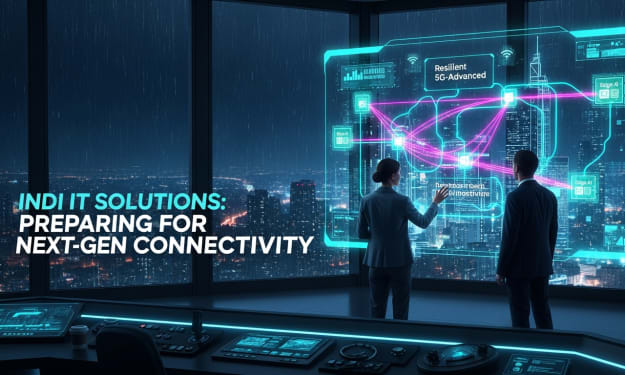
How Indi IT Solutions Prepares US Firms for Next-Gen Connectivity
US firms are hitting a connectivity wall. Legacy 4G-era systems are failing now. Static cloud models do not work well. They fail to meet sub-15ms latency needs. These needs are vital for 2026 operations.
By Devin Rosario3 days ago in 01
The Devil's Triangle
The sails ruffled in the breeze as we cruised along. The Sea Breeze was a mid-size catamaran that sailed out of Royal Naval Dockyard in Bermuda. We had booked this trip weeks in advance and were now looking at our Captain, Spike and two boat hands. Paddy and Wilson seemed like nice guys, joking around with the passengers and telling us some stories about Bermuda that only locals would know. Their island accents sounded almost British but they were pleasant to listen to.
By Barbara Gode Wiles5 days ago in Fiction



Comments
There are no comments for this story
Be the first to respond and start the conversation.