
What Is The Iris Recognition And How Do They Work?
Iris Recognition
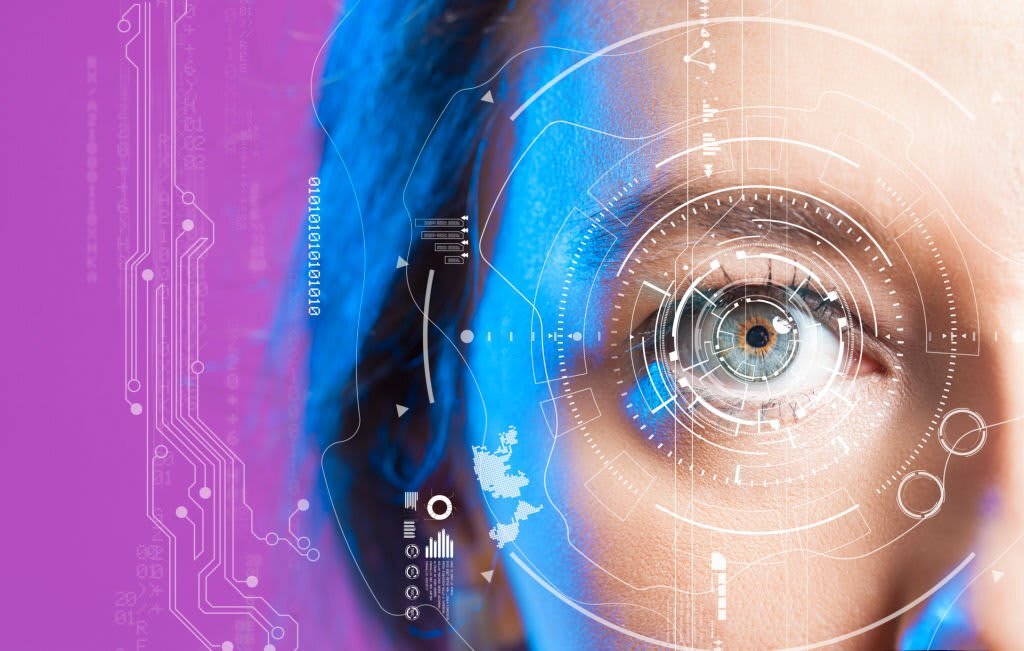
The iris of the eye predetermines the color of a person's eyes. If we look closely at the eyeball, lines can be seen on its surface that form a particular pattern, which is unique to any person and different for each eye (the right one has one, while the left one is completely different). It is very complex and practically does not change over time, just like fingerprints.
The iris scanner is designed to read this pattern and correlate with previously saved patterns. Near-infrared radiation is applied to scan the iris pattern. Firstly, it allows the scanner to work even in the dark, and secondly, it reads the image much more accurately than the radiation of the visible light spectrum. Glasses and contact lenses do not impede the passage of light rays, so they do not have a negative effect on the quality of recognition.
After the scan is complete, the drawing is translated into code that is compared to the previously saved record. If both match, the device is unlocked.
WHAT IS IRIS SCANNING? DEFINITION AND MEANING
Iris and retina scanning and recognition technologies are reliable methods of biometric identification. They have different characteristics that have a strong impact on their performance depending on environmental conditions and deployment goals. Both use non-contact scanners, but there are also notable differences between iris recognition and retinal scanning.
One of these differences is that iris recognition is considered a non-invasive method, while scanning the retina of the eye is, as visible light rays enter the eye during the scanning process.
These biometric identification technologies are often mistakenly perceived as the same thing, despite their individual differences. In this article we will discuss what distinguishes these two technologies that are being actively implemented in access control systems today.
HOW DOES THE IRIS SCANNER WORK?
Retinal scan biometric technology is used to display a unique pattern of the human retina. The blood vessels within it absorb light more intensely than the surrounding tissues, so they are easy to identify. Scanning the retina of the eye is performed by projecting a ray of infrared light not perceived by the eye into the human eye through the eyepiece of the scanner.
Because the blood vessels in the retina absorb this light more intensely than the rest of the eye, a specific pattern is created during the scan that is converted into computer code and stored in a database.
Retinal scans also have medical applications. Infectious diseases such as AIDS, syphilis, malaria, chickenpox, as well as hereditary diseases such as leukemia, lymphoma, and sickle cell anemia have effects on the eyes. Pregnancy also affects them, in addition to the signs of some chronic diseases, such as chronic heart failure or atherosclerosis, appear first in the eyes.
WHY IS IRIS RECOGNITION A UNIQUE TECHNOLOGY?
The iris of the eye is a tinted ring in the front part of the pupil, consisting of muscle and connective tissue and pigment cells, which change the size of the pupil. The pattern of the iris is unique and does not repeat itself even in twins.
The main advantages of iris recognition technology are that it does not need contact, the process is fast, it has a relatively high accuracy, and it is capable of long-distance operation. Recognition by the iris of the eye requires special equipment, which is why it is less common. However, recent innovations in biometrics have made the technology more affordable in terms of cost and installation. Thus, iris recognition is becoming more and more popular, especially in the field of consumer electronics.
WHERE ARE IRIS SCANNERS USED?
Iris scanners are used, for example, in the personal use of different users for the storage of information or access to an area. They are also found in offices, buildings and schools or universities. This technology gives great potential for biometric access and defense of personal data, in addition to creating a high level of defense since the entry key is biometrically in the user, making it almost impossible to falsify.
ADVANTAGES OF THE IRIS
- The speed: you only have to show the iris of the eye to the scanner.
- The identifier (eye) is always with the user, it is not necessary to memorize it and it cannot be forgotten, as is often the case with the password, or lost, as happens with the alienated environment.
- If we characterize this method in general, we can say that the main advantage is convenience.
THE FUTURE OF THE IRIS SCANNER
Biometric authentication has been quietly entering our lives. In fact, before we only saw biometrics in fantastic movies and today we already unlock the smartphone with a fingerprint, facial scan or even iris. Therefore, the current biometric authentication capabilities, their applications and development prospects in the near future are analyzed.
Biometric authentication is based on the fact that each of us has a set of unique parameters that can be used for identification. The set of parameters available for processing and analysis is constantly increasing due to the rapid scientific and technological advances that have occurred in the last hundred years.
About the Creator
Keep reading
More stories from Bianca Evans and writers in 01 and other communities.
Multi-Factor Authentication (MFA) - Everything You Should Know
Multi-factor authentication ( MFA) is a security technology that requires multiple authentication methods from independent categories of credentials to verify a user's identity for a login or other transaction. Multi-factor authentication combines two or more separate credentials: what the user knows , such as a password; what the user has , such as a security token; and what is the user, through the use of biometric verification methods.
By Bianca Evans4 years ago in 01
Nathan Allen Pirtle’s Influence on Modern Brand Strategy
In today’s crowded digital landscape, brands are no longer built on advertising alone. They are shaped by culture, trust, storytelling, and the ability to move at the speed of the internet without losing authenticity. Few strategists understand this balance as clearly as Nathan Allen Pirtle. His influence on modern brand strategy reflects a deeper shift in how brands earn relevance, loyalty, and long-term impact.
By Jeffrey D. Gross MD7 days ago in 01




Comments
There are no comments for this story
Be the first to respond and start the conversation.