
What is IoT Hardware? How Does It Work?
This article explores what IoT hardware is, the different types of components involved, how they work together, and why they are essential for shaping the connected future.

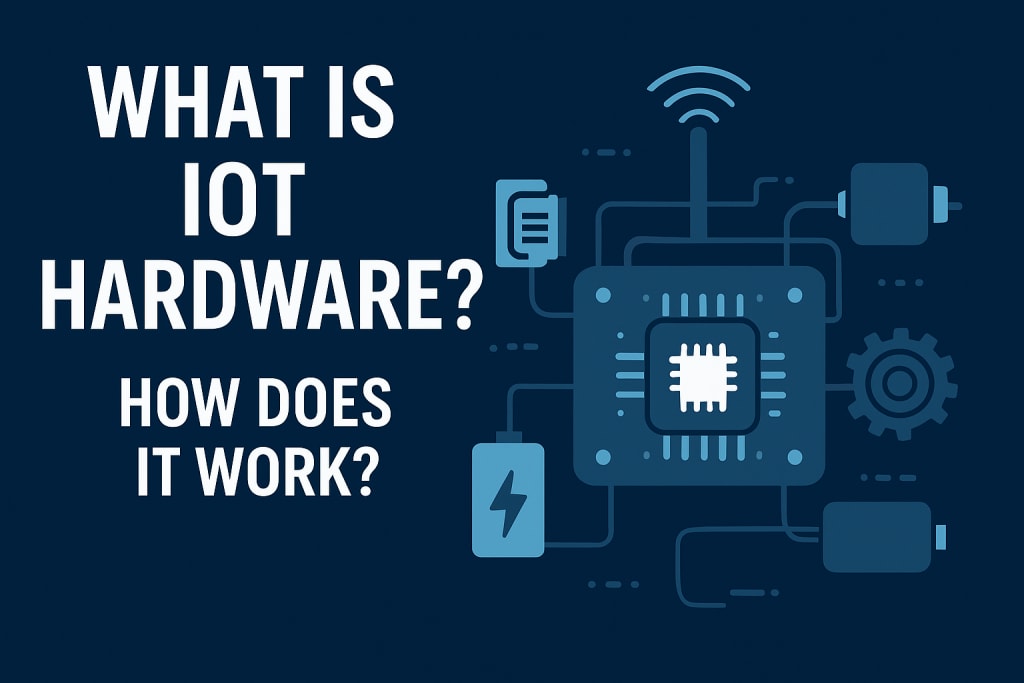
The Internet of Things (IoT) has revolutionized the way we interact with technology, bridging the gap between the physical and digital worlds. While most discussions around IoT tend to focus on software platforms, cloud integration, and applications, the foundation of every IoT ecosystem lies in IoT hardware. Without physical devices that sense, compute, and communicate, the “things” in IoT would not exist.
Understanding IoT Hardware
At its core, IoT hardware refers to the physical devices and components that collect data from the environment, process it, and transmit it to other systems. These devices can range from tiny sensors embedded in wearable devices to large industrial machines fitted with connected modules.
Every IoT device, no matter how simple or complex, consists of a combination of sensors, processors, actuators, communication modules, and power systems. Together, these components allow the device to interact with its environment and participate in a larger IoT network.
In short, IoT hardware acts as the bridge between the physical and digital worlds by converting real-world phenomena into usable data for analysis and automation.
Key Components of IoT Hardware
To understand IoT hardware, let’s break down its major building blocks:
1. Sensors
Sensors are the eyes and ears of IoT devices. They capture information about the physical environment and convert it into digital signals. Different types of sensors are used depending on the application, including:
Temperature sensors – Monitor heat and cold for smart homes, HVAC, and industrial systems.
Motion sensors – Detect movement in security systems or wearable fitness devices.
Light sensors – Used in smart lighting and energy-saving systems.
Pressure sensors – Found in automotive systems, healthcare devices, and manufacturing.
Biometric sensors – Capture human-related data such as heart rate or fingerprints.
Without sensors, IoT devices would have no way to “understand” the real world.
2. Microcontrollers and Processors
Sensors generate raw data, but it needs to be processed before being transmitted or acted upon. This is where microcontrollers (MCUs) and microprocessors (MPUs) come in.
Microcontrollers (MCUs): Compact chips that integrate CPU, memory, and input/output interfaces. Ideal for small, low-power IoT devices.
Microprocessors (MPUs): More powerful chips capable of handling complex computations, often used in gateways or industrial IoT systems.
Popular options include Arduino, Raspberry Pi, ESP32, and ARM-based chips.
3. Actuators
While sensors collect data, actuators perform actions based on processed information. For example:
A smart thermostat turning on an air conditioner.
An irrigation system opening a water valve.
A robotic arm adjusting movement in a factory.
Actuators make IoT systems interactive and responsive rather than just passive data collectors.
4. Communication Modules
IoT devices must communicate with other devices or the cloud. This requires connectivity hardware such as:
Wi-Fi modules – Ideal for home automation devices.
Bluetooth & BLE (Bluetooth Low Energy) – Common in wearables and short-range devices.
Cellular (4G, 5G, NB-IoT, LTE-M) – Used for wide-area IoT applications like smart cities and transportation.
LoRaWAN & Sigfox – Enable low-power, long-range communication.
Zigbee & Z-Wave – Popular in smart home ecosystems.
The choice of communication technology depends on factors like power consumption, range, data speed, and cost.
5. Power Management Systems
Since many IoT devices operate in remote or mobile environments, power efficiency is critical. Hardware includes:
Rechargeable batteries.
Solar cells or energy harvesting solutions.
Low-power chipsets designed to extend battery life.
Efficient power design ensures IoT hardware remains functional for years without frequent maintenance.
6. Edge Devices & Gateways
Not all IoT devices connect directly to the cloud. Some use edge computing to process data locally, reducing latency and bandwidth costs.
IoT Gateways act as intermediaries between devices and the cloud.
They handle data filtering, local analytics, and security functions.
Examples include industrial routers, smart hubs, and dedicated edge servers.
How IoT Hardware Works
The functionality of IoT hardware can be explained through a simple workflow:
Step 1: Data Collection
Sensors capture data from the physical world — temperature, motion, pressure, or any other measurable attribute.
Step 2: Data Processing
The microcontroller or processor interprets raw sensor signals. Basic devices may only perform minimal processing, while advanced devices apply machine learning at the edge.
Step 3: Communication
The processed data is transmitted via communication modules to other devices, gateways, or cloud platforms.
Step 4: Decision-Making
The IoT system (or cloud application) analyzes the data, compares it against predefined rules, or applies AI models to make decisions.
Step 5: Action
If required, actuators respond. For example, a smart lock opens, or a machine adjusts its performance.
This closed-loop process allows IoT hardware to create smart, automated, and data-driven environments.
Examples of IoT Hardware in Action
To better understand, let’s look at real-world examples:
Smart Home Devices
Smart thermostats (Nest, Ecobee) use temperature sensors, Wi-Fi modules, and actuators.
Smart bulbs integrate light sensors and Zigbee modules.
Healthcare Wearables
Fitness trackers measure heart rate, steps, and sleep cycles using biometric sensors and Bluetooth.
Industrial IoT (IIoT)
Machines are equipped with vibration and pressure sensors connected to gateways for predictive maintenance.
Smart Cities
Connected traffic lights, air-quality monitors, and waste management bins rely on low-power communication hardware like LoRaWAN.
Agriculture
Soil moisture sensors and automated irrigation systems optimize water usage.
Challenges in IoT Hardware Development
While IoT hardware has advanced rapidly, there are several challenges:
Power Efficiency: Ensuring long-lasting operation without frequent battery replacement.
Scalability: Designing hardware that works reliably when deployed in millions of units.
Interoperability: Devices must work across multiple standards and ecosystems.
Security: Protecting hardware from hacking and unauthorized access.
Cost vs. Performance: Balancing affordability with advanced capabilities.
These challenges drive continuous innovation in hardware design.
The Future of IoT Hardware
The next generation of IoT hardware is expected to be:
Smaller and More Powerful: Miniaturization will allow even everyday objects to embed connectivity.
Energy Harvesting Enabled: Devices will run indefinitely by drawing energy from light, motion, or heat.
AI-Powered at the Edge: Hardware will increasingly support machine learning for real-time decision-making.
More Secure by Design: Hardware-level encryption and authentication will become standard.
Integrated and Modular: Flexible designs will allow businesses to customize hardware for their specific IoT needs.
Why IoT Hardware Matters
IoT hardware is not just about “gadgets.” It is the foundation of digital transformation across industries. From enabling smart factories and connected healthcare to powering autonomous vehicles and sustainable agriculture, the quality and design of IoT hardware directly influence the efficiency, scalability, and success of IoT applications.
Simply put, without robust IoT hardware, the IoT ecosystem would remain a theoretical concept.
Final Thoughts
IoT hardware is the backbone of the Internet of Things, enabling devices to sense, process, and interact with the physical world. By combining sensors, processors, actuators, communication modules, and power systems, these devices bring intelligence into everyday environments.
As IoT continues to expand into every corner of our lives, from smart homes to smart cities, the demand for efficient, secure, and scalable IoT hardware will only grow. Businesses that understand and invest in this hardware foundation will be best positioned to harness the power of IoT for innovation and growth.
About the Creator
Alicia Black
Alicia Black is a dynamic digital marketing professional with a strong foundation in web and app development, email marketing, content creation, and AI-driven strategy.
Keep reading
More stories from Alicia Black and writers in 01 and other communities.
The Future of SEO in 2025: Why Smart Businesses Are Doubling Down on Search Optimization
In 2025, the digital world is moving faster than ever. With AI-driven search algorithms, voice search, and an increasingly competitive online marketplace, businesses can’t afford to ignore Search Engine Optimization (SEO). For small and medium-sized companies especially, SEO is no longer optional—it’s the difference between thriving online and getting lost in the noise.
By Alicia Black7 months ago in 01
Cost to Develop an App Like Tinder: Your 2026 Guide
Building a dating app right now feels like trying to catch lightning in a bottle. Y'all probably think it is just about swiping, but the tech underneath has grown quite thick lately. I reckon you are looking at a massive range of prices.
By Sherry Walker5 days ago in 01
The Technology Driving Interactive Education Apps
Education has evolved significantly in recent years, largely due to rapid advancements in digital technology. Traditional classroom learning is no longer the only method for gaining knowledge. With the rise of smartphones, tablets, and high-speed internet, learning has become more accessible, flexible, and engaging. Interactive education apps are at the center of this transformation, offering students and educators innovative ways to connect, learn, and share knowledge anytime and anywhere.
By Nayel Basim Al Shehhi6 days ago in 01




Comments
There are no comments for this story
Be the first to respond and start the conversation.