
What Are Passive Electronic Components? Why Do They Matter?
Understanding the Key Functions and Importance of Passive Components in Electronic Circuits

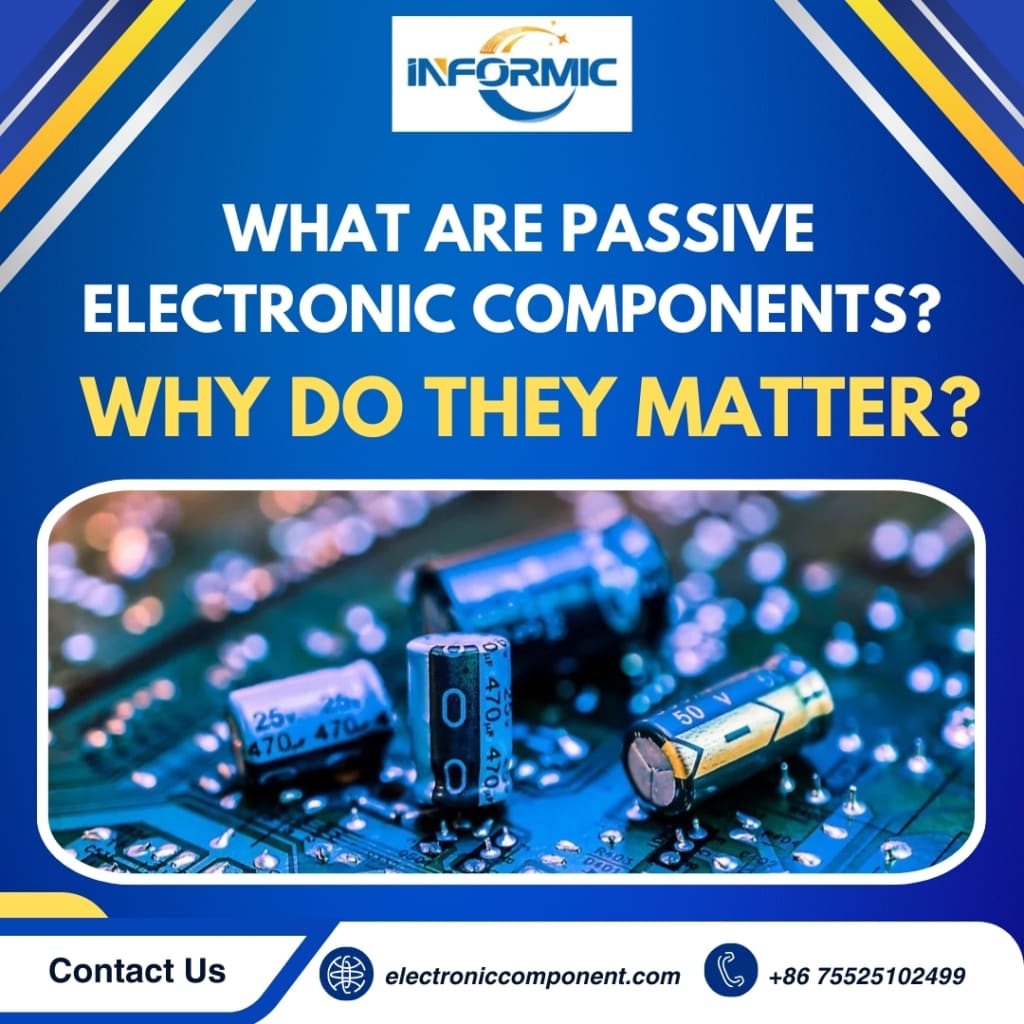
Today, the world is so driven by technology and electronics are found everywhere.
From a smartphone to an appliance in one's home to the car, electronic components power everything.
The general attention is always drawn to active components like transistors and integrated circuits, but passive ones have an equivalent status.
Without these passive components, no electronic circuit would work. But what are passive electronic components and why are they so important?
Well, let us break it down with some basics of passive electronic components and their types. Most importantly, what it means to modern electronics.
What Are Passive Electronic Components?
Passive electronic components comprise the electronic circuit building blocks. As opposed to active components like transistors and diodes, which need assistance from the external power source to operate, passive components do not need any power assistance to work. They use the energy already present in the circuit.
The hallmark of passive components is that they can not amplify or generate energy. Rather, they serve to control energy within a circuit and store or distribute energy. These components are critical in regulating current, voltage, and signals. Therefore, these components are important for any electronic device.
Most common examples of passive components are Resistors, capacitors, inductors and transformers. Each has a different characteristic. But they work together to keep electronic circuits functioning smoothly.
Types of Passive Electronic Components
Several types of passive components are designed to perform specific functions. The most common ones are:
1. Resistors
Resistors are the simplest. These are the most popular passive components. Its main function is to limit the flow of electric current and reduce it to a specific level. This is how the resistor protects the rest of the components of the circuit against the excess current. Otherwise, they may damage them.
Key Functions of Resistors:
- Voltage division within a circuit
- Limit current or prevent damage.
- Dissipating energy as heat.
For example, resistors ensure that the current is controlled in LED circuits. This prevents the LED from burning out.
2. Capacitors
The electronics capacitors store electrical energy. These components consist of two conductive plates separated by an insulation material- a dielectric. They are applicable in every area. They can be used for multiple purposes from smoothing out an electric supply to filtering signals.
Key Functions of Capacitors:
- Storing and releasing energy.
- Filtering out noise in power supplies.
- Blocking direct current while allowing alternating current to pass.
For instance, capacitors are used in electronic flash units in cameras. They store energy and release it quickly to produce a bright flash.
3. Inductors
Inductors are passive components that gather energy while electric current flows through them and store it in the magnetic field. They are coils of wire that primarily resist changes in current. Inductors are perfect for filtering and storing energy.
Key Functions of Inductors:
- Filtering signals in electronic circuits.
- Energy storage for power supplies.
- Reduction of electromagnetic interference.
Furthermore, inductors are generally used in radio frequency circuits to tune and filter signals.
4. Transformers
They help to transfer electrical energy through electromagnetic induction between two or more circuits. They can step up or down voltage levels. This makes them essential in power distribution and electronic devices.
Key Functions of Transformers:
- Changing voltage levels in power supplies.
- Isolation of circuits for safety purposes.
- Matching impedance in audio and RF applications.
For instance, your mobile phone charger contains a transformer. It converts high-voltage electricity from your wall outlet into a lower voltage that is ideal for charging your device.
5. Other Passive Components
Other than resistors, capacitors, inductors, and transformers, some passive components include:
Diodes (under some contexts): Though they're often considered active, diodes can function passively in rectification.
Crystal Oscillators: These are used in stabilizing frequencies in clocks and communication devices.
Filters: Combinations of inductors and capacitors designed to filter specific frequencies.
Why Do Passive Components Become Important?
Having known what passive components are, let us now see why they become so essential in electronics. Some of the important reasons are:
1. Stability and Control
Passive components provide stabilization of circuits with current and voltage influences. For instance, resistors make sure the correct current goes into sensitive components, such as LEDs or microchips, so that they can avoid overheating or malfunctioning.
2. Signal Processing
Capacitors and inductors play a major role in processing circuits for signals. They can filter out unwanted noise, ensuring that only the desired signals are transmitted. This is particularly important in communication systems and audio equipment.
3. Energy Storage and Conversion
Capacitors and inductors help in energy storage and conduction. In power supplies, they smooth out fluctuations in voltage and current, ensuring a steady supply of power to devices.
4. Safety
Transformers and resistors contribute to the safety of electronic devices. Transformers isolate circuits to prevent an electric shock whereas current is limited by resistors to prevent component damage.
5. Reliability
Passive components offer more reliability than active ones because they have no moving parts and don't need to use an external power source. So, they are less prone to failure, ensuring the longevity of electronic devices.
Passive Components Uses
Almost every electronic appliance has passive components. Some specific applications are:
Consumer Electronics: Passive components are used in smartphones, TVs, and computers. They do different jobs like signal filtering, energy storage and power regulation.
Automotive Industry: New car models use passive components in the sensors, lighting systems and other infotainment devices.
Medical Devices: Passive components are used for accurate signal processing and power regulation, as in heart monitors and various imaging devices.
Industrial Equipment: Passive components are being used in various machinery and control systems in order to provide stable operation and safety within those machinery.
Passive Component Selection
Selecting appropriate passive components for a circuit is very important. Some factors to consider are:
Specification: The respective voltages, currents, and power ratings should be compatible with the demands of the circuit.
Material: The quality of materials has an effect on performance as well as its durability.
Size: Miniaturization is important to modern electronics.
Tolerance: Components should work with appropriate tolerances, allowing for reliable performance.
Moreover, to get the best quality products choose the reputed electronic components distributor only as the quality and reliability of components may differ.
Final Words
Passive electronic components are the unacknowledged heroes of modern technology. However, they might not be as striking as active components. They provide stability, control, and safety in electronic circuits, ensuring that devices work efficiently and reliably.
The role of passive components in the complexity and accuracy of the electronics we use every day is worth appreciating.
A resistor regulates the current, a capacitor stores energy and a transformer changes the voltage. These components are necessary for modern electronics.
About the Creator
Shenzhen Informic Electronic Limited
As a trusted partner in electronic component sourcing, we at Shenzhen Informic Electronic Limited offer a vast inventory as a top electronic components distributor. For more information: https://electroniccomponent.com/
Keep reading
More stories from Shenzhen Informic Electronic Limited and writers in 01 and other communities.
The Growing Demand for Active Electronic Components
What makes your phone, car, or your favorite video game work so smoothly? Have you ever thought about this? It’s all thanks to tiny parts called active electronic components. These little helpers are super important in today’s world, and more and more people want them. In this article, we’re going to explore why these parts are in high demand, how companies are keeping up, and what’s next for them. Let’s understand!
By Shenzhen Informic Electronic Limited10 months ago in 01
Why Austin Startups Choose Native Over Cross-Platform in 2026?
In the bustling Austin startup ecosystem — a region with billions in early-stage funding and outsized startup growth compared with global averages (Austin’s ecosystem value recently reached about $64.6 billion compared with a global average of $20.4 billion) — founders are making a clear choice about how they build mobile products.
By Nick William7 days ago in 01
The Subtle Order Within CBD, Hemp, and THC Retail Spaces
Some retail environments are designed to draw attention. Others are designed to manage it. A CBD shop, hemp shop, or THC shop often belongs to the second category. These spaces are shaped less by marketing trends and more by careful organization, restraint, and an awareness of their surroundings.
By Abandoned Places near meabout 10 hours ago in 01
The Devil's Cut
“Comrade, finally you’re awake.” The voice was smooth, sensual. A flickering incandescent bar was all that lit the white, sterile room. All Vladimir remembered was everything going black. He tried to move his arms and found them strapped to the gurney.
By Matthew J. Fromm7 days ago in Fiction


Comments
There are no comments for this story
Be the first to respond and start the conversation.