
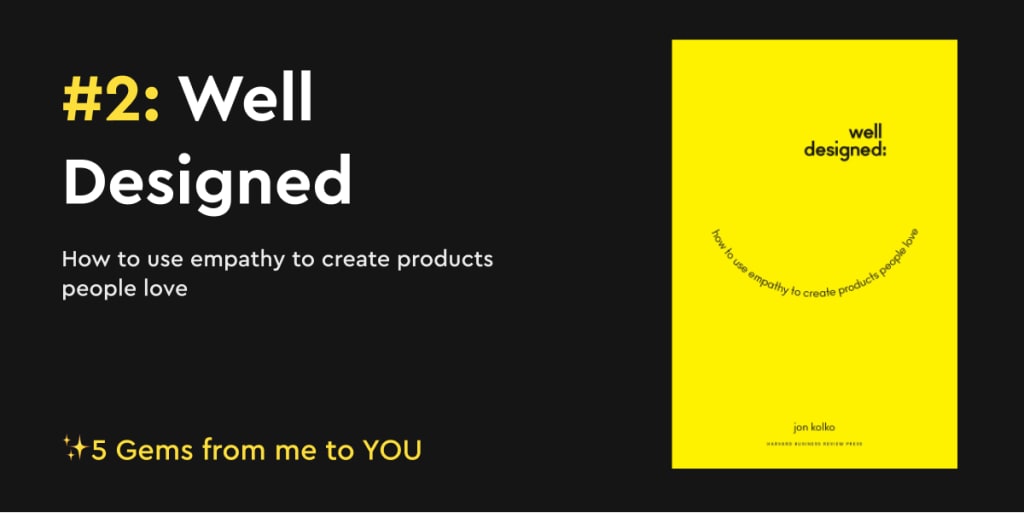
Well Designed: How to use empathy to create products people love
Sharing 5 Gems I got from reading this book!
Hey friends! 🤗
I just finished another book! 📖 Woohoo! 🎉 It took me longer than I had hoped but all the same, I finished.
“Well Designed” was a great read, especially for Product Managers and Product Designers. So, grab a notebook and a pen, because I’m about to share 5 amazing gems that’ll come in handy! 🤩 I promise they’re worth noting down!
1️⃣ Design, Design Process & Product Management are not exclusive
I’m sure the title of this gem gave you a bit of pause — and that’s totally reasonable! When it comes to design, design process, and product management, it can be easy to assume that they should be separate for a lot of reasons -but that’s not the case! When Product Managers and Designers work together, amazing products can be created. So if you’re a Product Manager, make sure to involve Designers in your strategizing and planning. And if you’re a Designer, don’t be afraid to talk to your PMs about your design approaches; brainstorm with them. With this kind of collaboration, the possibilities are endless! Don’t forget — when it feels hard, it’s because something great is worth working for!
2️⃣ Imagine Losing
Yeah, imagine losing. This point leans a bit more towards people who want to build products (not just products, amazing products ). This is how it works, imagine you were a product on the same shelf as your competitor. Two buyers who are in your target market approach your shelf and they end up picking the competing product. You lose, right? Here’s the fun part: think about why the other product was chosen — was it the price, the packaging, the messaging tone, marketing? Identify all these gaps and use them to build your product. Essentially, you’re taking the hypothetical and feeding it into reality. Biggest gem for me (though its not number 1)
3️⃣ Humanizing your product
“I’ve learned that people will forget what you said, people will forget what you did, but people will never forget how you made them feel.” — Maya Angelou .
This kind of sums up my thoughts. Just kidding.
In as much as people use products to satisfy needs, the ones that stick with them or stand out to them are those that make heavy impressions on them. Those ones will be the ones they will have at the top of their minds and run back to when they need that particular solved. And one way to stay at the top of your users’ minds is to assign human personalities to your product.
Identify what you want your product to be to your users; friendly, supportive, luxurious, authoritative, etc. It makes it easier to convey these personalities in your copy, feedback, interactions, interface, and others. Don’t forget to brainstorm this with your Product Manager and/or stakeholders.
Try this
What’s your favorite product?
Can you identify its personality? Why do you think so?
You can share your answers in the comment section.
4️⃣ Tell a story
Let’s assume you’re designing a karaoke music guessing game for families. Here’s how I would tell the story.
“The Adus are a 5-member family. They are a tight-knit unit and do everything together. It’s a Saturday night and they want something fun and different other than their usual activities. The father goes on to the appstore and sees {appName}, he reads the description, sees previews, and finds it interesting enough to download.
He opens the application and creates an account. He’s eager to start a game so he selects his caricature and provides his name. He selects the category he wants to play in. He’s starting. A 5-second audio plays and he sees 4 possible answers and makes a choice. He plays till all is done. He sees the scores on the leaderboard. Then passes the device to the next person”
This approach gives a very vivid overview of your potential users, their context, and how they’ll use the application. You set yourself up for designing the “perfect” solution
5️⃣ Ideate and Vary
Ideation is a term used in design to develop solutions for a problem. Designers either ideate or develop variations. Ideation is a creative process where they brainstorm and explore directions. The goal is to generate many ideas. Developing variations involves taking generated ideas and exploring different variations. Designers refine ideas by combining elements or executing them differently. Remember to ideate and vary to become more innovative and have fun!
Whew! Book #2 done. I can’t wait to get started on another. If you enjoyed this and kept a couple of gems for yourself, give me some 👏🏽 and leave some comments for me.
Till the next book, adios 👋🏾
About the Creator
Keep reading
More stories from writers in 01 and other communities.
Twitter Down
Twitter Down When a major social media platform like Twitter experiences technical problems, millions of users immediately search for answers. Twitter, also known as X, plays a central role in news sharing, public discussion, and real time updates, so even short disruptions can feel significant. Recently, many users have reported difficulties accessing Twitter, loading timelines, posting content, or using certain features. This has led to widespread questions about whether Twitter is down, why it happens, and what users should expect. This article answers the most common questions people search for and explains the situation clearly.
By America today a day ago in 01
Handbags and the Modern Conversation Around Replica Handbags
Handbags are one of the most enduring and adaptable accessories in human history. Originally designed as simple carriers for personal belongings, handbags gradually evolved alongside changes in clothing, travel, and social structures. Over time, they became objects that combine practicality with visual identity. Today, handbags are discussed not only as fashion items but also as cultural and economic symbols.
By charliesamuel6 days ago in 01



Comments
There are no comments for this story
Be the first to respond and start the conversation.