
Water Cooler Talk
Why Casual Conversations Are the Secret Sauce of Workplace Culture

If you ask people what they miss most about office life, the answer isn’t usually the commute or the endless meetings. More often than not, it’s the casual conversations—the quick hello in the hallway, the laughter over a shared snack, the spontaneous “Did you see that show last night?” around the water cooler.
These moments may feel small, but they carry an outsized influence on workplace culture. In fact, researchers have long pointed out that informal chats boost collaboration, trust, and even innovation. In a world where hybrid and remote work are here to stay, companies are rethinking how to recreate these cultural touchpoints digitally.
So, let’s dive into why water cooler talk matters, what happens when it’s missing, and how organizations can keep the conversation alive in the modern workplace.
The Real Value of Water Cooler Talk
At first glance, a five-minute conversation about the weekend barbecue or the latest Netflix hit might seem trivial. But beneath the small talk is something powerful.
- Relationship building: Informal chats are a low-stakes way for colleagues to get to know each other beyond job titles and tasks. They humanize people, which is the foundation of trust.
- Cross-team collaboration: Often, someone overhears a challenge, chimes in with a suggestion, and suddenly two departments are working together in ways that wouldn’t have happened through formal channels.
- Idea generation: Many breakthrough innovations don’t emerge from scheduled brainstorming sessions but from offhand remarks in casual conversations.
- Morale and wellbeing: Sharing a laugh or venting about a tricky project can ease stress and build camaraderie. That sense of belonging is a key driver of employee engagement.
According to a Gallup study, employees who report having strong friendships at work are seven times more likely to be engaged. And where do many of those friendships start? Around the water cooler.
What Happens When It’s Missing?
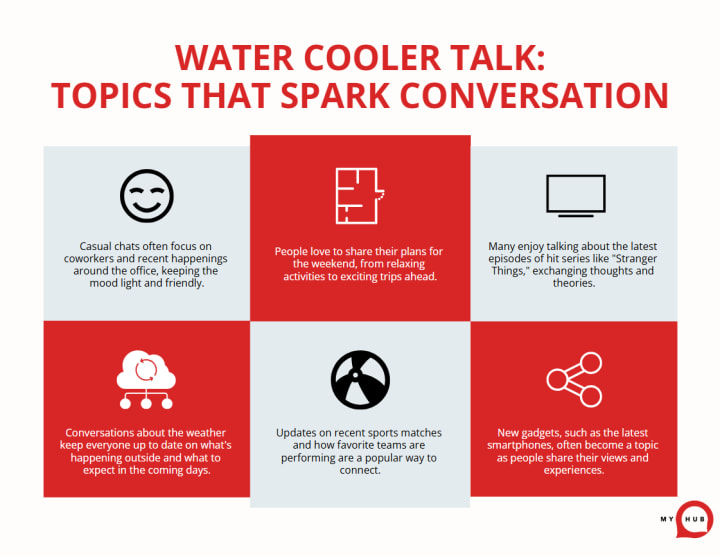
The absence of informal conversation can create more than just awkward silences. In fully remote or siloed workplaces, employees often report:
- Feelings of isolation: Without casual chatter, work becomes transactional and lonely.
- Reduced trust: If the only interactions are formal, it’s harder to develop the goodwill needed for teamwork.
- Slower knowledge sharing: Important context often travels informally. Without that, employees can feel left out of the loop.
- Lower engagement: A culture without levity and human connection feels flat, which can sap motivation.
In other words, water cooler talk isn’t fluff. It’s the connective tissue of organizational life. Without it, culture and collaboration both take a hit.
Reimagining the Water Cooler in a Digital World
With distributed teams, the traditional water cooler is harder to gather around. But that doesn’t mean casual conversation is a thing of the past. It just requires a digital rethink.
Here are a few ways organizations are recreating that sense of informal connection:
1. Digital Water Coolers
Modern intranet platforms like MyHub act as the central hub for both work and social interaction. Tools like team chat, discussion boards, and social feeds allow employees to connect naturally—sharing GIFs, quick wins, or even birthday shoutouts.
2. Virtual Coffee Breaks
Some teams schedule 15-minute “coffee chats” where work talk is off-limits. These help mimic the spontaneity of office conversations, even if they happen on Zoom.
3. Themed Channels
Creating Slack or Teams channels for hobbies—whether it’s #foodies, #pets, or #weekend-adventures—encourages employees to bring their authentic selves to work.
4. Digital Recognition
A quick “kudos” or shoutout on the intranet goes a long way. Recognition shared in public channels sparks positivity and can start conversations among colleagues.
5. Shared Rituals
From meme Fridays to monthly trivia, digital rituals build culture and replace some of the serendipity lost in remote setups.
The Business Case for Casual Conversations
Some leaders worry that encouraging chit-chat might hurt productivity. But research shows the opposite: teams that connect informally often collaborate more effectively and perform better overall.
- Innovation thrives when people feel comfortable speaking up and sharing ideas in informal ways.
- Employee engagement rises when people feel connected and supported.
- Retention improves because people are less likely to leave workplaces where they feel they belong.
- Knowledge flows faster when casual interactions supplement formal communication.
In other words, water cooler talk isn’t a distraction—it’s an investment in long-term productivity and culture.
Bringing Humanity Back to Work
At its core, water cooler talk is about humanity at work. It’s the laugh that breaks tension, the empathy that builds trust, the shared stories that create belonging. In a digital-first world, organizations need to be intentional about creating these spaces.
That’s why intranet solutions like MyHub are becoming essential. They don’t just streamline workflows and centralize documents—they make space for human connection, the kind that fuels collaboration and engagement.
If your organization is ready to bring some of that water cooler magic back—digitally and inclusively—you can book a free demo here.
Because when employees have room for small talk, big things happen.
(This article contains AI-generated material. The original version can be found on the MyHub Blog.)
About the Creator
MyHub Intranet
https://www.myhubintranet.com/about/
Keep reading
More stories from MyHub Intranet and writers in 01 and other communities.
Intranet Solutions
Work today doesn’t look like it did ten—or even five—years ago. Teams are hybrid, projects are global, and the tools we use multiply by the month. Amid all this change, one thing hasn’t gone away: the need for employees to connect, collaborate, and stay on the same page.
By MyHub Intranet5 months ago in 01
Google Billionaire Larry Page Snaps Up 2 Miami Mansions for $173 Million
Billionaire and Google co-founder Larry Page has shelled out more than $173 million in recent weeks, snapping up a pair of luxury estates tucked deep within Miami's discreet Coconut Grove enclave. Page made the high-dollar moves as speculation intensified over his broader departure from California, where a proposed ballot measure targets billionaires with a sweeping one-time wealth tax.
By Dena Falken Esq4 days ago in 01
How to Succeed at the Benson Directory®
Congratulations and welcome to the Benson Directory® employee #22391! As our newest call handler, you will have the privilege of speaking with dozens of unique and interesting people on a daily basis as well as the opportunity to earn bonuses for high performance. Contained within this handbook you will find a set of ease to follow instructions designed to help you settle in to your new role and begin paving the way to success.
By S. A. Crawforda day ago in Fiction



Comments
There are no comments for this story
Be the first to respond and start the conversation.