
Virtual Consort and the Other World
Today, humanity lives on the threshold of a parallel world whose hero is the "Avatar"


Today, humanity lives on the threshold of a parallel world whose hero is the "Avatar", or in a more clear expression, what has come to be called the virtual companion. Since the beginning of the second millennium, a system called "Second Life" has appeared on the Internet, offering its alternative world capabilities to users who are unable to achieve it in the real world. .
Almost every Internet user on the planet has a virtual companion that accompanies his real personality, and he leaves distinctive digital fingerprints for the simplest activities and practices of his daily life through which he interacts with smart applications.
We are in front of a world in which the real becomes virtual, in which the user can record his memories, opinions and personal experiences, so that he becomes the “other world” for an electronic companion, and the latter will live after the death of the real person, perhaps for centuries, where he can roam around the globe without a passport or identity, On foot, by plane, car or boat
Users of this world have the so-called virtual character and what is called in English (Avatar), and through this virtual character, the user can deal with the virtual environment surrounding him and also deal with the virtual characters of other users.
This consort has capabilities similar to the characters of actual reality, and sometimes even superior to them, as anyone can give him the form and function he wants and desires, such as the house he wants to live in, and he cannot get it in reality, and the job he has always dreamed of, and he only needs a click On a program to add to the "Avatar" features, and delete others, in order for the elusive dream to come true in reality, in addition to its use in many games and virtual reality applications around the world.
And close to the "world of metaverses" - which was announced a few months ago by the founder and president of Facebook Mark Zuckerberg at a conference considering this world the next generation of the Internet - we find Microsoft, which recently launched the "Horizon workrooms" project as an initial embodiment of metaverses; In preparation for entering the world of the avatar economy, and in this project, employees in the new “Horizon workrooms” can enter a virtual work office using a fictitious personality for each of them, and in this virtual room the user will see his computer and his colleagues, interact, deal and exchange ideas with them completely as if It was in a real business room in the building of the company or institution.
So, we are in front of a world in which the real becomes virtual, in which the user can record his memories, opinions and personal experiences, so that he becomes the "other world" of an electronic companion, and the latter will live after the death of the real person, perhaps for centuries, where he can roam around the globe without a passport or Identity, by foot or by plane, car or ship. He will choose where he will go and with whom he will travel and will deal, and will determine the method of buying and selling through cryptocurrencies that he cannot even catch.
It is another world in which people - in the era of the Fourth Industrial Revolution - unleash their dreams that they cannot achieve on the ground. They will roam freely there, they can build the friendships they want, and they can chat via text, audio and even video. It is the investment in the virtual field and augmented reality in which the specialized figures indicate that it will double 21 times over the next four years, to reach 15.5 billion euros in 2022, meaning that virtual reality is no longer science fiction after its integration into our present and reality, and there are those who herald a fourth type. From virtual reality, it does not exist yet, but it is widely used in the ideas of science fiction literature, in which addressing the senses is transcended to addressing the mind directly.
Did you know, dear reader, that there are more than 4.66 billion active users on the Internet all over the world, and many of them may be wondering whether we should be afraid of the future or unleash the future and its surprises? How will we benefit from this comprehensive digital revolution based on information and communication technology, and how will we avoid its harms and dangers? Will these technologies unlock and increase our capabilities, or will they limit them? Will we remain captives to the world of "Metaverse" that Mark Zuckerberg preached, which in the next ten years may represent a reality in which one billion users, hundreds of billions of dollars of digital commerce, and millions of jobs for creators and developers? Will the "Metaverse" generation see itself as an exceptional generation that lives a unique life compared to previous or even future generations? The most important question remains, "Where are we going?"
About the Creator
Keep reading
More stories from Roxanne Mann and writers in 01 and other communities.
For Whom is Global Citizen Network?
The past days witnessed a strange event, which the media did not pay attention to, in its busy coverage of the war in Ukraine, although the event was not far from it. The Global Citizen Foundation was able to raise more than $10 billion for the benefit of Ukrainian refugees, in a global event that demonstrated the global impact of the Foundation, in putting pressure on world leaders and decision-makers, to provide support and assistance that alleviate the suffering of peoples, and help them face the results of the crisis. crises they are going through.
By Roxanne Mann4 years ago in 01
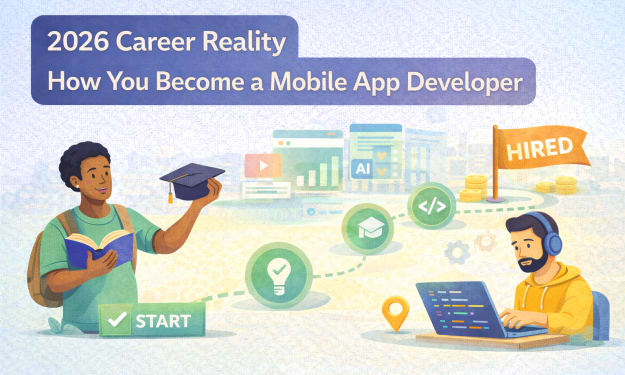
2026 Career Reality How You Become a Mobile App Developer
In 2026, the question how do you become a mobile app developer is no longer answered by learning a stack and shipping an app. A tectonic shift inside the Google ecosystem has tied developer relevance to AI Retrieval, Zero Click behavior, and entity-level trust, creating direct career risk for those who build without authority awareness.
By Mike Pichai6 days ago in 01



Comments