
Villanelle of Regret: A Story Told in Circles
1.🎭 Why the Villanelle Mirrors Human Regret. 2.🌒 The Heart as a Poet of Regret. 3.✨ The Poem: Villanelle of Regret. 4.🔍 What the Poem Reveals. 5.🌅 Turning Regret Into Reflection. 6.🌟 Final Thoughts: A Poem That Teaches Us How to Heal.
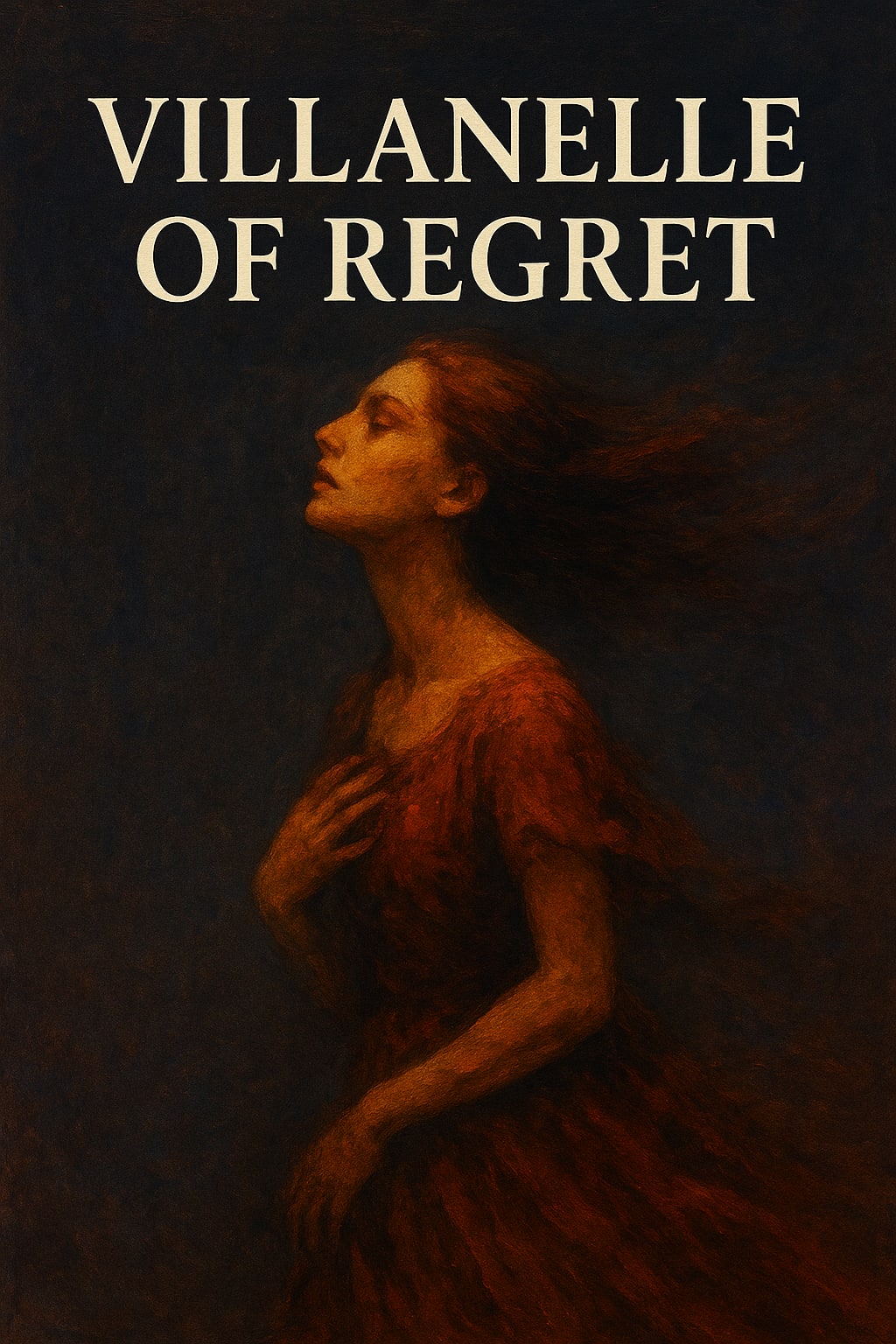
Regret is one of the few emotions that refuses to age. It does not fade with time, nor soften with distance. Instead, it circles back—again and again—like a whispered refrain we once tried to forget. Perhaps this is why the villanelle, with its repeating lines and looping structure, feels like the perfect vessel for expressing remorse. A villanelle does not move on quickly; it returns, revisits, and reopens the doors we thought we had closed.
In this article, we explore the meaning of regret through the poetic lens of the villanelle, and how the human heart often becomes a poet against its own will—crafting stanzas out of memories, stitching rhymes out of mistakes, and repeating emotional refrains until we finally learn from them.
---
🎭 Why the Villanelle Mirrors Human Regret
A villanelle is shaped by three defining traits:
1. Repetition
Two lines repeat throughout the poem, echoing like thoughts we cannot silence.
2. Circular Movement
The poem returns to its beginning—just as the mind returns to the past.
3. Emotional Compression
With only 19 lines, every word must hold weight, just like every memory in a moment of regret.
Unlike other poetic forms, the villanelle forces us to sit with the emotion.
There is no escape, no digression, no fading.
The form itself becomes the message:
what hurts will return until it is understood.
---
🌒 The Heart as a Poet of Regret
Every regret has its own voice. Sometimes it whispers, sometimes it shouts, and sometimes it hides in silence—waiting for quiet nights or slow mornings to rise again.
Regret becomes its own author, writing its truths across our lives:
The apologies we never made
The chances we didn’t take
The people we lost by accident
The dreams we abandoned with intention
The moments we replay in our minds, desperate to rewrite them
To feel regret is to be human.
To give it shape through poetry is to reclaim power over it.
---
✨ The Poem: Villanelle of Regret
The night repeats the things I can’t forget,
Old echoes circle back to where they start;
I walk the paths I never should have met.
The heart remembers wounds that linger wet,
Each choice a ghost that presses on the heart;
The night repeats the things I can’t forget.
I drown in thoughts that whisper, “Not yet, not yet,”
Their echoes pulling all my peace apart;
I walk the paths I never should have met.
The moments lost return with quiet threat,
Their weight a shadow cast across my heart;
The night repeats the things I can’t forget.
A fragile hope, a promise unmet,
Still curls like smoke around my fractured heart;
I walk the paths I never should have met.
Yet in the dark, forgiveness and regret
Stand side by side, refusing to depart;
The night repeats the things I can’t forget,
I walk the paths I never should have met.
---
⭐ Villanelle of Regret
The night repeats the things I can’t forget,
And every shadow knows the price I paid;
I walk the paths I never should have met.
The moon recalls each promise left unmet,
Its silver light reveals the scars I made;
The night repeats the things I can’t forget.
I chase the hours drowned in past regret,
Their whispers rising where my fears were laid;
I walk the paths I never should have met.
I speak to ghosts who linger in my breath,
They answer softly how my heart betrayed;
The night repeats the things I can’t forget.
What once was hope now hangs like heavy debt,
Bright choices dimmed by wounds that will not fade;
I walk the paths I never should have met.
Yet still I search for peace in fate's vignette,
A quiet truth in memories misplayed;
The night repeats the things I can’t forget,
I walk the paths I never should have met.
---
🔍 What the Poem Reveals
As you read the villanelle, notice how the refrains evolve with each return. Their meaning deepens. Their tone sharpens. Their weight grows heavier.
This mirrors the way regret works inside us:
The first memory hurts.
The second memory teaches.
The final memory transforms us.
Like the poem, we do not escape our past—we learn to reinterpret it.
---
🌅 Turning Regret Into Reflection
Regret only holds power when left unexamined.
When we name it, write it, and face it directly, something strange happens: the pain softens, and clarity takes its place.
Here are ways regret can become growth:
✔ Acknowledge the feeling
Ignoring it makes it stronger.
✔ Understand what it taught you
Regret is often pointing to a boundary or need you ignored.
✔ Forgive your younger self
They acted with the knowledge and courage they had.
✔ Transform it through writing
Poetry turns confusion into meaning.
---
🌟 Final Thoughts: A Poem That Teaches Us How to Heal
“Villanelle of Regret” is not merely a poem—it is a reminder that every human heart carries a past, and every past carries a lesson.
We cannot erase our mistakes, but we can reshape their influence.
We can choose what they mean.
We can choose what they make us become.
Regret is not the end of the story.
It is the beginning of wisdom.
About the Creator
Keep reading
More stories from SULAIMAN SHAH and writers in 01 and other communities.
What I Learned About Pest Control After Living in Detroit
Living in Detroit for several years has taught me that pest problems are not just a seasonal inconvenience — they’re often a long-term reality. From mice seeking warmth during winter to insects becoming active in the summer, pests tend to find their way into homes regardless of how careful you are.
By Jamal Moorea day ago in 01
What Businesses Often Expect vs What Digital Marketing Services Deliver
By 2026, most businesses no longer misunderstand what digital marketing is. The misunderstanding sits elsewhere. It sits in how results are produced, where money actually goes, and why timelines stretch far beyond initial promises.
By Jane Smith5 days ago in 01
A Failed Artist, A Disillusioned Poet, An Underpaid Game Show Host
I took my son and niece to Gori, a small town in Georgia where Joseph Stalin was born. They talked me into visiting the Stalin's Museum, the largest in the post-Soviet space. I had resisted going there because I just can't stand the monster and know enough about him, or so I thought.
By Lana V Lynx6 days ago in FYI


Comments
There are no comments for this story
Be the first to respond and start the conversation.