
Vijayalaxmi’s Innovative Work in Federated AI and Ethical Machine Learning Earns IEEE Recognition
Vijayalaxmi Methuku is a senior product manager who has published a series of innovative papers.

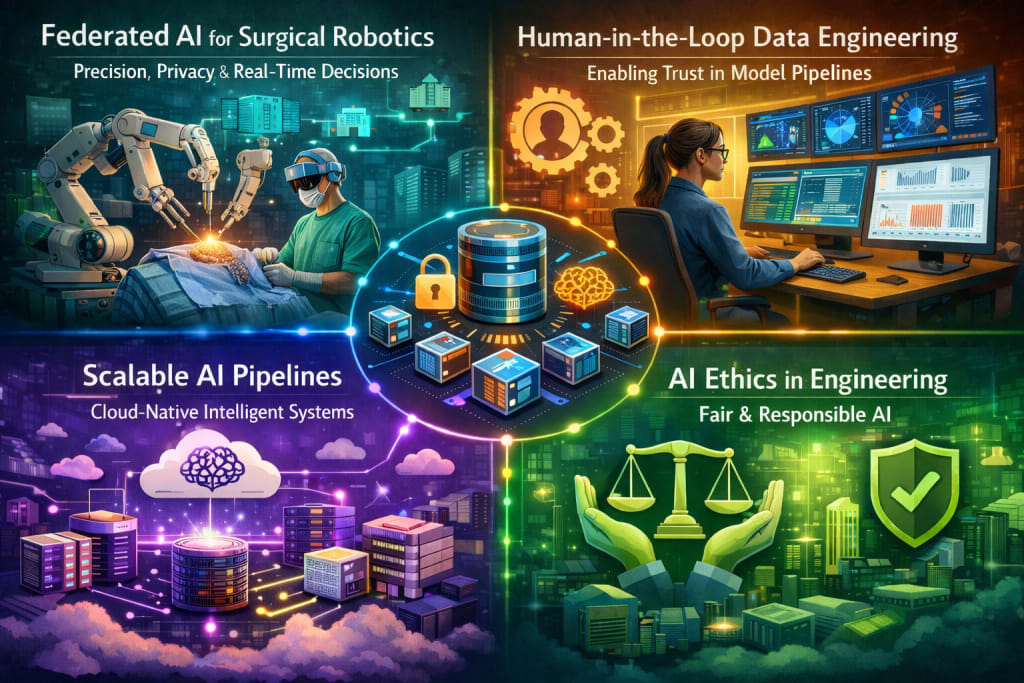
Senior Product Manager Vijayalaxmi Methuku is making waves in the artificial intelligence research community, with IEEE - the world's largest technical professional organization - publishing a series of her innovative papers that address some of the most pressing challenges in modern AI systems.
Ms. Methuku's research portfolio, spanning surgical robotics, data engineering, cloud-native architectures, and AI ethics, demonstrates a rare combination of technical depth and practical relevance that is drawing attention from industry leaders and academic institutions alike.
Breaking New Ground in Surgical Robotics
At the forefront of Vijayalaxmi's contributions is her work on federated artificial intelligence for surgical robotics, a field where precision can mean the difference between life and death. Her paper, "Federated AI for Surgical Robotics: Enhancing Precision, Privacy, and Real-Time Decision-Making in Smart Healthcare," scheduled for presentation at the IEEE conference in Hubbali, India, this June, tackles a critical challenge facing modern medical technology.
Surgical robots are increasingly relying on AI systems to assist surgeons with complex procedures. However, traditional AI approaches require centralizing sensitive patient data - a practice that raises significant privacy concerns and regulatory hurdles. Vijayalaxmi's research presents a federated learning framework that allows surgical AI systems to learn from distributed hospital data without ever transferring patient information to central servers.
"The implications for healthcare are enormous," said a medical technology researcher reviewing the work. "This approach could enable surgical robots to benefit from collective learning across thousands of procedures while maintaining absolute patient privacy."
Her framework addresses three interconnected challenges: enhancing surgical precision through collaborative learning, protecting patient privacy through decentralized data processing, and enabling real-time decision support during critical procedures. The research demonstrates how federated AI can achieve performance comparable to centralized systems while maintaining strict data governance standards required in healthcare settings.
Building Trust in AI Systems
Privacy concerns extend beyond healthcare, as Ms. Methuku explores in her complementary research, "Human-in-the-Loop Data Engineering for Federated AI: Enabling Trust in Model Pipelines." This work, also selected for IEEE publication and presentation in Bengaluru this June, examines how human expertise can be systematically integrated into AI development processes.
The research challenges a common misconception in AI development - that more automation always leads to better outcomes. Vijayalaxmi's findings reveal that strategic human involvement at critical decision points actually enhances both model performance and stakeholder trust.
Her framework establishes specific intervention points where human judgment adds maximum value: during data quality assessment, feature engineering, model validation, and bias detection. Rather than treating human oversight as a bottleneck to be minimized, Vijayalaxmi's approach positions it as a crucial quality assurance mechanism.
"Trust in AI isn't just about algorithmic accuracy," Vijayalaxmi's research emphasizes. "It's about demonstrating that systems incorporate human values, domain expertise, and ethical considerations throughout their development lifecycle."
The paper provides detailed protocols for implementing human-in-the-loop processes within federated learning environments - a particularly challenging technical problem since data remains distributed across multiple locations. Her solution enables expert review and intervention without requiring centralized data access, maintaining privacy guarantees while improving model trustworthiness.
Architecting Scalable AI Infrastructure
Moving beyond specific applications, Ms. Methuku addresses the fundamental infrastructure challenges facing AI deployment in her paper "Engineering Scalable AI Pipelines: A Cloud-Native Approach for Intelligent Transactional Systems." This research, also scheduled for presentation at the Bengaluru conference, examines how modern cloud architectures can support AI systems handling millions of transactions.
Financial services, e-commerce platforms, and telecommunications networks all face similar challenges: they must process enormous transaction volumes while applying sophisticated AI models for fraud detection, personalization, and optimization. Traditional AI architectures often struggle under such demanding conditions, becoming performance bottlenecks that limit business operations.
Ms. Methuku's cloud-native approach reimagines AI pipeline architecture from the ground up. Her framework leverages containerization, microservices patterns, and distributed computing to create AI systems that scale horizontally - adding capacity simply by deploying additional resources rather than requiring fundamental redesign.
The research demonstrates how intelligent load balancing, automated resource allocation, and fault-tolerant design patterns can maintain AI system performance even as transaction volumes spike unpredictably. Her architecture has been validated in simulated environments processing transaction rates comparable to major financial institutions.
"Scalability isn't just about handling more data," industry analysts note regarding Vijayalaxmi's work. "It's about maintaining consistent performance, reliability, and cost-efficiency as systems grow. This research provides a blueprint for achieving all three simultaneously."
Championing Ethical AI Development
Perhaps most timely is Vijayalaxmi's work on AI ethics, presented in her paper "AI Ethics in Engineering: Enhancing Fairness in Machine Learning Models for Critical Systems," to be presented at the IEEE conference in Coimbatore this April. As AI systems increasingly influence consequential decisions - from loan approvals to medical diagnoses - concerns about algorithmic bias and fairness have intensified.
Ms. Methuku's research moves beyond abstract ethical principles to concrete engineering practices. She identifies specific technical interventions that reduce bias in machine learning models deployed in critical systems where errors can have severe consequences.
Her framework addresses bias at multiple stages: in training data collection and curation, during model architecture design, throughout the training process, and in deployment monitoring. Each stage presents distinct fairness challenges requiring tailored technical solutions.
Particularly innovative is Vijayalaxmi's treatment of fairness trade-offs. Different fairness definitions - demographic parity, equalized odds, individual fairness - can conflict with each other, requiring careful balance based on application context. Her research provides decision frameworks helping engineers navigate these trade-offs systematically rather than ad-hoc.
The paper also examines fairness in federated learning environments, where training data distributed across multiple organizations may have different bias characteristics. Vijayalaxmi demonstrates how federated approaches can actually improve fairness by incorporating diverse data sources, provided proper safeguards are implemented.
"AI ethics often remains theoretical," observed an academic reviewing the paper. "Ms. Methuku's contribution is making it practical - giving engineers specific tools and methods they can implement in real systems."
Recognition from IEEE
IEEE's decision to publish this collection of papers reflects their significance to the computing research community. IEEE publications undergo rigorous peer review, with acceptance rates at premier conferences typically ranging from 15-25%. Multiple acceptances across different conference venues demonstrates both the breadth and quality of Vijayalaxmi's research program.
The conferences themselves represent important forums for advancing computing research. IEEE conferences attract leading researchers and practitioners from around the world, providing venues for sharing innovations, receiving expert feedback, and establishing research collaborations.
Ms. Methuku's work will reach audiences across multiple AI subdisciplines - from healthcare technologists interested in surgical robotics to financial services engineers focused on scalable transaction processing to ethicists concerned with algorithmic fairness. This cross-disciplinary impact amplifies her research contributions.
Addressing Tomorrow's Challenges Today
What distinguishes Vijayalaxmi's research is its forward-looking orientation. Rather than merely documenting current practices or incrementally improving existing systems, her work anticipates emerging challenges and proposes solutions before problems become critical.
Federated learning, for instance, remains a relatively nascent technology despite growing rapidly. By establishing frameworks for applying it in demanding contexts like surgical robotics and critical transactional systems, Ms. Methuku is helping shape the technology's evolution toward practical deployment.
Similarly, her emphasis on human-in-the-loop approaches counters prevailing industry trends toward complete automation. As organizations increasingly recognize that fully autonomous AI systems can perpetuate biases and generate unexpected failures, Vijayalaxmi's frameworks for systematically incorporating human judgment position her ahead of the curve.
Her ethical AI work likewise addresses challenges that will only grow more urgent as AI deployment accelerates. By developing practical fairness engineering methods now, Vijayalaxmi helps organizations build ethically sound systems rather than retrofitting ethical considerations after deployment - an approach that rarely succeeds.
Global Impact from Indian Innovation
Ms. Methuku's research presentations at Indian conferences also highlight the country's growing prominence in AI research. India has emerged as a significant hub for computing innovation, with researchers making important contributions across artificial intelligence, machine learning, and data science.
The conferences hosting Vijayalaxmi's work - in Hubbali, Bengaluru, and Coimbatore - demonstrate the geographic distribution of research activity across India, extending beyond traditional technology centers. This decentralization strengthens the country's overall research ecosystem and creates opportunities for regional institutions and researchers.
For the international research community, Vijayalaxmi's work exemplifies how global collaboration accelerates innovation. Her research addresses universal challenges - healthcare privacy, AI scalability, algorithmic fairness - while drawing on diverse perspectives and expertise.
What's Next
With four major papers accepted for presentation at prestigious IEEE conferences, Vijayalaxmi has established herself as a researcher whose work merits close attention. The questions she addresses - how to deploy AI systems that are simultaneously powerful, private, scalable, and ethical - will define the technology's trajectory over coming years.
As these papers are presented and published throughout 2025, they will likely generate further research building on Vijayalaxmi's frameworks. Conference presentations often spark collaborations, inspire new research directions, and influence industry practices as attendees return to their organizations with fresh insights.
For organizations grappling with AI deployment challenges, Vijayalaxmi's research offers more than academic interest - it provides actionable frameworks applicable to real-world systems. From hospitals considering surgical robotics to financial institutions scaling transaction processing to any organization concerned about algorithmic fairness, her work delivers practical guidance grounded in rigorous research.
In an era when artificial intelligence promises to transform industries while raising profound questions about privacy, fairness, and human agency, researchers like Vijayalaxmi who combine technical sophistication with ethical consideration are essential. Her growing body of work suggests we're witnessing the emergence of a significant voice in shaping AI's future development - one that will ensure the technology serves humanity's best interests while achieving its full potential.
About the Creator
Oliver Jones Jr.
Oliver Jones Jr. is a journalist with a keen interest in the dynamic worlds of technology, business, and entrepreneurship.
Keep reading
More stories from Oliver Jones Jr. and writers in 01 and other communities.
The New Project Power Duo: Lakshmi Triveni Kavuru Maps Co-Creation in AI Workflows and a Healthier Way to Schedule the Future
Artificial intelligence did not enter organizations with fanfare; it arrived quietly, reshaping how decisions are made, how schedules compress, and how accountability diffuses across humans and machines. In this shifting terrain, Lakshmi Triveni Kavuru has emerged as one of the most consequential thinkers redefining what project management must become in an AI augmented world. Her 2025 research does not treat AI as an efficiency add-on or a disruptive curiosity. It treats it as a structural force that rewrites participation, authority, and sustainability in modern delivery systems.
By Oliver Jones Jr.about a month ago in 01
Snapchat Account Hacking: Modern Threats and Defenses in 2026
Snapchat remains a prime target for malicious actors seeking unauthorized access to user accounts. This comprehensive analysis explores contemporary attack vectors that emerged by 2026, demonstrates protective measures through Python-based security implementations, and provides actionable defense strategies. Understanding these mechanisms is crucial not for exploitation, but for developing robust countermeasures that protect digital identities in an increasingly connected world.
By Alexander Hoffmanna day ago in 01
React Development for SaaS Platforms: Best Practices That Scale
Introduction The deployment of a SaaS platform is not merely about being fast, but being scalable as users, features, and data grow. Due to its component-based design, performance, and ecosystem, React has become one of the preferred platforms when developing SaaS products. React facilitates a SaaS platform to remain flexible, maintainable, and future-ready when used properly.
By Rutvik Sangani6 days ago in 01
Off the Book
It ended like every other stupid idea. Badly, and alone. I’m researching digital confession ethics, he said. A tech ethicist. He gestured at floating data I couldn’t see then pulled out a physical notebook. Actual paper, fountain pen. He held it up like he was showing me scripture.
By Nicky Frankly5 days ago in Fiction




Comments
There are no comments for this story
Be the first to respond and start the conversation.