
United States Robotic Process Automation Market Size and Forecast 2026–2034
AI-Driven Automation Reshapes Enterprise Operations Across the United States

Market Overview
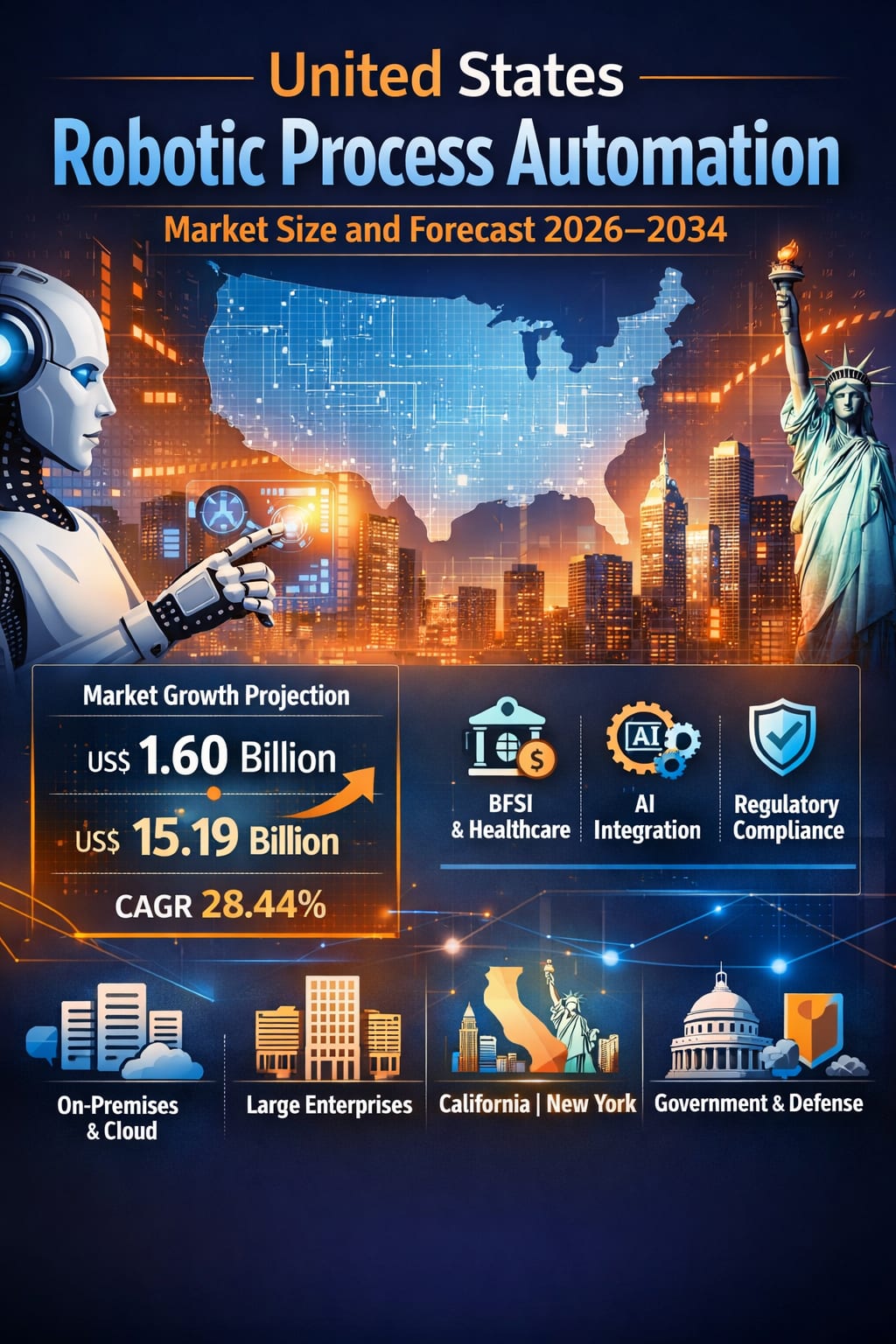
The United States Robotic Process Automation (RPA) Market is undergoing a profound transformation as enterprises increasingly automate repetitive, rule-based, and time-consuming business processes. According to Renub Research, the U.S. RPA market is projected to grow from US$ 1.60 Billion in 2025 to US$ 15.19 Billion by 2034, registering an impressive CAGR of 28.44% during 2026–2034.
This extraordinary growth reflects the accelerating adoption of automation technologies across banking, healthcare, manufacturing, retail, government, and telecommunications. Enterprises are embracing RPA to improve operational efficiency, reduce costs, enhance compliance accuracy, and integrate digital workforces alongside human employees. As artificial intelligence (AI), machine learning (ML), and natural language processing (NLP) converge with traditional RPA platforms, automation in the U.S. is rapidly evolving from simple task execution to intelligent, end-to-end business orchestration.
United States Robotic Process Automation Market Outlook
Robotic Process Automation is a software-based technology that uses digital bots to automate repetitive, rule-driven tasks traditionally performed by human workers. These tasks include data entry, invoice processing, payroll administration, customer onboarding, report generation, claims processing, and system-to-system data transfers.
RPA bots interact with enterprise applications through user interfaces in the same way humans do, eliminating the need for changes to existing IT infrastructure. This non-intrusive nature of RPA makes it especially attractive for organizations operating with complex legacy systems.
In the United States, RPA adoption has accelerated rapidly as companies pursue digital transformation strategies aimed at boosting productivity, improving compliance, and mitigating workforce shortages. The integration of cloud computing, AI, ML, and analytics has further enhanced RPA’s value proposition, transforming basic automation into intelligent automation capable of handling semi-structured data and decision-based workflows.
The U.S. benefits from a mature enterprise IT ecosystem, a highly skilled workforce, and strong investment in enterprise software innovation. These factors position the country as one of the most advanced and lucrative RPA markets globally.
Growth Drivers in the United States Robotic Process Automation Market
Enterprise Demand for Operational Efficiency and Cost Optimization
One of the most powerful drivers of RPA adoption in the U.S. is the growing need for operational efficiency and cost reduction. Enterprises across BFSI, healthcare, retail, telecom, and manufacturing manage massive volumes of repetitive processes that are both time-consuming and error-prone when handled manually.
RPA enables organizations to execute these tasks faster, more accurately, and around the clock without fatigue. Rising labor costs in the U.S. further incentivize automation as companies aim to control administrative expenses without expanding headcount. RPA delivers strong return on investment through reduced error rates, improved productivity, and faster process turnaround.
Large-scale bot deployments are increasingly used to stabilize operations during workforce shortages, seasonal demand spikes, and economic uncertainty. As a result, RPA is no longer viewed as an optional IT enhancement but as a strategic necessity for enterprise resilience and scalability.
Rapid Digital Transformation and AI Integration
The ongoing digital transformation of U.S. enterprises is another major growth catalyst. As organizations migrate to cloud platforms, digital ERPs, CRMs, and analytics tools, process integration becomes more complex. RPA acts as a digital bridge between legacy systems and modern applications without costly system overhauls.
The convergence of RPA with AI, ML, computer vision, and NLP has expanded automation capabilities beyond simple rule-based tasks. Intelligent RPA solutions can now process documents, emails, voice inputs, and unstructured data, enabling advanced use cases such as fraud detection, automated claims processing, predictive analytics, and customer service automation.
As U.S. enterprises pursue end-to-end digital operations, intelligent automation is emerging as a core investment area supporting long-term competitiveness.
Regulatory Compliance, Audit Readiness, and Risk Management
Regulatory complexity across U.S. industries such as banking, insurance, healthcare, energy, and government continues to drive RPA adoption. Organizations must comply with stringent data security, reporting, and audit requirements, where accuracy and consistency are critical.
RPA ensures compliance-driven processes are executed uniformly with system-generated audit trails. Automation minimizes human error in regulatory reporting, tax processing, transaction monitoring, and patient data management. RPA also strengthens cybersecurity through automated access provisioning, identity management, and continuous monitoring.
As regulatory scrutiny intensifies, automation has become an essential tool for governance, risk management, and compliance, reinforcing sustained demand for RPA solutions across the U.S. market.
Challenges in the United States Robotic Process Automation Market
High Initial Deployment Costs and Process Standardization Issues
Despite long-term cost benefits, high initial investment remains a barrier for some organizations. Large-scale RPA deployments require spending on software licenses, infrastructure, cybersecurity integration, consulting services, and workforce training.
Many organizations attempt to automate poorly documented or unstable processes, leading to bot failures and limited ROI. Successful RPA implementation requires upfront process standardization, reengineering, and data cleansing, which can be resource-intensive.
Frequent changes to enterprise software interfaces also increase ongoing bot maintenance costs. Without strong automation governance and clear business cases, RPA initiatives may struggle to scale, particularly among cost-sensitive SMEs.
Workforce Resistance, Skill Gaps, and Change Management
Workforce resistance remains a notable challenge in RPA adoption, driven largely by fears of job displacement. Inadequate communication and poor change management can reduce employee acceptance and collaboration.
Additionally, RPA implementation requires specialized skills in bot development, testing, cybersecurity, and process optimization. The shortage of experienced automation professionals in the U.S. increases hiring costs and project timelines. As automation becomes more AI-driven, the skills gap continues to widen.
Organizations must invest in reskilling, upskilling, and workforce transformation programs to ensure successful human-bot collaboration and long-term automation sustainability.
United States Robotic Process Automation Software Market
Software remains the backbone of the U.S. RPA market, encompassing bot design tools, orchestration platforms, analytics dashboards, and security frameworks. Enterprises favor solutions that offer low-code development, AI integration, cloud compatibility, and real-time performance monitoring.
Subscription-based and SaaS RPA platforms have lowered entry barriers for SMEs, accelerating adoption. Continuous innovation in intelligent document processing, chatbots, and decision engines ensures rising investment in RPA software across industries.
Rule-Based RPA Market in the United States
Rule-based RPA continues to dominate deployments, automating deterministic, repetitive tasks using predefined workflows. Applications include invoice processing, payroll, transaction reconciliation, order entry, and compliance reporting.
These bots offer fast deployment, high stability, and quick ROI, making them ideal for large-scale back-office operations. Many organizations adopt layered automation strategies where rule-based bots handle core processes while AI-enhanced bots manage exceptions and complex tasks.
On-Premises RPA Market in the United States
On-premises deployment remains strong among highly regulated sectors such as BFSI, government, defense, and healthcare. These organizations prioritize direct control over data, infrastructure, and security.
On-premises RPA offers enhanced customization, stronger governance, and easier integration with legacy systems. While cloud-based RPA is gaining momentum, sensitive data environments continue to rely on on-premises solutions for compliance and security assurance.
Large Enterprises Driving RPA Adoption
Large enterprises dominate the U.S. RPA market, deploying hundreds or thousands of bots across finance, HR, procurement, IT, customer service, and compliance functions. Automation Centers of Excellence (CoEs) are commonly established to manage governance and scalability.
Advanced use cases such as predictive analytics, intelligent document processing, and enterprise orchestration generate higher ROI. Strong financial capacity and long-term digital roadmaps position large enterprises as primary revenue contributors.
Industry-Wise RPA Adoption
BFSI
The BFSI sector leads RPA adoption, automating loan processing, KYC verification, fraud detection, claims management, and regulatory reporting. High transaction volumes and strict compliance needs make automation indispensable.
Government and Defense
Government agencies deploy RPA to modernize operations, improve transparency, and enhance citizen services. Defense applications include logistics automation, cybersecurity monitoring, and documentation workflows.
State-Wise Market Insights
California: Leads RPA adoption due to its strong technology ecosystem and high labor costs.
New York: Driven by financial services, insurance, and media industries.
Washington: Supported by federal agencies, aerospace manufacturing, and cloud services.
Arizona: Growing adoption among healthcare providers, logistics firms, and SMEs.
Market Segmentation
By Component: Software, Services
By Operation: Rule-based, Knowledge-based
By Deployment: On-premises, Cloud-based
By Organization Size: Large Enterprises, SMEs
By End User: BFSI, Healthcare, Retail, IT & Telecom, Government & Defense, Logistics, Energy, Others
By States: California, Texas, New York, Florida, Illinois, Arizona, and Rest of U.S.
Competitive Landscape
Key players shaping the U.S. RPA market include:
Amelia US LLC
Automation Anywhere Inc.
AutomationEdge
Blue Prism Group PLC
Infosys Limited
Kofax Inc.
NICE Ltd.
Pegasystems Inc.
Verint Systems
Final Thoughts
The United States Robotic Process Automation Market is entering a decisive growth phase as enterprises prioritize efficiency, resilience, and intelligent automation. Backed by strong digital infrastructure, regulatory demand, and rapid AI integration, RPA is evolving into a foundational technology for enterprise operations.
With market value projected to reach US$ 15.19 Billion by 2034, RPA will continue reshaping how U.S. organizations operate, compete, and innovate. Companies that successfully combine automation with workforce transformation will emerge as long-term leaders in the digital economy.
About the Creator
Tom Shane
Tom Shane is a content writer specializing in SEO-driven blogs, product descriptions, and thought leadership. He crafts engaging, research-backed content that connects with audiences and drives results.
iPhone 18 Pro Leaks Drama: The Dynamic Island Confusion Explained
The iPhone 18 Pro is already stirring up controversy, and it all started with a viral video from FPT. The renders showed off what looked like a major display redesign—one where the Dynamic Island had been shifted over to the left side of the screen. Unsurprisingly, the internet went into meltdown mode.
By Info Post Gate7 days ago in 01
melania trump documentary
The release of Melania, a new documentary centered on First Lady Melania Trump, has drawn global attention even before its official debut. Promoted as an intimate portrait of one of the most private figures in modern American politics, the film aims to offer audiences a rare glimpse into her personal and public life. Yet the project has sparked discussion not only about its subject but also about the evolving role of political storytelling in contemporary media.
By Saboor Brohi 4 days ago in 01
A Love Forboding
The chipped stone slope caused unbearable footing. I slid, skirting on my heels. I cast my shield, relinquishing my guard to stay upright. Left with my double-edge and a prayer to the maker, I skated toward my objective. The earthly stubble gave way to solid ground. I found myself restored, a trail of dust in my wake.
By James U. Rizzi3 days ago in Fiction




Comments
There are no comments for this story
Be the first to respond and start the conversation.