
United States Cryptocurrency Market Size and Forecast 2025–2033
Digital Assets Move Toward the Financial Mainstream as Institutional Adoption and Blockchain Innovation Reshape America’s Economy

United States Cryptocurrency Market Outlook
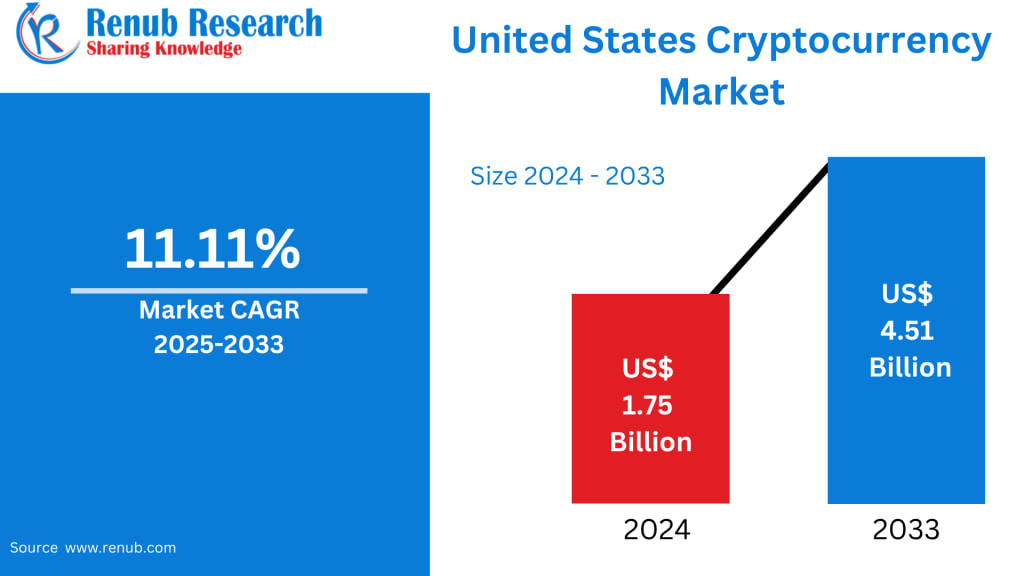
The United States Cryptocurrency Market is expected to reach US$ 4.51 billion by 2033, rising from US$ 1.75 billion in 2024, at a Compound Annual Growth Rate (CAGR) of 11.11% from 2025 to 2033, according to Renub Research. This steady expansion reflects the growing integration of digital assets into the financial ecosystem, driven by rising institutional participation, advancements in blockchain infrastructure, and increasing consumer acceptance of decentralized financial systems.
Cryptocurrencies, once perceived as speculative instruments on the fringe of finance, are now transitioning into a recognized component of the modern digital economy. From retail payments and cross-border remittances to institutional investment strategies and decentralized finance (DeFi), cryptocurrencies are reshaping how value is exchanged, stored, and managed. In the United States, a mature financial infrastructure combined with strong innovation capabilities has positioned the country as a global leader in cryptocurrency development and adoption.
As financial institutions, fintech startups, and technology firms continue to invest in blockchain-based solutions, the U.S. cryptocurrency market is evolving into a more stable, regulated, and diverse ecosystem. Although challenges such as regulatory uncertainty and price volatility persist, the long-term outlook remains optimistic as innovation and governance mature in parallel.
United States Cryptocurrency Industry Overview
The United States Cryptocurrency Market is experiencing significant momentum as digital assets gain mainstream acceptance across financial, commercial, and technological sectors. What began as a niche movement among early adopters has now become an increasingly integrated part of the national financial architecture. Cryptocurrencies are being used not only as investment vehicles but also as payment tools, treasury assets, and foundational components of blockchain-based applications.
The widespread adoption of blockchain technology has strengthened trust in decentralized networks by offering transparency, security, and efficiency in financial transactions. Financial institutions are exploring tokenization of assets, decentralized settlement systems, and blockchain-enabled compliance tools. Meanwhile, consumers benefit from faster transactions, lower cross-border transfer costs, and improved access to digital financial services.
The U.S. has also emerged as a regulatory and innovation hub. Federal and state authorities are actively exploring frameworks to improve consumer protection, combat illicit activity, and establish clear guidelines for crypto exchanges and service providers. Several states have adopted progressive regulatory approaches, allowing responsible experimentation while ensuring oversight. As institutional investors, payment processors, and fintech firms integrate digital assets into their operations, the market continues to mature.
The expansion of decentralized finance (DeFi), non-fungible tokens (NFTs), and blockchain-based identity and supply chain solutions is opening new avenues of growth. While regulatory complexity and market volatility remain concerns, partnerships between traditional financial institutions and crypto enterprises are reinforcing confidence in the industry’s long-term viability.
Key Factors Driving the United States Cryptocurrency Market Growth
Increasing Institutional Adoption and Investment
Institutional adoption has emerged as one of the most powerful catalysts for the U.S. cryptocurrency market. Major banks, hedge funds, asset managers, and publicly traded companies are increasingly incorporating digital assets into their portfolios to diversify holdings and hedge against inflation and macroeconomic uncertainty.
The development of regulated cryptocurrency exchanges, custody services, and compliance tools has reduced barriers to entry for institutional investors. Products such as cryptocurrency exchange-traded funds (ETFs) and blockchain-based financial instruments have further expanded access to digital assets through traditional investment channels. Corporations are also using cryptocurrencies for treasury management and cross-border settlements, accelerating their integration into mainstream financial operations.
Institutional participation enhances market credibility and liquidity while encouraging regulatory collaboration, technological innovation, and ecosystem development. This growing involvement is a key driver behind the projected 11.11% CAGR from 2025 to 2033.
Technological Advancements in Blockchain Infrastructure
Ongoing advancements in blockchain technology are significantly strengthening the foundation of the cryptocurrency ecosystem in the United States. Improvements in scalability, transaction speed, and energy efficiency are addressing some of the earliest limitations of blockchain networks.
The integration of smart contracts, layer-2 scaling solutions, and interoperability protocols has enabled faster, cheaper, and more secure transactions. Decentralized finance platforms are offering alternatives to traditional banking services such as lending, borrowing, and asset trading, expanding financial accessibility. Tokenization of real-world assets is also gaining traction, allowing fractional ownership and enhanced liquidity.
Enhanced cybersecurity measures, encryption protocols, and decentralized identity frameworks are improving trust and reliability. As blockchain technology evolves, it continues to drive adoption across industries, from finance and healthcare to logistics and government services.
Growing Consumer Awareness and Digital Payment Adoption
Consumer awareness of cryptocurrencies has increased dramatically, supported by expanding digital payment infrastructure and educational initiatives. Digital wallets, mobile applications, and user-friendly trading platforms have made cryptocurrency transactions more accessible to everyday users.
Retailers, e-commerce platforms, and service providers are increasingly accepting cryptocurrencies as payment methods, reinforcing their role as functional digital currencies rather than purely speculative assets. The growing emphasis on financial inclusion and cost-effective cross-border remittances has also boosted adoption among underserved communities and international users.
As media coverage, educational programs, and real-world applications continue to grow, consumer confidence in digital assets is strengthening. This trend is expected to drive sustained usage across payments, investments, and decentralized financial services in the coming decade.
Challenges in the United States Cryptocurrency Market
Regulatory Uncertainty and Compliance Issues
Regulatory ambiguity remains one of the most significant challenges facing the U.S. cryptocurrency market. The absence of a unified federal framework creates inconsistencies across states, complicating compliance for businesses and investors. Differing interpretations of whether cryptocurrencies are securities, commodities, or currencies further add to legal complexity.
Evolving rules related to taxation, anti-money laundering (AML), and know-your-customer (KYC) requirements impose additional operational burdens. While regulatory oversight is essential for consumer protection and fraud prevention, frequent policy changes can discourage innovation and delay investment decisions.
Establishing clear, consistent, and transparent regulatory standards will be critical to building long-term market confidence and supporting sustainable growth.
Market Volatility and Security Concerns
Cryptocurrency price volatility remains a major obstacle to broader adoption. Sharp fluctuations discourage risk-averse investors and limit cryptocurrencies’ usability as stable mediums of exchange. Market manipulation, speculative trading, and macroeconomic factors further contribute to instability.
Security concerns also persist. Cyber threats such as hacking, phishing, and ransomware attacks continue to challenge trust in digital platforms. While advancements in encryption, custody solutions, and blockchain analytics have improved security, the risk of asset loss remains a critical issue.
Addressing these challenges through enhanced regulation, insurance solutions, and technological safeguards will be essential to strengthening resilience and fostering trust in the cryptocurrency ecosystem.
United States Cryptocurrency Market Overview by States
California Cryptocurrency Market
California leads the U.S. cryptocurrency market, supported by Silicon Valley’s innovation ecosystem and strong venture capital presence. The state hosts numerous blockchain startups, fintech developers, and digital asset exchanges. Partnerships between technology firms and financial institutions are accelerating product development, while academic institutions foster research and workforce development.
California’s progressive stance toward digital innovation enables experimentation across industries, from decentralized finance to enterprise blockchain solutions. Despite regulatory debates, the state remains a central driver of cryptocurrency adoption and technological advancement.
Texas Cryptocurrency Market
Texas is rapidly emerging as a major cryptocurrency hub, driven by favorable business policies, affordable energy resources, and expanding institutional investment. The state has become a center for cryptocurrency mining operations and blockchain startups.
Public and private sector collaboration is promoting blockchain applications in finance, energy, and logistics. While regulatory clarity and environmental sustainability remain areas of focus, Texas’ economic scale and business-friendly environment position it as one of the fastest-growing crypto markets in the nation.
New York Cryptocurrency Market
New York plays a pivotal role due to its status as a global financial capital. The state’s early regulatory framework, including the BitLicense, has established structured oversight for crypto businesses. Major exchanges, financial institutions, and fintech companies operate extensively in the region.
While regulatory requirements are stringent, they enhance investor confidence and market integrity. New York continues to shape the national cryptocurrency landscape by balancing innovation with compliance in one of the world’s most influential financial ecosystems.
Florida Cryptocurrency Market
Florida’s cryptocurrency market is expanding rapidly, fueled by its favorable tax environment and growing fintech ecosystem. Miami has become a prominent blockchain hub, hosting international conferences and attracting investment in digital finance projects.
Retail adoption is increasing as businesses in real estate, tourism, and services accept cryptocurrencies for transactions. With government support for blockchain initiatives and a strong international business presence, Florida is positioned as a progressive leader in digital asset adoption.
Recent Developments in the U.S. Cryptocurrency Market
June 10, 2024: Robinhood announced its agreement to acquire international cryptocurrency exchange Bitstamp in an all-cash transaction valued at nearly US$ 200 million, pending regulatory approvals expected in early 2025. This marks Robinhood’s first major institutional expansion in the crypto sector, strengthening its global presence.
November 2024: Coinbase established an Engineering Hub in Singapore in partnership with the Singapore Economic Development Board (EDB). The initiative aims to support blockchain innovation by empowering engineers with advanced tools, training, and resources, reinforcing Coinbase’s commitment to global crypto development.
Market Segmentations
By Component:
Hardware
Software
Others
By Process:
Mining
Transaction
By Type:
Bitcoin
Bitcoin Cash
Ethereum
Litecoin
Ripple
Others
By End Use:
Banking
Gaming
Government
Healthcare
Retail & E-commerce
Trading
Others
By States:
California, Texas, New York, Florida, Illinois, Pennsylvania, Ohio, Georgia, New Jersey, Washington, North Carolina, Massachusetts, Virginia, Michigan, Maryland, Colorado, Tennessee, Indiana, Arizona, Minnesota, Wisconsin, Missouri, Connecticut, South Carolina, Oregon, Louisiana, Alabama, Kentucky, Rest of United States
All Key Players Covered With:
Company Overviews
Key Personnel
Recent Developments
SWOT Analysis
Revenue Analysis
Major Companies Profiled:
Advanced Micro Devices, Inc.; Binance; Bitfury Group Limited; BitGo, Inc.; Bitmain Technologies Holding Company; Intel Corporation; NVIDIA Corporation; Ripple; Xapo Holdings Limited; Xilinx, Inc.
Final Thoughts
The United States Cryptocurrency Market is entering a new phase of maturity, shaped by institutional investment, technological innovation, and growing public acceptance. With the market projected to expand from US$ 1.75 billion in 2024 to US$ 4.51 billion by 2033 at a CAGR of 11.11%, digital assets are no longer peripheral to the financial system—they are becoming integral to its future.
While challenges such as regulatory uncertainty, price volatility, and cybersecurity risks remain, the momentum toward standardized governance, improved infrastructure, and broader adoption is unmistakable. As states like California, Texas, New York, and Florida continue to lead innovation, the U.S. is poised to remain at the forefront of the global cryptocurrency landscape.
For investors, institutions, and consumers alike, the next decade will likely define how digital assets integrate into everyday finance. If innovation and regulation continue to evolve in tandem, cryptocurrency in the United States will not only grow—it will help redefine the very architecture of the modern financial economy.
About the Creator
Keep reading
More stories from Aaina Oberoi and writers in 01 and other communities.
Europe Books Market Size and Forecast 2026–2034
Europe Books Market Outlook The Europe books market is anticipated to increase from US$ 44.68 Billion in 2025 to US$ 62.29 Billion in 2034, driven by sustained demand across educational, academic, professional, and leisure reading segments. It is likely that the market will grow at a CAGR of 3.76% from 2026–2034 due to an increased focus on literacy, the growth of digital audiobooks, expansion of online retail channels, and continued innovation in content by publishers in major European economies.
By Aaina Oberoia day ago in 01
What I Learned About Pest Control After Living in Detroit
Living in Detroit for several years has taught me that pest problems are not just a seasonal inconvenience — they’re often a long-term reality. From mice seeking warmth during winter to insects becoming active in the summer, pests tend to find their way into homes regardless of how careful you are.
By Jamal Mooreabout 12 hours ago in 01
What Businesses Often Expect vs What Digital Marketing Services Deliver
By 2026, most businesses no longer misunderstand what digital marketing is. The misunderstanding sits elsewhere. It sits in how results are produced, where money actually goes, and why timelines stretch far beyond initial promises.
By Jane Smith5 days ago in 01
'20/20'
"Do It Again" the track that would ultimately open the Beach Boys final album on Capitol Records which was released on February 10th 1969 had originally been released as a single in August of 1968. The track was the first of many post-Pet Sounds era throwbacks to the early Beach Boys sound which would become continually more cliched and eventually lead the Beach Boys to the level of self-parody they would eventually succumb to in the 1980s while their closest contemporaries The Beatles nearing the end of their run in 1969 would go on to be viewed as the most influential band of all time. However, the song itself is not bad on its surface, and it opens with a futuristic sounding (for 1969) drumbeat captured by then-Beach Boys engineer Stephen Desper using tape delays on the drums performed by Dennis Wilson and John Guerin. The song has been re-recorded numerous times over the years on various Beach Boys-related projects most notably the 2011 re-recording at Capitol studios featuring the five surviving Beach Boys at the time backed instrumentally by various members of both the Brian Wilson Band and Mike Loves touring "Beach Boys" to promote the then upcoming Beach Boys 50th Anniversary reunion tour in 2012. The hammering and power drill sound at the end of the song was an excerpt from a track called "Workshop" that was to be a part of the uncompleted "SMiLE" album.
By Sean Callaghan5 days ago in Beat


Comments
There are no comments for this story
Be the first to respond and start the conversation.