
Understanding Day Trading: Flag Patterns and Price Action Strategies
Navigating the Markets: Harnessing Flag Patterns and Price Action for Day Trading Success


Day trading is a strategy employed by traders who seek to capitalize on short-term market movements, typically buying and selling securities within the same trading day. Unlike long-term investing, day trading requires a keen understanding of market dynamics, rapid decision-making skills, and a solid grasp of technical analysis. Among the various tools and strategies day traders use, flag patterns and price action techniques stand out for their effectiveness and simplicity.
What is Day Trading?
Day trading involves the buying and selling of financial instruments such as stocks, options, or futures within the same trading day. Day traders aim to profit from small price movements, often executing multiple trades in a single day. The appeal of day trading lies in its potential for high returns, but it also carries significant risks.
Traders rely heavily on technical analysis, which involves studying historical price charts and trading volume to predict future price movements. Successful day trading requires discipline, a well-defined trading plan, and an understanding of various market indicators.
Flag Patterns: An Overview
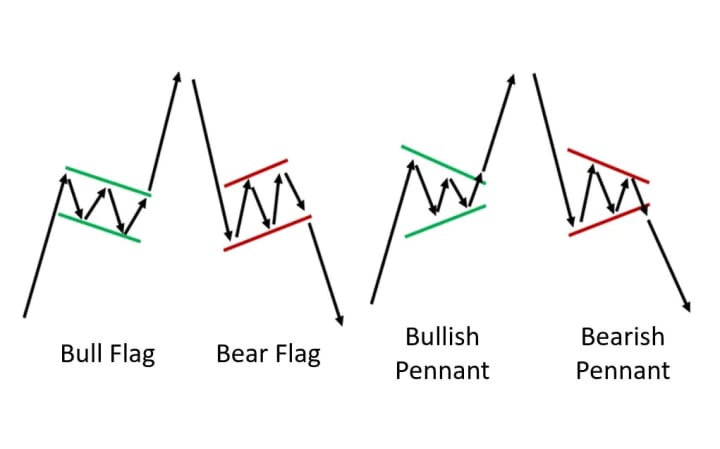
Flag patterns are one of the most recognized continuation patterns in technical analysis. They typically form after a strong price movement and suggest a brief consolidation period before the prevailing trend resumes. There are two main types of flag patterns: bullish flags and bearish flags.
Bullish Flags
A bullish flag pattern emerges after a strong upward price movement, followed by a brief consolidation or pullback that forms a rectangular shape. This consolidation is characterized by lower highs and higher lows, resembling a flag on a pole. After the consolidation period, a breakout occurs when the price moves above the upper trendline of the flag, signaling the continuation of the upward trend.
Example of a Bullish Flag:
Flagpole: A sharp upward movement creates a flagpole.
Consolidation: Price trades sideways, forming the flag.
Breakout: Price breaks above the flag's upper trendline, presenting a buying opportunity.
Bearish Flags
Conversely, a bearish flag pattern appears after a significant downward price movement. Following this decline, the price enters a consolidation phase that forms a rectangular shape, showing higher lows and lower highs. A breakout occurs when the price moves below the lower trendline of the flag, indicating a continuation of the downward trend.
Example of a Bearish Flag:
Flagpole: A sharp downward movement creates the flagpole.
Consolidation: Price trades sideways, forming the flag.
Breakout: Price breaks below the flag's lower trendline, signaling a selling opportunity.
Price Action Trading
Price action trading is a technique that focuses on the movement of price rather than relying on technical indicators or fundamental analysis. It involves reading and interpreting price charts to make trading decisions. Price action traders analyze patterns, support and resistance levels, and other market behaviors to forecast future price movements.
Key Components of Price Action Trading
Candlestick Patterns: Traders observe candlestick formations to gauge market sentiment. Patterns like doji, hammer, and engulfing can provide insights into potential reversals or continuations.
Support and Resistance: These are critical levels where price tends to reverse or consolidate. Identifying support and resistance helps traders make informed entry and exit decisions.
Trend Analysis: Understanding the current market trend is crucial for successful trading. Price action traders look for higher highs and higher lows in an uptrend or lower highs and lower lows in a downtrend.
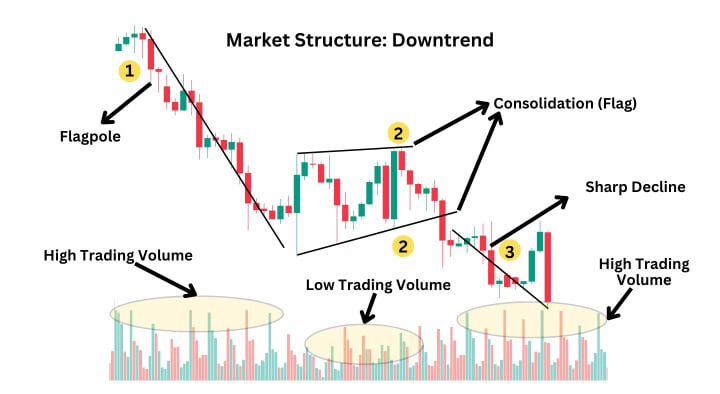
Volume Analysis: Analyzing trading volume can provide insights into the strength of a price movement. Increased volume during a breakout often indicates a higher likelihood of continuation.
Combining Flag Patterns with Price Action Strategies
Flag patterns and price action trading complement each other well. By incorporating flag patterns into a price action strategy, traders can enhance their decision-making process. Here’s how to effectively combine these two approaches:
Identifying Flag Patterns: Start by scanning charts for potential flag patterns. Look for strong flagpoles followed by a consolidation phase.
Confirming with Price Action: Use price action signals, such as candlestick patterns and volume analysis, to confirm the likelihood of a breakout. For instance, a bullish flag may be confirmed by a strong bullish engulfing candle accompanied by increased volume.
Setting Entry and Exit Points: Determine entry points based on breakout levels of the flag pattern. Set stop-loss orders below the flag for bullish patterns and above the flag for bearish patterns. Profit targets can be set based on the height of the flagpole.
Risk Management: Implement proper risk management techniques to protect capital. This includes determining position sizes based on risk tolerance and using stop-loss orders effectively.
Conclusion
Day trading using flag patterns and price action strategies can be a rewarding endeavor for those willing to invest time in learning and practicing. While the potential for profit is significant, so are the risks involved. A disciplined approach, combined with a solid understanding of technical analysis, can help traders navigate the volatile world of day trading successfully.
Ultimately, the key to success lies in continuous education, practice, and maintaining a trader’s mindset focused on long-term growth rather than short-term wins. Whether you’re a novice or an experienced trader, mastering flag patterns and price action strategies can enhance your trading arsenal and improve your chances of success in the fast-paced world of day trading.
Thank you 🙏
Future of Resilience
About the Creator
Future of Resilience
I enjoy writing book and product review, relationship and parenting blogs. I hope you enjoy my writing. Happy Reading!
Keep reading
More stories from Future of Resilience and writers in 01 and other communities.
A Comprehensive Review of TheTradingFloor.com’s Day Trading Risk Calculator
Day trading can be a thrilling yet perilous venture, where every decision can make or break your trading strategy. With the right tools, however, you can navigate this complex landscape more effectively. TheDay Trading Risk Calculator from TheTradingFloor.com stands out as a critical asset for both novice and seasoned traders. In this review, we'll explore five key points that highlight the functionality, benefits, and overall effectiveness of this innovative tool.
By Future of Resilience about a year ago in 01
Understanding Flexible Packaging Bags and Films in Modern Manufacturing
Flexible packaging bags and films have become an essential part of modern packaging systems worldwide. Used across industries such as food, pharmaceuticals, agriculture, and personal care, flexible packaging supports efficient product handling while adapting to diverse functional needs. Unlike rigid formats, flexible packaging is characterized by its ability to change shape, offering practicality in storage, transport, and use.
By charliesamuel2 days ago in 01
App Development Cost and Timeline: St. Louis 2026
Estimating the App Development Cost and Timeline: St. Louis 2026 requires deep research. It requires more than just a surface-level quote. You must understand the Midwest’s evolving tech ecosystem. St. Louis-based founders face a unique "sweet spot" in 2026. You are operating in a major technical hub. It combines the technical rigor of coastal standards. It also offers the fiscal advantages of a regional talent pool.
By Del Rosario3 days ago in 01



Comments (1)
Good work. Great definitions made it easy to kind of understand, but technically I am not really business related on this side. I am more like an office clerk- typing, record/bookeeping, filing,etc;