
“U.S.-China Business Tensions: Trade Wars, Technology Battles, and the Future of Global Markets”
“How Economic Rivalry Between the U.S. and China is Reshaping Trade, Technology, and Global Business Strategies”

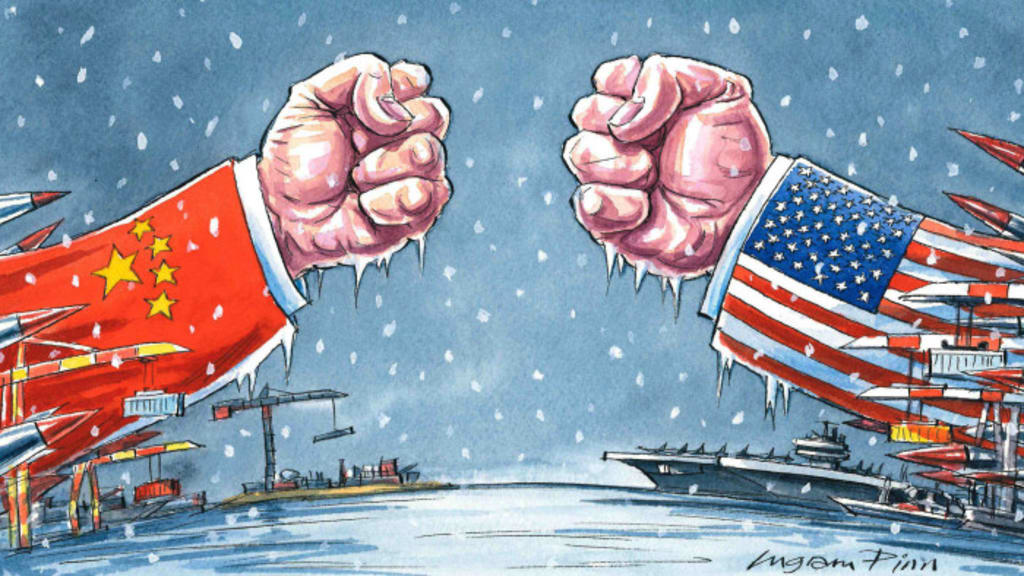
The economic relationship between China and the United States has long been one of cooperation and competition. Over the past few decades, both nations have benefited from trade, investment, and technological exchanges. However, tensions have escalated in recent years, driven by issues such as trade imbalances, intellectual property disputes, national security concerns, and differing political ideologies. These tensions have reshaped global markets and influenced businesses, investors, and policymakers worldwide.
Trade Wars and Tariffs
One of the most significant events in U.S.-China business relations was the trade war initiated during the Trump administration in 2018. The U.S. imposed tariffs on billions of dollars’ worth of Chinese goods, accusing China of unfair trade practices, such as forced technology transfers and subsidies to state-owned enterprises. In retaliation, China imposed its own tariffs on American products, particularly agricultural goods, automobiles, and energy exports.
Although the Biden administration has taken a slightly different approach, many of the tariffs and trade restrictions remain in place. The trade war has led to disruptions in global supply chains, increased costs for businesses, and economic uncertainty. While some American companies have moved manufacturing away from China to countries like Vietnam, India, and Mexico, China remains a critical part of the global production network.
Technology and National Security Concerns
Technology has become a major battlefield in the U.S.-China economic rivalry. The U.S. has accused China of intellectual property theft and has imposed restrictions on Chinese technology firms, citing national security concerns. One of the most notable cases is Huawei, a leading Chinese telecommunications company that has been banned from using American technology and has faced severe restrictions in Western markets.
The U.S. government has also implemented measures to limit China’s access to advanced semiconductor technology. American companies and allies, such as the Netherlands and Japan, have restricted the export of high-tech chipmaking equipment to China. In response, China has increased investments in its semiconductor industry to reduce reliance on foreign technology.
Chinese companies such as TikTok have also faced scrutiny in the U.S. over data privacy concerns. The American government has pressured TikTok’s parent company, ByteDance, to either sell its U.S. operations or face a potential ban. Similar concerns have been raised about other Chinese apps and digital platforms operating in the U.S.
Investment Restrictions and Economic Decoupling
The U.S. has taken steps to reduce economic dependency on China by restricting investments in certain Chinese companies, especially those linked to military and surveillance technologies. The U.S. government has also tightened regulations on Chinese investments in American businesses, particularly in sectors like artificial intelligence, biotechnology, and infrastructure.
China, on the other hand, has encouraged domestic firms to reduce reliance on American technology and has promoted its own companies in key industries such as electric vehicles, artificial intelligence, and renewable energy. The concept of “economic decoupling”—where the two economies become less interdependent—has gained traction, though a complete separation remains unlikely given the deep economic ties.
Impact on Global Markets and Businesses
The ongoing U.S.-China tensions have affected global businesses and economies in several ways:
1. Supply Chain Disruptions: Companies worldwide have had to rethink their supply chains due to tariffs and geopolitical uncertainties. Many businesses are adopting a “China plus one” strategy, diversifying manufacturing locations to reduce risks.
2. Investment Uncertainty: Foreign direct investment (FDI) flows between the U.S. and China have declined as regulatory scrutiny increases. Companies are more cautious about cross-border mergers and acquisitions.
3. Technology Race: The battle over technology dominance has led to increased government support for research and development in both countries. The global semiconductor industry, in particular, is witnessing a surge in investments as China and the U.S. strive for self-sufficiency.
4. Currency and Financial Markets: The Chinese yuan and the U.S. dollar have been impacted by trade tensions and economic policies. The Chinese government is also promoting the use of the yuan in international trade to reduce dependence on the U.S. dollar.
Future Outlook: Cooperation or Confrontation?
While tensions remain high, both China and the U.S. have incentives to cooperate in certain areas. Climate change, global health, and financial stability are issues that require joint efforts from the world’s two largest economies. Moreover, businesses in both countries continue to seek ways to maintain economic ties despite political challenges.
However, the risk of further confrontations remains, especially in sensitive areas like Taiwan, cybersecurity, and human rights. The upcoming U.S. elections, China’s economic policies, and global geopolitical developments will play a crucial role in shaping the future of U.S.-China business relations.
About the Creator
Muhammad yaqoob
MuHsin.
Be HaPPy AloN…..
Keep reading
More stories from Muhammad yaqoob and writers in 01 and other communities.
The Bond of the Hills
High in the green mountains, where the clouds touch the peaks and the wind whispers through the trees, there was a small village full of kind-hearted people. Life in this village was simple but beautiful. Every day, the sun rose over the snowy hills, and children ran barefoot through the fields, laughing and playing under the blue sky.
By Muhammad yaqoob8 months ago in 01
Japan Smart Doorbell Market Size and Forecast 2025–2033
Market Snapshot The Japan Smart Doorbell Market is expected to reach US$ 736.05 million by 2033, up from US$ 212.53 million in 2024, expanding at a robust CAGR of 14.8% from 2025 to 2033. Rapid urbanization, increasing adoption of smart home technologies, and rising demand for home security systems are driving market growth. Advancements in AI, video analytics, and wireless connectivity are further strengthening consumer demand for smart doorbell systems.
By jaiklin Fanandish3 days ago in 01
How to Plan a Cross-Border Campaign with a Chinese Crypto Marketing Agency in 2026?
Cross-border expansion remains a defining objective for blockchain projects seeking relevance beyond domestic markets. In 2026, working with a Chinese crypto marketing agency for cross-border campaigns involves navigating not only language and culture, but also regulatory boundaries, digital ecosystems, and communication norms unique to China and global crypto environments. As China maintains strict controls on domestic cryptocurrency trading while continuing to influence global blockchain development through infrastructure, research, and Web3 innovation abroad, cross-border collaboration requires careful strategic planning.
By Jack santoabout 4 hours ago in 01


Comments
There are no comments for this story
Be the first to respond and start the conversation.