
Turning the Load: How Coil Upenders and Winding Technology Support Heavy‑Duty Manufacturing
Why rotating heavy materials and forming coils precisely are both essential to modern industrial workflows


In industrial environments where heavy coils, molds, and cylindrical loads are part of daily operations, the ability to handle weight safely and predictably is critical. Manufacturing does not end when a component is formed; it continues through handling, repositioning, inspection, and preparation for the next stage of processing or transport. Without proper handling systems, even well-made components can be damaged or become safety hazards. Technologies designed for these tasks help reduce physical strain on workers, minimize the risk of accidents, prevent surface or structural damage, and maintain steady efficiency across production floors where consistency and reliability are essential.
Understanding the Role of a Coil Upender
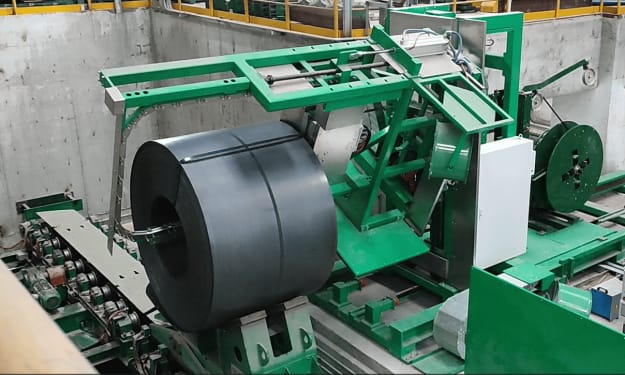
A coil upender is a mechanical device used to rotate heavy loads—such as metal coils, molds, or large fabricated parts—between horizontal and vertical orientations. Instead of relying on cranes, chains, or manual force, an upender performs this movement in a controlled and steady manner using powered mechanisms.
In industries such as steel processing, aluminum production, and paper manufacturing, coils often need to be reoriented for storage, transport, or further processing. By mechanizing this rotation, factories can reduce the risk of workplace injuries and ensure that loads are positioned accurately each time.
Similar systems are also applied to mold upender, where large tooling components must be flipped for inspection, maintenance, or machining. This versatility allows upenders to fit into a wide range of material‑handling workflows without fundamentally changing their core function.
Why Orientation Matters in Industrial Handling
The orientation of a heavy component affects how it is stored, moved, and processed. Horizontal positioning may be more stable during internal transport, while vertical alignment is often required for integration with Automatic Wrapping Machine, strapping, or machining equipment.
By enabling smooth transitions between orientations, upending equipment supports consistent material flow within a facility. Instead of interrupting operations to reposition heavy loads manually or with temporary setups, materials can move through defined pathways with greater control. This reduces reliance on improvised handling methods that often introduce delays or safety risks and helps maintain predictable production schedules, especially in environments where timing, coordination, and equipment alignment are critical.
An Overview of Coil Winding Technology
While upenders deal with the movement of finished or semi‑finished coils, coil winding technology addresses how those coils are produced. Coil winding is the process of wrapping insulated conductive wire around a form or core to create components used in motors, transformers, generators, and inductors.
The design of a winding—including turn count, wire placement, and insulation—directly affects the electrical and thermal performance of the final product. For this reason, winding equipment often emphasizes accuracy and repeatability, especially in applications where precision is critical.
Modern winding systems range from manually operated machines to automated platforms capable of controlling tension, speed, and winding geometry. These advances support both higher production volumes and tighter quality tolerances.
Connecting Production and Handling Technologies
Together, winding systems and upending equipment illustrate how different stages of manufacturing rely on specialized tools. One focuses on forming functional components with precision, while the other ensures those components can be moved and positioned safely once they exist.
By integrating accurate production methods with controlled material handling, industrial operations can maintain continuity across processes that involve heavy loads and complex components. This coordination helps support safer workplaces and more reliable manufacturing outcomes.
Conclusion
Coil upenders and winding technologies represent two different but closely connected sides of industrial operations. One ensures that heavy components can be moved and repositioned safely after production, while the other focuses on creating those components with precision from the start. Together, they highlight how modern manufacturing depends not only on how products are made, but also on how they are handled once they exist.
By integrating controlled production methods with reliable material‑handling systems, industrial facilities can reduce risk, improve consistency, and maintain smoother workflows across complex manufacturing environments.
About the Creator
Keep reading
More stories from charliesamuel and writers in 01 and other communities.
Behind the Scenes of Modern Coil Packaging and Securing
Industrial packaging has evolved well beyond simple manual processes. In sectors such as metal production, wire manufacturing, and large-scale fabrication, the way products are prepared after manufacturing can be just as critical as how they are made. Packaging is no longer only about containment; it is closely tied to product protection, handling efficiency, and workplace safety. Autoamtic coil packing line systems and strapping methods play a significant role in this stage, helping bridge the gap between production and logistics by ensuring materials are stabilized, protected from damage, and ready for movement through complex supply chains.
By charliesamuel16 days ago in 01
What Does the Empty Grey Chat Box Mean on Snapchat?
Have you ever been trying to message someone on Snapchat and noticed that your chat box is empty and grey instead of the usual blue color? It can be confusing and frustrating. But don't worry; you're not alone! This article will explore what the empty grey chat box on Snapchat means and how you can troubleshoot the issue.
By Intelligent Creator5 days ago in 01
What Makes James Kodrowski a Respected Entrepreneur, Business Leader & Investor?
In today’s fast-evolving business environment, respect is earned not just through success, but through consistency, leadership mindset, and long-term impact. James Kodrowski stands out as a respected Entrepreneur, Business Leader & Investor because of his ability to combine strategic thinking with disciplined execution. His professional journey reflects a deep understanding of how modern businesses grow, adapt, and sustain value in competitive markets.
By James Kodrowski3 days ago in 01


Comments
There are no comments for this story
Be the first to respond and start the conversation.