
To All The Men Who Are “Lesbians, Too”
Your attraction to women and my attraction to women? Not the same.

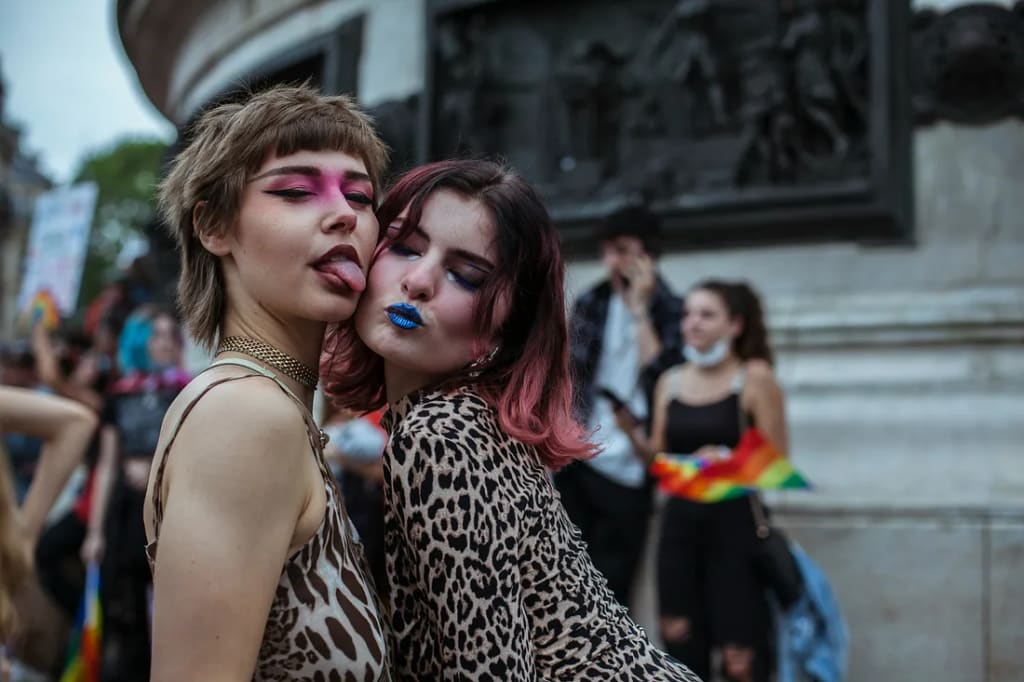
We’ve all heard men say it at some point.
Wait, you like women? Me too! I guess we’re both lesbians.
Or words to that effect.
It’s intended to be comical; some use it to break the ice. Drake even rapped it towards the end of 2021.
On the surface, this might seem like nothing more than a harmless quip from a man trying to highlight a point of connection. And I’m sure it is, in most cases.
But it did get my cogs turning, especially given how much conversation is centred around the interminable complexities of romantic attraction nowadays. And also because I’m a lesbian and so are my cogs.
The truth is, attraction to women is not a universal experience that unites straight men and lesbians.
In fact, the assumption that we experience attraction towards women in the same way is not just inaccurate — it actually reveals a fundamental misunderstanding of desire itself.
Why?
Because attraction isn’t just about what you like; it’s about how you like it and why. And when you break it down into its smallest factions, you realise one thing:
Men and lesbians are not only not teammates in desire — we’re not even playing the same game.
The belief that heterosexual men and lesbians share the same kind of attraction to women isn’t just a modern-day misconception — it’s a centuries-old idea, shaped by society’s perception (and frequent dismissal) of female desire.
For most of history, mainstream culture simply didn’t take lesbian attraction seriously. In some places, it wasn’t even acknowledged — laws that criminalised homosexuality often focused solely on men, as if women simply couldn’t experience real romantic desire for each other.
The logic was simple: no man involved, no legitimacy.
This is still the case today in many developing countries, such as Nigeria. Homosexuality between men is punishable by death in some parts; and yet between women? Not valid enough to penalise at all.
This erasure of female desire isn’t just about legality — it reflects a deeper cultural tendency to see women’s attraction as less real, less serious, or even nonexistent. And yet, when men claim to ‘relate’ to lesbians, their version of attraction operates on an entirely different level.
For many straight men, attraction to women is a primarily visual, external experience involving an element of consumption and subsequent conquest. Boys will be boys, I suppose.
Even in pop culture, lesbian attraction has often been framed in ways that make it more palatable to men. Early Hollywood either ignored lesbians entirely or portrayed them as tragic figures doomed to an unhappy fate.
Growing up, I seldom saw representations of lesbians in the media. And when the media finally did start embracing lesbianism, especially in the late 20th century, it was often filtered through a male fantasy to boost its marketability.
It wasn’t until later in life that I realised how much that lack of representation had shaped my own understanding of desire, and how much it affected how I approached my relationships with women.
For lesbians, attraction to women isn’t about expectation or admiration from a distance — it’s about connection. We don’t just like how women look; we love how they move, how they think, the makeup of their character.
Our natural commonalities create an automatic emotional proximity that helps us feel connected without having to utter a word.
Our attraction isn’t just about watching women; it’s about knowing them.
The Male Gaze vs. The Lesbian Gaze
This fundamental difference in how attraction works is why the male gaze and the lesbian gaze tell two completely different stories about desire.
Men sexualise women, whereas lesbians idolise them; and this difference is why mainstream media so often fails at portraying lesbians in a way that actually feels authentic.
The male gaze — which dominates most film, TV, and advertising — presents women as visually desirable, often sexualised in ways that don’t reflect how women actually experience attraction.
The lesbian gaze, on the other hand, is different. It doesn’t just focus on how a woman looks, but who she is. It lingers on the curve of her smile, the way her eyes light up when she talks about something she loves, the way she carries herself.
This is why when men ask: “Do you think she’s hot?” it can feel off-putting, because what they really mean is: “Are you objectifying her, too?”
The answer is no — we’re seeing her as a person.
And this, in part, is why male attraction to women often feels more hollow. Men take the superficial aspects of attraction and make them central. They don’t understand the emotional connection and the personal intricacies that define how women relate to one another.
Power, Privilege, and Attraction
Here’s where the gap widens even further: power dynamics.
As a woman, I’ve noticed that the dynamics of male attraction towards women are often laced with an unspoken sense of entitlement—the belief (whether conscious or not) that men’s feelings should be acknowledged, validated, or even rewarded.
Male desire comes with a sense of admiration, sure, but also a layer of expectation. Since men as a group hold systemic power over women, this comes as no surprise.
It’s why they react so differently to rejection than women do — often taking it personally, as if a woman’s disinterest in them is an offense rather than just part of life.
A man who gets turned down might call a woman a bitch, a lesbian, insult her looks, or insist that “she wasn’t that hot anyway.”
You’ll notice comments from women in the TikTok video above echoing this same sentiment:
no but this is so ACCURATE
why they switch up so quickly
so it’s a universal experience huh
The lesbian experience doesn’t feature that same power dynamic. We are women, so we know what it feels like to be on the receiving end of unwanted attention, unrealistic expectations, and the constant feeling of being perceived.
I’ve never resorted to insults or frustration when I’ve been turned down by a woman. There’s no bitterness or blow to the ego; just an understanding that we don’t always connect, and that’s okay.
Lesbians don’t pursue with the assumption that we’re owed anything in return. We, in contrast to men, are socialised to accept rejection quietly.
So why does it feel so absurd when a man claims that we both like women?
To put it plainly:
It reduces lesbian attraction to something male-centred.
It erases the reality that queer women love women differently — not as some sort of social quota to be met, but as something more visceral.
And sometimes, let’s be real, it’s just an attempt to make lesbians feel more accessible to men. Because if we’re on the “same team”, then maybe, just maybe, we’ll let them in.
That’s probably why straight men keep trying to claim lesbianism for themselves — whether it’s the guy at the bar telling you he “totally gets it”, or Drake, of all people, rapping “Yeah, say that you a lesbian, girl, me too.” (Aubrey, please. Be serious.)
At the end of the day, we don’t experience attraction the same way because our relationships to women, power, and desire are fundamentally different.
Men being “lesbians, too” is like someone wearing a band tee but not knowing any of the songs. Sure, they’ve got the look, but they’re not bouncing about in the mosh pit.
So when it comes to desire, we, women, are definitely in a league of our own.
About the Creator
Dena Falken Esq
Dena Falken Esq is renowned in the legal community as the Founder and CEO of Legal-Ease International, where she has made significant contributions to enhancing legal communication and proficiency worldwide.
Keep reading
More stories from Dena Falken Esq and writers in 01 and other communities.
Tariffs Aren’t the Endgame for Canada — It’s Annexation
Canada is about to get a lesson in realpolitik. For years, the world believed that a rules-based international order — anchored by treaties, trade agreements, and long-standing norms — would constrain even the most powerful states. President Trump’s sudden imposition of steep 25% tariffs on Canadian goods proves otherwise.
By Dena Falken Esq9 months ago in 01
Handbags and the Modern Conversation Around Replica Handbags
Handbags are one of the most enduring and adaptable accessories in human history. Originally designed as simple carriers for personal belongings, handbags gradually evolved alongside changes in clothing, travel, and social structures. Over time, they became objects that combine practicality with visual identity. Today, handbags are discussed not only as fashion items but also as cultural and economic symbols.
By charliesamuelabout 4 hours ago in 01
What Happens When You Block Someone on Snapchat?
What happens when you block someone on Snapchat? Though we wish it never occurs to you, are we all curious about what happens whenever you block others on Snapchat? For some reason, viewers never get to experience the other aspect of the story. Can they still get in touch with you? Are they able to see your storylines?
By Intelligent Creator5 days ago in 01
A Failed Artist, A Disillusioned Poet, An Underpaid Game Show Host
I took my son and niece to Gori, a small town in Georgia where Joseph Stalin was born. They talked me into visiting the Stalin's Museum, the largest in the post-Soviet space. I had resisted going there because I just can't stand the monster and know enough about him, or so I thought.
By Lana V Lynx6 days ago in FYI



Comments
There are no comments for this story
Be the first to respond and start the conversation.