
Tim Ferriss: The 4 Hour Workweek
Maximize life quality while minimizing work hours!

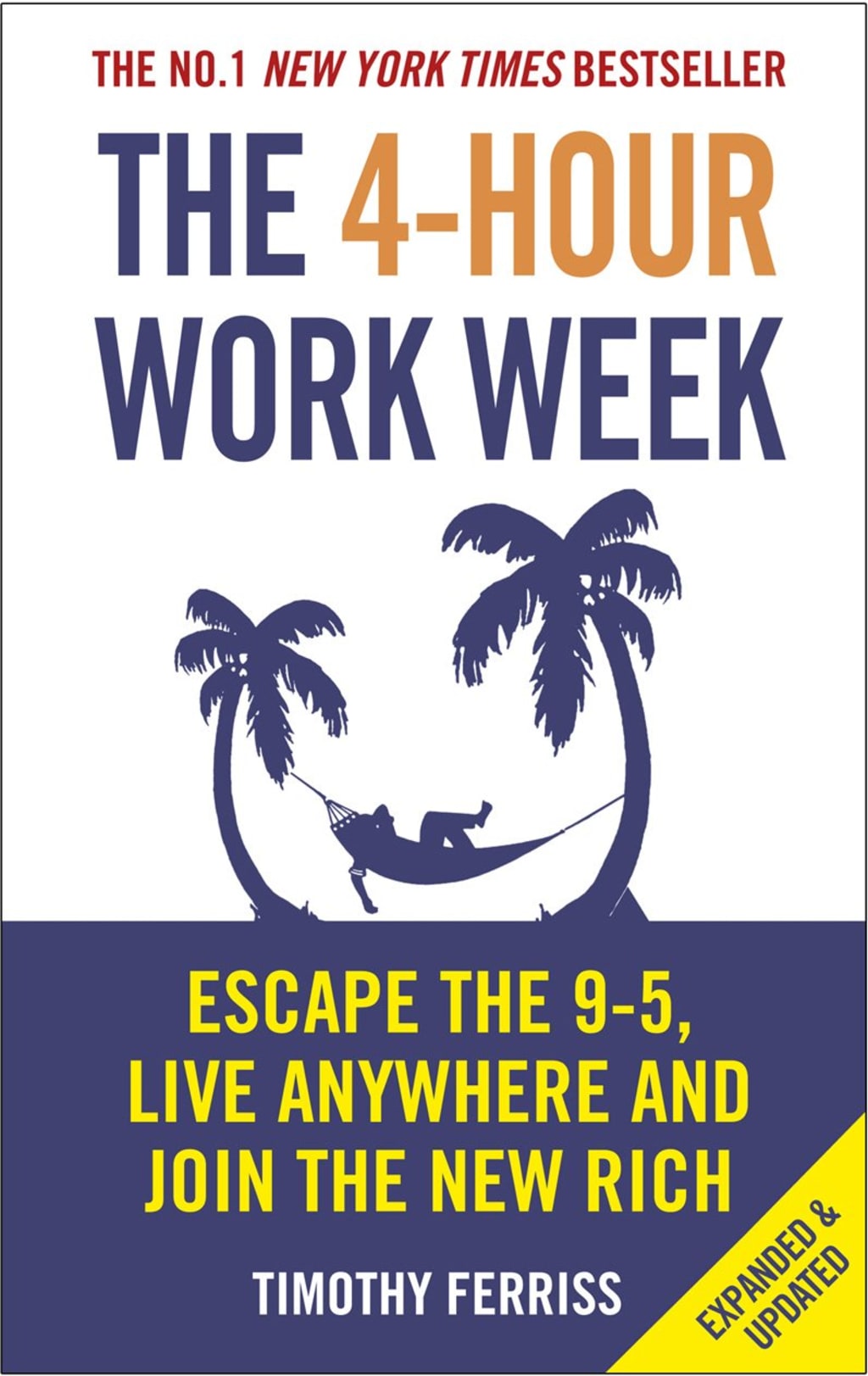
- In "The 4-Hour Workweek," Tim Ferriss introduces the concept of the "New Rich" (NR) lifestyle, which encompasses individuals who have successfully achieved financial independence and personal freedom by optimizing their work-life balance. These individuals no longer subscribe to the conventional notion of working long hours and postponing personal enjoyment until retirement. Instead, they prioritize creating a lifestyle that allows them to focus on their passions, relationships, and personal growth while maintaining a sustainable income.
- At the heart of Ferriss's approach is the DEAL framework, which consists of four main components: Definition, Elimination, Automation, and Liberation. This framework serves as a blueprint for individuals seeking the NR lifestyle. The Definition phase involves identifying your goals and values, which will guide your journey toward the four-hour workweek. Elimination focuses on applying the Pareto Principle and removing distractions to create a more effective work environment. Automation is all about outsourcing and automating tasks to maximize efficiency and create time for more meaningful pursuits. Lastly, Liberation emphasizes the importance of remote work and developing passive income streams to achieve true freedom and flexibility in your life.
- One core principle in "The 4-Hour Workweek" that distinguishes it from traditional productivity approaches is its focus on effectiveness rather than efficiency. Effectiveness involves accomplishing the right tasks to achieve your desired outcomes, whereas efficiency focuses on completing tasks as quickly as possible. By prioritizing effectiveness, you ensure that your efforts are aligned with your long-term goals and values. This mindset allows you to concentrate on high-impact tasks and achieve lasting results, ultimately leading to a more fulfilling and balanced lifestyle.
- Pareto Principle, also known as the 80/20 rule, which suggests that 20% of our efforts produce 80% of the desired results. By focusing on high-impact tasks and eliminating or minimizing low-impact tasks, you can maximize your productivity.
- Alongside this principle, effective time management and the elimination of distractions are crucial. Prioritize tasks using the Eisenhower Matrix, establish daily routines, and limit your use of technology during work hours to ensure focused and uninterrupted work.
- Outsourcing and automation play a significant role in Ferriss's approach, allowing you to delegate tasks and streamline your work. Assess which tasks are suitable for outsourcing or automation and utilize freelancing platforms or automated software tools to save valuable time. Simultaneously, consider the feasibility of a remote work model to provide flexibility in your schedule.
- Lastly, explore various passive income opportunities, such as real estate, the stock market, or online businesses, to achieve financial independence and reduce reliance on traditional work hours.
INTRODUCTION
A four-hour workweek – doesn't that sound incredible? It's as if you're living a fantasy. Instead of dedicating 40 hours every week, you only commit four hours, without compromising your earnings. In fact, you'd make in a month what others typically make in a year.
Imagine not having to spend 35, 40, or even 45 years working tirelessly before finally retiring. You'd possess the liberty and adaptability to relish life right away.
It appears fantastic and almost dream-like. At times, it may even seem like an unattainable aspiration – something that only a fortunate few might achieve but likely won't work for you.
However, it's not merely a far-fetched idea. Tim Ferriss believes that there is a formula that anyone – including you – can follow to attain this goal. So, if you're prepared to put in the effort, let's explore how to transform those 40 hours into a mere four.
Now, prior to exploring the insights offered by this book, let's take a moment to familiarize ourselves with Tim, his past and what brought him to write this amazing book.
TIM'S BACKGROUND
Tim Ferriss is an American author, entrepreneur, investor, and podcast host. Born on July 20, 1977, in East Hampton, New York, he is best known for the book that we are exploring today, "The 4-Hour Workweek", which became a New York Times bestseller and has been translated into numerous languages.
Ferriss attended Princeton University, where he earned a BA in East Asian Studies in 2000. After graduating, he worked in sales at a data storage company before starting his own business, BrainQUICKEN, which sold nutritional supplements. Ferriss later sold the company in 2010.
In addition to "The 4-Hour Workweek," Ferriss has authored several other books, including "The 4-Hour Body", "The 4-Hour Chef", and "Tools of Titans", which will be cover in future posts. He is also the host of the popular podcast, "The Tim Ferriss Show," where he interviews high-performers from various fields, such as sports, business, and entertainment, to gain insights into their habits and routines.
Ferriss has been involved in various ventures as an angel investor and advisor. He has invested in companies like Facebook, Twitter, and Uber, among others, and has been featured in numerous media outlets, including The New York Times, The Wall Street Journal, and Forbes.
KEY IDEAS
In his book, Ferriss brings 3 main ideas:
MAIN TECHNIQUES AND STRATEGIES
With these strategies in mind, you can embark on the journey to optimize your work-life balance and potentially turn the dream of a four-hour workweek into reality. Keep in mind that results may vary depending on your field, but Ferriss's techniques offer valuable insights for anyone looking to enhance their productivity and redefine the way they approach work.
Once all the ideas have been presented in the book, they are reinforced with a plethora of success stories and case studies, demonstrating their effectiveness and substantiating their value beyond mere talk.
CONCLUSION
While the book offers valuable insights and strategies for achieving financial independence and creating a more fulfilling work-life balance, it is essential to recognize that the feasibility and effectiveness of these techniques may vary depending on an individual's specific job or industry. For some, implementing the principles of the four-hour workweek may lead to greater personal and professional satisfaction; for others, it may not be as easily applicable. Reflecting on your personal experiences and goals can provide a more nuanced understanding of how these concepts might apply to your life.
The conclusion serves as a recap of the book's main concepts and takeaways, emphasizing the transformative potential of Ferriss's techniques for those who successfully apply them. By challenging conventional notions of work and productivity, "The 4-Hour Workweek" encourages readers to consider alternative approaches to achieving their personal and financial goals. While the concept of a four-hour workweek may not be attainable for everyone, the strategies outlined in the book can provide valuable insights for enhancing productivity and prioritizing personal well-being.
If the above has awaken your curiosity for the possibilities of a better life, and want to know more about what Tim has to offer, find below a link to the author's find below a link below to the book's kindle version in Amazon.
About the Creator
The Daily Reader Chronicles
Daily Reader Chronicles offers daily book recommendations in genres like self-help, adventure, autobiographies, and philosophy, providing a steady flow of intriguing titles for our audience.
Keep reading
More stories from writers in 01 and other communities.
Why Austin Startups Choose Native Over Cross-Platform in 2026?
In the bustling Austin startup ecosystem — a region with billions in early-stage funding and outsized startup growth compared with global averages (Austin’s ecosystem value recently reached about $64.6 billion compared with a global average of $20.4 billion) — founders are making a clear choice about how they build mobile products.
By Nick William5 days ago in 01
How to Succeed at the Benson Directory®
Congratulations and welcome to the Benson Directory® employee #22391! As our newest call handler, you will have the privilege of speaking with dozens of unique and interesting people on a daily basis as well as the opportunity to earn bonuses for high performance. Contained within this handbook you will find a set of ease to follow instructions designed to help you settle in to your new role and begin paving the way to success.
By S. A. Crawford2 days ago in Fiction
The Devil's Cut
“Comrade, finally you’re awake.” The voice was smooth, sensual. A flickering incandescent bar was all that lit the white, sterile room. All Vladimir remembered was everything going black. He tried to move his arms and found them strapped to the gurney.
By Matthew J. Fromm5 days ago in Fiction




Comments
There are no comments for this story
Be the first to respond and start the conversation.