
TI-83 vs. ChatGPT: Which One Truly Revolutionized the Way We Learn?
How Two Tech Tools, Decades Apart, Changed the Face of Education—One Graph at a Time, One Prompt at a Time


Let’s rewind for a moment.
You’re sitting in a high school math class, probably somewhere between 1997 and 2010. The teacher is scrawling equations on the whiteboard, and you’re trying to keep up. Then, they say the magic words:
“Pull out your TI-83s.”
That moment—if you were there for it—was a turning point. The TI-83 graphing calculator, developed by Texas Instruments, wasn’t just a gadget. It was a rite of passage. It meant you were doing real math now. You were part of the elite crew who could plot parabolas, solve inequalities, and graph sine waves like a pro.
It was revolutionary.
Now, flash forward to today. Students are asking ChatGPT to explain algebraic expressions, summarize chapters of To Kill a Mockingbird, or help them brainstorm essay topics. And the answers come instantly, tailored to their level, their tone, their style of learning.
This is a different kind of revolution. And the question is worth asking:
Which of these tools—TI-83 or ChatGPT—had the bigger impact on learning?
Let’s dive into the history, the context, the culture, and the long-lasting legacy of both tools.
📚 The Rise of the TI-83: A Graphing Icon
When the TI-83 launched in 1996, it wasn’t the first calculator to hit classrooms—but it was the first to become essential in the modern curriculum.
With a grayscale screen, a menu system straight out of a sci-fi novel, and a seemingly infinite number of button combinations, it did something no calculator before it had done at scale:
It made math visual.
You could now:
- Instantly plot a linear function and watch the line appear before your eyes.
- Zoom in and out on curves and parabolas like a handheld math microscope.
- Run calculations that used to take five minutes of long division in five seconds.
And let’s be honest—some of us got very creative with its "programmable" memory. Whether it was storing notes for a test, or sneaking in games like Tetris, Mario, or the infamous "Drug Wars," the TI-83 became both a tool and a toy.
But more than that—it became mandatory. Standardized tests, AP courses, and college prep programs all required it. And for a while, it was the gold standard of classroom tech.
But it had limits.
The TI-83 was strictly math-focused. And unless you were one of the rare students who truly enjoyed graph theory, you weren’t firing it up outside of Algebra II.
🤖 Enter ChatGPT: The Infinite Tutor in Your Pocket
Now let’s look at the new kid on the educational block.
ChatGPT came into public view in 2022, released by OpenAI, and quickly became the go-to assistant for everything from writing emails to coding Python scripts. But in the world of education, it became something else entirely:
A personalized, 24/7, judgment-free tutor.
Ask it anything. Really. Anything.
- Need help with a math problem? It can explain the answer and show you how to solve similar ones.
- Confused by a biology term? It’ll break it down in plain English.
- Can’t understand Shakespeare? It’ll translate it like your best friend who’s seen the movie version.
Even better? It can adjust how it explains things. Like humor? It’ll be funny. Prefer step-by-step instructions? It’ll do that too.
Unlike the TI-83, ChatGPT isn’t limited to math. It’s a tutor, writing assistant, study partner, and creativity booster—across every subject.
And while some schools and teachers initially feared ChatGPT would promote cheating, many are now embracing it as a tool for learning empowerment.
🔍 Breaking Down the Impact
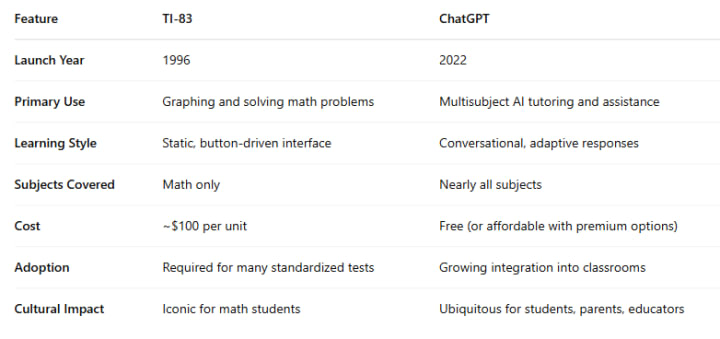
Let’s compare the two side-by-side:
👨👩👧👦 Don’t Forget the Parents
Here’s something the TI-83 never really helped with: parents helping their kids with homework.
We’ve all been there. Your child asks for help on a math problem that looks like it was written in Klingon. You remember sort of doing it 20 years ago, but not enough to help.
ChatGPT changes that dynamic.
Parents can:
- Look up concepts they forgot.
- Ask ChatGPT for simple explanations they can understand.
- Use it to double-check their kid’s work or quiz them for a test.
This bridges the generation gap in education and restores confidence for parents trying to stay involved.
🛠️ Other Game-Changers in Education
While the TI-83 and ChatGPT are certainly milestones, they’re part of a larger trend. Other tools that have redefined the classroom include:
- Khan Academy: Brought free education to anyone with internet access.
- YouTube (CrashCourse, Veritasium, etc.): Turned classrooms into theaters of dynamic, engaging learning.
- Desmos: A free online graphing calculator that rivals TI products in flexibility.
- Google Classroom: Enabled seamless digital assignment management and communication between students and teachers.
Each tool chipped away at the rigid model of classroom learning. But ChatGPT may be the first to crack it wide open.
🎯 So… Who Wins?
It’s hard to overstate the impact of the TI-83. For many students, it was the first time they felt like they were “doing real math.” It was visual, fast, and empowering—at least for math students.
But ChatGPT isn’t just changing how we learn. It’s changing what it means to learn.
It’s:
- Empowering learners of all ages
- Making education accessible 24/7
- Helping bridge language, cultural, and cognitive gaps
- Encouraging self-directed learning and curiosity
The TI-83 taught us math. ChatGPT teaches us how to think, explore, and ask better questions.
That’s a leap, not just a step.
💬 Final Thoughts: From Tools to Transformation
Both tools represent revolutions in their own right. The TI-83 gave us power over math. ChatGPT gives us power over learning itself.
In a world where attention spans are shrinking and information is infinite, ChatGPT might just be the mentor we didn’t know we needed.
If the TI-83 helped us pass Algebra, ChatGPT might just help us pass life.
Did a piece of tech change the way you learned? Did ChatGPT help your kid with their homework—or help you brush up on something forgotten?
Leave a comment and share your experience. Let’s celebrate how far we’ve come in the classroom—and where we’re headed next.
Michael Phillips writes about technology, education, and modern fatherhood. Find more of his work at fatherandco.substack.com.
About the Creator
Michael Phillips
Michael Phillips | Rebuilder & Truth Teller
Writing raw, real stories about fatherhood, family court, trauma, disabilities, technology, sports, politics, and starting over.
Keep reading
More stories from Michael Phillips and writers in 01 and other communities.
Stronger Than Steel, Rooted in America
In a time when green tech is too often a euphemism for government waste and elitist virtue signaling, a Maryland startup may have actually delivered the real deal: a game-changing innovation that's strong, sustainable, and - believe it or not - patriotic.
By Michael Phillips8 months ago in 01
How AI-Powered Design Is Changing Digital Experience Creation
Software design traditionally required human designers to manually draw every screen. A team created fixed layouts and navigation paths. Every user saw the exact same interface, regardless of their specific goals. This approach is inefficient for complex applications. Today, AI-powered design alters this entire process. It introduces algorithms that assemble interfaces dynamically. The software builds the screen based on the specific needs of the person using it in real time.
By ViitorCloud Technologiesabout 19 hours ago in 01




Comments
There are no comments for this story
Be the first to respond and start the conversation.