
"The Visionary: Elon Musk's Journey to Mars and Beyond"?
"A Legacy Forged in Innovation, Risk, and the Pursuit of the Impossible"?

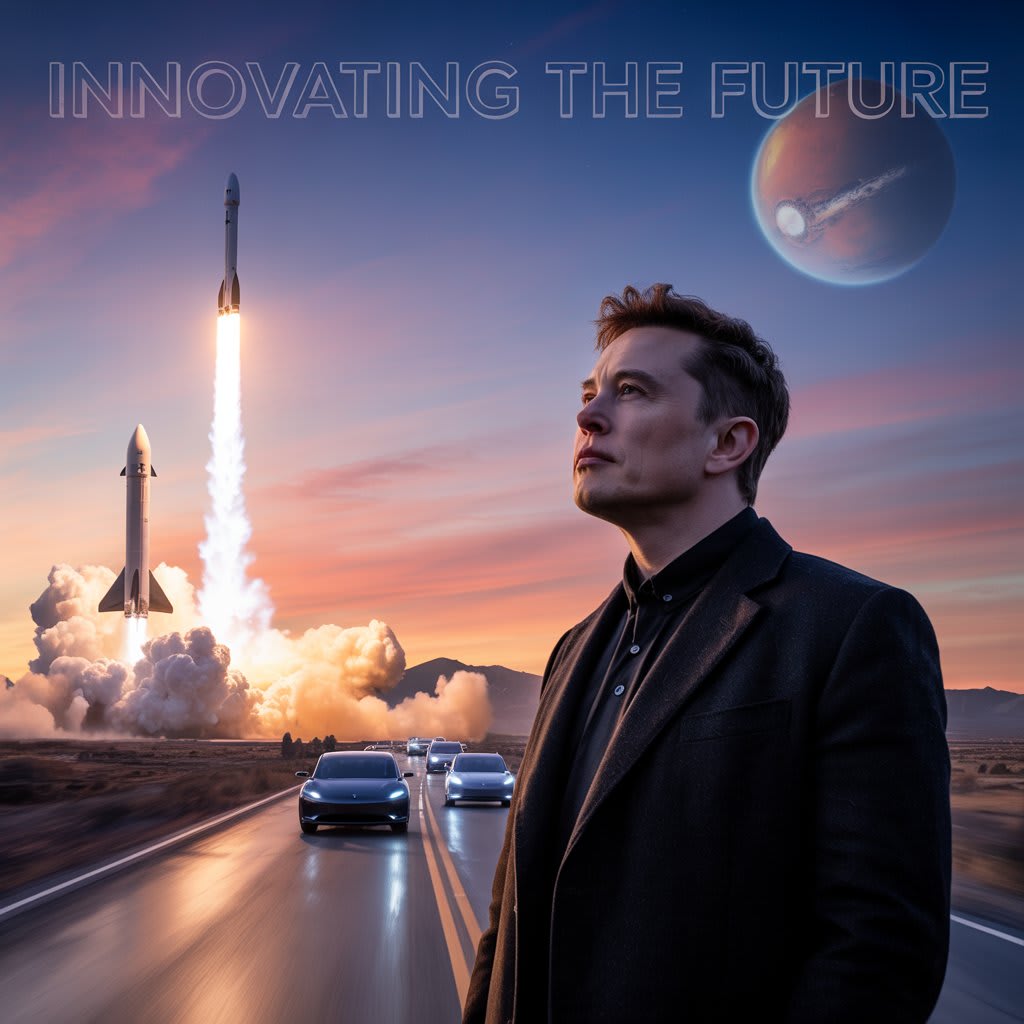
The Visionary: Elon Musk's Journey to Mars and Beyond
A Legacy Forged in Innovation, Risk, and the Pursuit of the Impossible
In the early hours of a quiet morning in Pretoria, South Africa, a child was born who would one day reshape the future of humanity. Elon Musk’s birth on June 28, 1971, set in motion a journey that would blend innovation, risk, and the relentless pursuit of impossible goals. From his early fascination with technology to the creation of world-changing companies like PayPal, Tesla, and SpaceX, Musk’s story is one of unyielding determination and audacity, daring to challenge the limits of what was thought possible.
Musk’s love for technology began at a young age. He was an avid reader, often diving into science fiction novels like Isaac Asimov’s Foundation series, and by the age of 10, he had already taught himself how to program computers. His innate curiosity and technical mind would eventually lead him to create his first software: a simple video game called Blastar, which he sold for $500 at the age of 12. This early entrepreneurial spirit was a sign of the path Musk would follow—one defined by a constant drive to create and innovate.
After relocating to Canada and then to the United States for his studies, Musk attended the University of Pennsylvania, where he earned degrees in both physics and economics. It was during this time that he began to form the vision that would shape his future: to use technology to solve the world's most pressing problems. His dream was grand and ambitious, but it was always rooted in a deep understanding of the sciences and the belief that the future could be shaped by human ingenuity.
In 1995, after dropping out of a Ph.D. program at Stanford University, Musk co-founded Zip2, a software company that provided business directories and maps for newspapers. The company’s success led to its eventual sale to Compaq for nearly $300 million. Musk’s next move was to invest his earnings in X.com, an online payment company he founded with the goal of revolutionizing the banking industry. X.com eventually became PayPal, which was acquired by eBay for $1.5 billion in stock, solidifying Musk’s position as a Silicon Valley entrepreneur with an uncanny ability to disrupt industries.
But Musk’s true vision extended far beyond e-commerce and online payments. He sought to change the world on a larger scale, particularly by addressing two critical challenges: climate change and the future of humanity. His solution was Tesla Motors, a company that would accelerate the world’s transition to sustainable energy. At the time, the idea of an all-electric car that could compete with traditional gasoline-powered vehicles seemed audacious. The automotive industry was deeply entrenched in fossil fuels, and many believed that electric vehicles would never achieve mass-market appeal.
Musk, however, was undeterred. His first major goal for Tesla was to produce an electric sports car, the Roadster, which would prove that electric vehicles could be fast, sleek, and desirable. The Roadster's success helped validate the electric car market, and it set the stage for Tesla’s more affordable models, including the Model S, Model 3, and Model X. Despite facing numerous challenges—including near bankruptcy—Musk’s refusal to give up led Tesla to become one of the most valuable automakers in the world.
While Tesla was transforming the automotive industry, Musk’s sights were set on a grander vision—nothing short of the colonization of Mars. In 2002, he founded SpaceX (Space Exploration Technologies Corp.) with the goal of reducing space transportation costs and making space travel affordable and accessible. At the time, the idea of a private company achieving spaceflight seemed nearly impossible. The space industry was dominated by government agencies like NASA, and many questioned Musk’s ability to compete.
The early years of SpaceX were marked by failure. The company’s first three attempts to launch a rocket into space ended in disaster. Yet Musk refused to give up. He invested his own money to fund a fourth launch, and in 2008, SpaceX successfully launched the Falcon 1, becoming the first privately funded company to reach orbit. This was a pivotal moment not just for SpaceX, but for the entire space industry. Musk’s success showed that private enterprise could achieve what once seemed impossible, and it opened the door for the commercialization of space.
With SpaceX, Musk’s vision for the future went beyond just launching rockets. His ambition was to make space travel not only feasible but also sustainable. The development of the Falcon 9 rocket, which could land and be reused, revolutionized the economics of space travel. This innovation has reduced the cost of launching payloads into space by more than 90%. Musk’s ultimate goal with SpaceX is to establish a human settlement on Mars, ensuring the survival of humanity in case of catastrophic events on Earth.
While these two companies—Tesla and SpaceX—are perhaps Musk’s most famous ventures, they represent just a portion of his grand vision. He’s also pursued projects like the Hyperloop, a high-speed transportation system, and Neuralink, a company focused on developing brain-machine interfaces. Each of these ventures, in its own way, is aimed at solving some of the most difficult problems humanity faces, from clean energy to space exploration to the future of artificial intelligence.
Yet Musk's journey hasn’t been without controversy. His outspoken nature on social media, his ambitious timelines, and his relentless pursuit of perfection have often led to public scrutiny and criticism. Musk’s management style has been described as intense, and his expectation of himself and his teams can be grueling. But his unwavering belief in his vision, even in the face of tremendous adversity, has allowed him to achieve things many thought were impossible.
Musk’s legacy will undoubtedly be one of audacity—of dreaming big and relentlessly pursuing those dreams no matter how impossible they may seem. His efforts have already transformed multiple industries and have inspired a new generation of entrepreneurs, engineers, and visionaries to reach for the stars.
As we look to the future, Musk’s work is far from over. With SpaceX’s Starship program aiming for Mars, Tesla’s ongoing advancements in sustainable energy, and his ventures into artificial intelligence and brain-computer interfaces, Elon Musk’s journey is one of continuous innovation. Whether or not we ever colonize Mars, Musk has already changed the trajectory of human progress—showing us that with enough determination, even the most impossible dreams can become reality.
About the Creator
Top tipple tricks
Been thinking a lot about drinking, lately. Not least because of a recent episode of over-indulgence and the inevitable after effects. Some readers may recall the earlier articles I wrote about beating the booze. Here I set out an experiment in techniques for cutting down on my alcohol intake. The experiment was successful, the techniques worked, and I have armed myself with an arsenal of weapons in the war against the demon drink. I have yet to fire the first round however. It's all a question of timing (perhaps procrastination).
By Raymond G. Taylor6 days ago in Psyche



Comments
There are no comments for this story
Be the first to respond and start the conversation.