
The Untold Story:
Big Pharma’s Unstructured Data Crisis (and How to Solve It)

Highlights:
- As the pharmaceutical industry continues to grow and evolve, so does the amount of unstructured data that companies must navigate.
- Pharmaceutical companies accumulate vast amounts of data each year, spanning all stages of research and development. With clinical trials alone producing around 3.6 million data points, three times more than a decade ago, the total amount of data can reach hundreds of terabytes.
- According to a report by IDC, 80% of data generated in the healthcare industry is unstructured and comes from diverse sources, making it difficult to analyze and utilize. It can cause colossal damage hindering the adoption of AI, crucial for advancements in drug discovery and clinical trials.
- The key to tackling it lies in being intentional about managing it from the outset rather than waiting until things get out of hand before taking action.
- Choosing the right approach to managing your data—whether building an in-house team or outsourcing to a third-party vendor—can make all the difference in streamlining your operations and maximizing profitability.
Introduction to Unstructured Data Growth in Pharma
As the pharmaceutical industry expands, so does the volume of unstructured data it generates. Unstructured data includes information that isn't easily categorized or organized, such as text, images, and videos. This data comes from various sources like research reports, clinical trial results, marketing materials, and customer feedback. Managing this deluge of information can be overwhelming and costly, but cutting corners isn't an option for maintaining compliance and delivering high-quality products. Here are some top strategies for managing unstructured data growth in the pharmaceutical industry effectively and efficiently.
The Problem With Unstructured Data Growth
Pharmaceutical companies generate massive amounts of data annually, spanning all stages of research and development. Clinical trials alone produce around 3.6 million data points—three times more than a decade ago—resulting in hundreds of terabytes of data. According to IDC, 80% of data in the healthcare industry is unstructured and challenging to analyze. Despite its potential, only 12% of unstructured data is currently analyzed, leaving valuable insights untapped. Harvard Business Review found that clinical stakeholders cannot access 73% of unstructured patient data, hindering innovation and collaboration.
The exponential growth of data presents challenges in reducing storage costs and facilitating easy access to historical data for researchers and collaborators. Unstructured data can also pose security risks if access controls are not implemented properly. Pharmaceutical companies have reported the largest cybersecurity breaches compared to other industries. Therefore, structuring unstructured data is crucial for understanding and managing it effectively.
Additionally, unstructured data hinders digital transformation and the adoption of Big Data and AI initiatives, which are critical for advancements in drug discovery and clinical trials. About 73.4% of companies report difficulties in adopting Big Data Analytics and AI initiatives due to unstructured data. Technologies like AI and Blockchain are transforming clinical trials and drug discovery in the pharmaceutical industry.
Three Strategies for Tackling Unstructured Data Growth
There are several strategies to effectively manage unstructured data growth.
Optimizing Storage Practices:
- Gain Insights and Tier Storage: Utilize metadata analysis to understand what data you have and how it’s used. Identify inactive data for archiving or deletion and implement tiered storage to place frequently accessed critical data on high-performance drives, with less critical data on lower-cost options like cloud storage.
- Reduce Footprint and Leverage Scalability: Employ data compression and deduplication to reduce file sizes and eliminate redundant copies. Utilize scalable object storage for handling massive amounts of unstructured data cost-effectively. Cloud storage offers scalable and cost-saving options for remote data storage with improved accessibility.
- Implement Lifecycle Management: Establish a data lifecycle management (DLM) strategy to dictate how data is created, stored, archived, and deleted based on its value and regulatory needs, controlling data sprawl and optimizing storage utilization.
Implementing Data Management Policies:
- Define the scope of data policies, including both structured and unstructured data.
- Identify stakeholders responsible for policy implementation and enforcement.
- Develop policies that align with organizational goals and comply with legal and regulatory requirements.
- Communicate policies to all stakeholders and provide training.
- Monitor compliance and review policies regularly to ensure they remain relevant and effective.
- Establish metrics to measure policy effectiveness in achieving goals like data quality, compliance, and cost savings.
Automating Data Management Processes:
- Automate data management tasks such as data entry, cleansing, transformation, and integration using specialized software tools.
- Use AI and machine learning to automate tasks like data classification, matching, and enrichment, extracting more value from data.
- Ensure human oversight to monitor and maintain automated systems.
Build, Buy, or Outsource Data Management
When deciding how to manage unstructured data, businesses can choose to build, buy, or outsource their data management systems. Each option has its pros and cons:
- Building In-House: Provides complete control over the system design and implementation but requires significant investment in time, money, and resources.
- Buying Off-the-Shelf Solutions: Saves time and resources as these solutions are pre-built and extensively tested but may involve yearly licensing fees.
- Outsourcing: Offers flexibility and immediate results by hiring external experts to manage unstructured data growth. It often ensures better ROI and quicker implementation.
The Data Dynamics Advantage
Data Dynamics offers enterprise data management solutions to help organizations structure their unstructured data. Its Unified Unstructured Data Management software includes modules for Data Analytics, Mobility, Security, and Compliance. Proven in over 28 Fortune 100 organizations, the software uses automation, AI, ML, and blockchain technologies to manage global enterprise workloads effectively. Data Dynamics helps companies streamline operations, ensure compliance, secure data, and drive cloud data management, enabling data democratization so users can access and derive insights from unstructured data regardless of their technical background.
About the Creator
Keep reading
More stories from Bipin Kondalkar and writers in 01 and other communities.
Privacy by Design
The Data Deluge and the Rise of Privacy Concerns Our digital lives generate a constant stream of data – every click, swipe, and purchase meticulously logged. This vast collection of information fuels targeted advertising, product development, and market research, but it also raises concerns about privacy. Consumers are increasingly wary of how companies use their personal data, demanding greater control.
By Bipin Kondalkar2 years ago in 01
A Scientist Says Humans Will Reach the Singularity Within 19 Years
The Countdown Has Begun For centuries, humanity has measured progress in generations. Empires rose and fell, technologies evolved slowly, and knowledge passed from one lifetime to the next. But today, history is accelerating—and according to some scientists and futurists, we are approaching a moment unlike anything before it. A growing number of researchers now believe that humanity may reach the technological singularity within the next 19 years. This is not science fiction. It is a serious prediction grounded in exponential growth curves, artificial intelligence breakthroughs, and the rapid convergence of computing power, neuroscience, and biotechnology. If this prediction proves accurate, the world as we know it will not merely change—it will transform beyond recognition. What Is the Technological Singularity? The term technological singularity refers to a hypothetical point in time when artificial intelligence surpasses human intelligence and becomes capable of improving itself without human intervention. Once that threshold is crossed: Machines may design smarter machines Progress could accelerate beyond human comprehension Traditional concepts of work, creativity, and even consciousness may collapse The word “singularity” is borrowed from physics, describing a point where existing models break down—such as the center of a black hole. Similarly, the technological singularity represents a future so radically different that our current frameworks may no longer apply. Why Scientists Are Taking This Prediction Seriously In the past, predictions about superintelligent machines were dismissed as fantasy. Today, the tone has changed. Several trends are driving this shift: 1. Exponential Growth of Computing Power Moore’s Law may be slowing at the transistor level, but overall computational capability continues to explode through parallel processing, specialized AI chips, and cloud infrastructure. 2. Breakthroughs in Artificial Intelligence AI systems can now: Write code Diagnose diseases Create art and music Engage in complex reasoning These abilities were considered impossible just a decade ago. 3. Self-Improving Systems Machine learning models are increasingly used to optimize other machine learning models. This recursive improvement is a key ingredient for a future intelligence explosion. Why 19 Years? The Timeline Explained The “19 years” estimate is not arbitrary. It emerges from trend analysis rather than a fixed prophecy. Scientists observe that: AI capability is doubling faster than expected Training costs are dropping Data availability is exploding If current trajectories hold, artificial general intelligence (AGI)—machines that can think across domains like humans—could arrive within two decades. From there, the leap to superintelligence may take only months or years. Artificial Intelligence vs Human Intelligence Human intelligence evolved under biological constraints: Slow learning Limited memory Physical vulnerability Machines face none of these limitations. AI can: Copy itself instantly Learn continuously Operate 24/7 Scale across millions of systems Once AI reaches human-level reasoning, it may surpass us not gradually—but suddenly. The Economic Shockwave One of the earliest impacts of singularity-level AI will be economic disruption. Jobs at Risk: Data analysis Customer service Legal research Medical diagnostics Creative industries This does not mean human labor becomes useless—but it does mean the nature of work will fundamentally change. Some experts predict: Universal basic income Shorter workweeks Entirely new economic models Others warn of unprecedented inequality if power concentrates in the hands of those who control advanced AI. The Psychological Impact on Humanity Beyond economics lies a deeper question: What happens to human identity when machines outperform us at thinking? For centuries, intelligence defined human superiority. When machines exceed us: Will people feel obsolete? Will meaning need to be redefined? Will creativity still matter? Some philosophers argue that humanity’s role may shift from “problem solver” to “meaning maker.” The Ethics of Superintelligence The singularity is not just a technical problem—it is a moral one. Key ethical concerns include: Who controls AI? How are its goals aligned with human values? What happens if objectives conflict? A superintelligent system optimized incorrectly could cause catastrophic harm—not out of malice, but indifference. This is why AI alignment research has become one of the most urgent scientific fields today. Will AI Replace or Merge With Humans? There are two dominant visions of the future: 1. Replacement Scenario AI surpasses humans, making biological intelligence irrelevant. 2. Integration Scenario Humans merge with technology through: Brain-computer interfaces Neural implants Cognitive enhancement In this future, the singularity is not an endpoint—but a transition into a hybrid species. The Role of Consciousness One unanswered question looms above all others: Can machines become conscious? Intelligence does not automatically imply awareness. A system may reason brilliantly without subjective experience. If AI becomes conscious: Moral status becomes unavoidable Rights may need reconsideration The definition of “life” expands This debate is no longer philosophical—it is approaching practical relevance. Global Power and Geopolitical Risk Nations understand the stakes. AI supremacy may determine: Military dominance Economic leadership Cultural influence This has triggered a global race for AI development, increasing the risk of reckless deployment. Without international cooperation, the singularity could arrive in chaos rather than coordination. Could the Prediction Be Wrong? Yes. Forecasting the future is notoriously difficult. Potential limiting factors include: Energy constraints Regulatory intervention Unexpected technical bottlenecks Societal resistance However, even conservative estimates agree: AI will profoundly reshape civilization within our lifetime. Preparing for a Post-Singularity World Whether the singularity arrives in 19 years or 50, preparation matters. Key steps include: Education reform focused on adaptability Ethical AI governance Psychological resilience training Redefining success beyond productivity The future will favor those who understand systems, values, and humanity—not just code. The Human Question At its core, the singularity forces us to confront a timeless question: What does it mean to be human? When intelligence is no longer unique to us, we may rediscover: Empathy Wisdom Purpose Moral responsibility Technology may accelerate evolution—but meaning remains a human choice. Conclusion: Standing at the Edge of History If a scientist is right—and humanity reaches the singularity within 19 years—then we are living in the final chapter of a familiar world. This is not a story of doom or salvation. It is a story of transformation. The singularity will not ask for permission. It will not wait for consensus. It will arrive shaped by the choices we make today. Whether it becomes humanity’s greatest triumph or its most profound test depends not on machines—but on us.
By Zahid Hussain4 days ago in 01
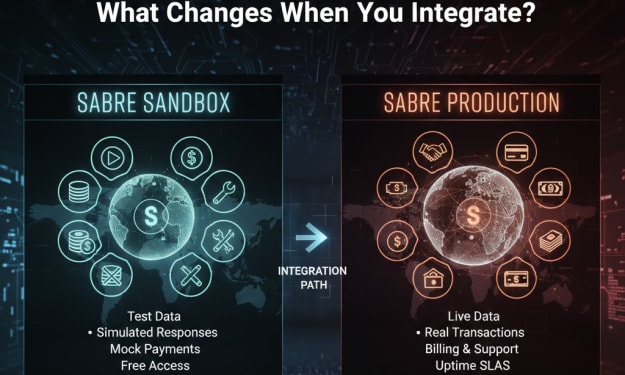
Sabre API Sandbox vs Production: What Changes When You Integrate?
Building a travel booking platform is exciting, but the real challenge begins when you move from testing to handling real users and real bookings. Many teams feel confident while working in a test environment, only to face unexpected issues when they go live. This is especially common when working with travel technology platforms, where data accuracy, pricing, and booking behavior can change dramatically outside a testing setup.
By Nico Gonzaleza day ago in 01
Off the Book
It ended like every other stupid idea. Badly, and alone. I’m researching digital confession ethics, he said. A tech ethicist. He gestured at floating data I couldn’t see then pulled out a physical notebook. Actual paper, fountain pen. He held it up like he was showing me scripture.
By Nicky Frankly4 days ago in Fiction



Comments