
The "Spanglish" App Market: Building Interfaces for Miami’s Dual Audience
Reflections on the space between two languages and the code that connects them.

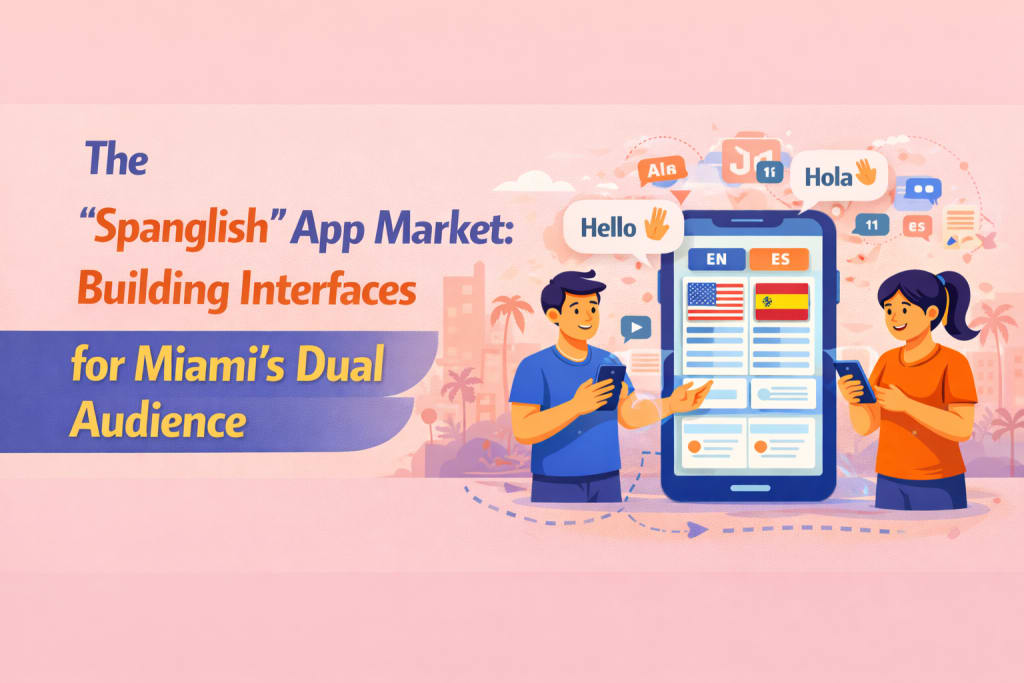
I spent yesterday afternoon at a bakery in Little Havana, watching a woman order a cafecito while simultaneously checking her bank balance on her phone. She was drifting effortlessly between Spanish and English, sometimes within the same sentence. It hit me then that Miami isn't just a bilingual city; it’s a "fluid" city.
In most tech hubs, "localization" is something you do for a foreign market. You build an app in English, and then you "translate" it for Spain or Mexico. But in Miami, the "foreign" market is right across the street. If you aren't thinking about a dual audience from the very first wireframe, you aren't just missing a demographic; you’re missing the soul of the city.
The friction of the "Toggle"
I used to think that a language toggle—that little globe icon in the corner—was enough. I assumed that giving someone the choice between "English" and "Español" was the gold standard of inclusivity. But as I’ve looked at how people actually use mobile app development Miami provides, I’ve realized the toggle is often a source of friction.
It forces a choice that many people here don't actually make in their daily lives. I’ve started noticing that the most successful local apps are moving away from "either/or" and toward "both/and." This is crucial because, as of 2026, over 65% of Miami-Dade residents speak a language other than English at home, and many of them navigate digital spaces in a "hybrid" mode.
Designing for the "Expansion"
One of the first things I learned about bilingual design is that Spanish is simply "longer" than English. I read a 2026 UX report suggesting that Spanish text typically expands by 20% to 30% compared to its English counterpart.
I sat in a design review last week where a beautiful, minimalist button that said "Save" completely broke when we switched the locale to "Guardar cambios." The text was bleeding out of the container, making the app look unfinished. In 2026, where 73% of users abandon an app due to confusing or broken layouts, these small "overflows" are expensive mistakes.
I’ve realized that you have to design with "flexible white space." You can’t have rigid, fixed-width boxes. You have to build for the expansion. It’s a technical challenge, but it’s also a metaphor for the city itself—you have to leave room for the language to breathe.
The cultural weight of an icon
I assumed that icons were universal. I thought a "shopping cart" meant the same thing to everyone. But I’ve learned that the cultural context of an image is just as important as the text. For instance, recent studies in multicultural UX design show that family-centric icons often resonate more in Miami than the standard "individual" profile silhouettes.
I’ve seen global firms with local branches, like Indi IT Solutions, lean heavily into this "cultural mapping." They don't just translate words; they translate the "vibe." They understand that a fintech app in Miami needs to feel secure, but it also needs to feel "personal" in a way that a sterile, Wall Street-style app might not.
The rise of the "Bilingual AI"
As we move through 2026, the tech stack is changing to support this dual audience. We’re moving beyond static translation files and toward real-time, AI-driven localization.
I’ve talked to developers in Wynwood who are using Natural Language Processing (NLP) models specifically trained on Miami’s unique dialect. These models can understand "Spanglish" slang and localized idioms that a standard translator would completely miss.
According to 2026 market trends, 63% of developers are now integrating AI features to personalize content. In Miami, this means hyper-personalized, linguistically fluid experiences that see a 22% higher retention rate. We’re moving toward a future where the app doesn't just "speak" two languages; it understands the "code-switching" that defines our daily lives.
The 2026 funding surge for AI-native platforms
This shift isn't just aesthetic; it’s being backed by significant capital. In Q4 2025 alone, Miami startups raised over $612 million, with AI-native platforms leading the charge.
Investors are pouring money into companies that can solve the "bilingual gap" at scale. For example, local insurtech Kanguro Insurance recently launched an AI-powered policy creation tool specifically targeting the Latino community with a fully bilingual, mobile-first experience. This kind of specialized innovation is what is making Miami the "AI Capital of the South."
A quiet reflection on the "Why"
I sat on a bench near the water yesterday, watching the skyline. I realized that the "Spanglish" app market isn't just a business opportunity; it’s a form of respect.
When you build an interface that acknowledges the complexity of your user’s world, you’re telling them that they belong. You’re saying that their identity isn't a "technical hurdle" to be overcome, but a feature to be celebrated.
Thinking back on the journey
Looking back at my first "English-only" projects, I feel a sense of missed connection. I was building for a version of the world that didn't actually exist in my own backyard.
The world of mobile app development Miami offers is now one of the most exciting linguistic frontiers in tech. We’re building tools that bridge the gap between two worlds, and in doing so, we’re creating something entirely new. I don’t have all the answers yet, and my Spanish is still a work in progress, but for the first time, I feel like I’m finally speaking the right language.
About the Creator
Ash Smith
Ash Smith writes about tech, emerging technologies, AI, and work life. He creates clear, trustworthy stories for clients in Seattle, Indianapolis, Portland, San Diego, Tampa, Austin, Los Angeles, and Charlotte.
Top Patio Slab Designs to Upgrade Your Garden Instantly
If you have been browsing Patio Slabs For Sale lately or searching for the perfect Garden Slab to transform your outdoor space, you are not alone. More homeowners are realising that the right patio design can completely change how a garden looks and feels. It is no longer just about laying concrete and calling it done. A thoughtfully chosen patio slab design can turn a plain patch of lawn into a space that feels styled, welcoming and genuinely personal.
By Ammaari Stones2 days ago in 01
Snapchat Account Hacking: Modern Threats and Defenses in 2026
Snapchat remains a prime target for malicious actors seeking unauthorized access to user accounts. This comprehensive analysis explores contemporary attack vectors that emerged by 2026, demonstrates protective measures through Python-based security implementations, and provides actionable defense strategies. Understanding these mechanisms is crucial not for exploitation, but for developing robust countermeasures that protect digital identities in an increasingly connected world.
By Alexander Hoffmann6 days ago in 01
Book Review: Atmosphere by Taylor Jenkins Reid
I flipped the book over in my hands in the centre of the small airport book shop. Although I had heard promising reviews of Atmosphere by Taylor Jenkins Reid, I hesitated. The synopsis didn’t compel me - I wasn’t much of a space girly. In high school it made me cringe when my peers would talk about the stars.
By sleepy drafts6 days ago in BookClub


Comments
There are no comments for this story
Be the first to respond and start the conversation.